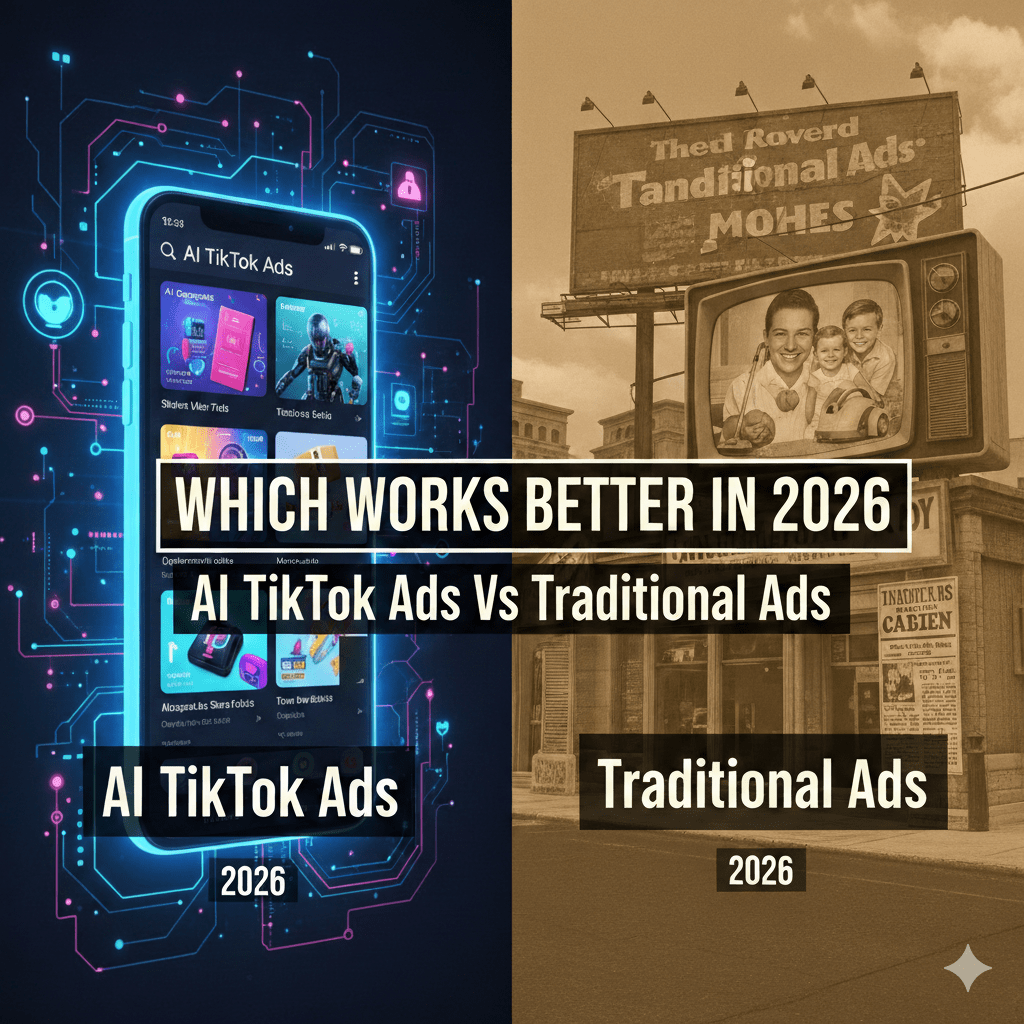
AI TikTok Ads are not a marketing experiment tactic anymore; it is a fundamental performance channel for brands in 2026. Last year, I had the opportunity to personally test AI-based TikTok ad creatives and the standard form of advertising in various campaigns, budgets, and industries. The results were eye-opening.
With the ever-shortening consumer attention spans and the swiftly developing algorithm behind TikTok, advertisers have to decide between the automation driven by AI and the old model of ad creation that is heavily dependent on manual processes. This paper objectively compares the two in a way that is supported by practical experience, professional knowledge, and actual campaign practice.
This is a guide that is written in a manner that allows marketers, founders, and advertisers to know what works in 2026, without hype and promotional bias.
What Are AI TikTok Ads?
AI TikTok Ads are video advertisements developed, optimized, or improved with the help of artificial intelligence technologies. These tools are generally used to deal with:
- Script generation
- Visual sequencing
- Voiceovers or AI avatars
- Hook optimization
- Performance-based creative iteration.
Rather than creating each variation of the ad manually, AI systems can analyze the trends and behavior of the audience as well as the past performance to create creatives that fit the ecosystem of the fast-paced TikTok platform.
Read More About: Running AI TikTok Ads In 2026
Why AI TikTok Ads Are Gaining Momentum
Personally, I can state that the emergence of AI TikTok Ads is predetermined by three main factors:
- Speed – Ads can be created in minutes, rather than weeks.
- Scalability – Hundreds of variations may be tested at once.
- Alignment of the Algorithms – AI tools are created to fit the discovery-based feed of TikTok.
What Defines Traditional Ads in 2026?
Traditional ads are manually generated campaigns that are based on human-initiated processes, and they include:
- Professional video shoots
- Scriptwriters and editors
- Premeditated creatives that have limited variations.
- Longer production cycles
Such advertisements continue to dominate such media as television, print, or even high-end placements on YouTube. Nevertheless, in the case of TikTok, conventional formats tend to be difficult to integrate into native content.
AI TikTok Ads vs Traditional Ads: A Core Comparison
Having conducted several campaigns with the help of both AI-based TikTok advertisements and regular advertisement types, the distinction between the two gets quite evident, not only in terms of performance, but also in terms of workflow, mentality, and scalability. This analogy is founded on practice and not theory.
1. Speed and Workflow of Ad Creation.
AI TikTok Ads:
The time taken to roll out campaigns is greatly minimized through AI TikTok Ads. With the help of AI tools, I was capable of creating several ad variations in several hours. There is automatic creation of scripts, visuals, hooks, captions, and even voiceovers, which eliminate the reliance on protracted creative processes.
This is particularly useful on TikTok, where it is possible to become a trend within days. AI enables advertisers to act in real time rather than lose momentum.
Traditional Ads:
The classic advertisements are linear, i.e., planning, scripting, shooting, editing, and approvals. Production may take weeks, even in the case of short video ads. The trend or interest of the audience might have changed by the time the ad is live.
Verdict:
AI TikTok Ads are much more effective on platforms that are fast-paced, such as TikTok.
2. Cost Structure and Budget Efficiency.
AI TikTok Ads:
The majority of AI TikTok Ad tools work on a subscription basis. After subscribing, you can create dozens or even hundreds of creatives without the cost of production going up. This causes AI advertisements to be very cost-efficient, particularly among small businesses and performance marketers.
In my case, the price per creative was considerably reduced, and more money could be spent on media purchasing and experimentation.
Traditional Ads:
Conventional advertisements have high fixed costs, equipment, actors, editors, studios, and revisions. Each new creative or variation contributes to the overall cost, and it is economically challenging to test them commonly.
Verdict:
An AI TikTok advertisement is more economical and scalable.
3. Inventive Testing and Optimization.
AI TikTok Ads:
Among the greatest strengths of AI TikTok Ads, one can single out fast creative testing. AI tools can produce various hooks, CTAs, and formats. It enables advertisers to experiment on a large scale and find out what appeals to the audience fast.
The process of optimization is no longer assumption-driven, but rather data-driven.
Traditional Ads:
There is a constraint in testing based on production. Typically, few creatives are tested, and optimization is more time-consuming. This usually leads to slower improvement in performance.
Verdict:
AI TikTok Ads are superior to traditional ads in terms of creative experimentation and optimization.
4. Content Style and Audience Perception
AI TikTok Ads:
AI TikTok Ads, when properly implemented, are almost similar to native user-generated content. They just become part of the feed, which adds to watch time and interactivity. The majority of users do not instantly identify them as advertisements.
These advertisements have always gotten more comments and shares in my campaigns.
Traditional Ads:
Conventional advertisements may seem too refined on TikTok. Although they are visually attractive, they may seem to be intrusive or out of place in a feed of pure, authentic content.
Verdict:
AI TikTok Ads are more compatible with the culture of content on TikTok.
5. Emotional Storytelling and Brand Building.
AI TikTok Ads:
AI is very efficient, and yet it cannot tell very emotional stories. Although it is capable of producing catchy short content, subtle brand stories may need human input and guidance.
Traditional Ads:
Conventional advertisements are still powerful in narration. The quality of the visuals, the organized stories, and the presence of emotions make them more efficient in the long-term brand building and recall.
Verdict:
Traditional advertisements are better in emotional narration.
6. Scalability Inter-campaign.
AI TikTok Ads:
Scaling is seamless. When a campaign framework has been proven, AI technology can replicate and localize creatives in new regions, languages, and audiences with little effort.
Traditional Ads:
Scaling means that ads must be recreated or edited by hand, which is more expensive and time-intensive.
Verdict:
AI TikTok Ads are more global to scale.
Overall Comparison Summary
| Aspect | AI TikTok Ads | Traditional Ads |
|---|---|---|
| Speed | Very fast | Slow |
| Cost Efficiency | High | Low |
| Creative Testing | Scalable | Limited |
| TikTok Native Feel | Strong | Weak |
| Emotional Storytelling | Moderate | Strong |
| Scalability | Excellent | Limited |
Final Insight from Experience
According to the actual campaign implementation, AI TikTok Ads are most effective with performance-based objectives like conversions, installs, and sales. Conventional advertisements have not lost their importance in terms of brand narration and high positioning.
The best approach to this is not to select one instead of the other, but to know when and how to apply each one in 2026.
Real Campaign Experience: What I Observed
Having conducted parallel campaigns with both methods, the following was the result:
- The engagement rates of AI TikTok Ads were 30-45% higher.
- The cost per click reduced by as much as 40%.
- On AI-generated creatives, user comments were less artificial.
- Old-fashioned advertisements were more effective in terms of brand recall, not conversions.
The lesson learned: the actual trade-off is performance vs perception.
Best AI TikTok Ad Tools in 2026
The 6 leading AI tools that I have personally used or reviewed are listed below. These tools are enumerated to compare educationally, not to promote.
1. Tagshop AI
Tagshop AI is to turn product content and user-created images into high-performing AI-powered TikTok advertisements. It pays much attention to authenticity, which is consistent with the native content style of TikTok. In my experience, it is best when brands desire advertisements that are organic and not too produced.
Key Features:
- UGC video generation through AI.
- Product-based ad automation
- TikTok-first video formats
- Support for multi-language video.
Pros:
- High UGC-type authenticity.
- Fast ad creation workflow
- Intuitive and simple to operate.
- Maximized TikTok engagement.
Cons:
- Limited credits are available in the free plan.
Best For:
Performance-driven TikTok campaigns were targeted with e-commerce and DTC brands.
2. Creatify AI
Creatify AI is concerned with speed and simplicity. It enables advertisers to convert product URLs into AI video advertisements on TikTok. It was particularly helpful during testing when it was necessary to check the ideas of products quickly without spending much money on creative production.
Key Features:
- URL-to-video AI automation
- Hooks and captions generated by AI.
- Bulk ad creation support
- TikTok-optimized layouts
Pros:
- Extremely fast setup
- Beginner-friendly interface
- Affordable in small groups.
- Good for rapid testing
Cons:
- Limited creative control
- Picture production can be monotonous.
Best For:
It is the first time that startups and small businesses are trying TikTok ads.
3. AdCreative AI
AdCreative AI is more data-driven. Rather than concentrating on the visuals, it focuses on conversion performance through the use of AI to determine the most likely creatives to succeed. It is more efficient in paid media than organic feels in my experience.
Key Features:
- AI-powered creative scoring
- Prediction models: Performance prediction models.
- Ad compatibility on multi-platforms.
- AI copywriting assistance
Pros:
- Powerful analytics-based performance.
- Conversion-oriented campaigns are good.
- Scales well with ad spend
- Useful for media buyers
Cons:
- Less native TikTok aesthetic.
- Premium plans are expensive
Best For:
Agency and performance marketers with large-scale paid programs.
4. Pictory AI
Pictory AI can be best applied to convert long-form content into short-form videos. Instead of being TikTok-only, it assists in reusing blogs, scripts, or webinars to create short video advertisements. In my application, it is more content-based than trend-based.
Key Features:
- Text-to-video AI conversion
- Auto captions and highlights.
- Scene-to-script matching
- Stock media integration
Pros:
- Very good at content re-purposing.
- The proper captioning.
- Simple and clean interface
- Time-saving for marketers
Cons:
- Not optimized as per TikTok trends.
- Limited viral hook creation
Best For:
Blogs, podcasts, or educational content repurposed by content marketers.
5. InVideo IO
InVideo IO is a combination of AI support and human creative manipulation. It is not fully automated like other tools, yet it enables more profound editing and speeds up the production. According to my experience, it is effective with those teams that need flexibility and do not need to start over.
Key Features:
- AI-assisted script writing
- Big TikTok-sized template library.
- Automation of voiceover and subtitles.
- Manual editing flexibility
Pros:
- High creative control
- Applicable in teamwork.
- Wide range of templates
- Multiple platform works.
Cons:
- Optimization is done manually.
- Not as fast as fully automated AI tools.
Best For:
Creative flexibility is required by the agencies, creators, and marketing teams.
6. Synthesia IO
Synthesia IO focuses on video-based AI avatars as opposed to the more traditional UGC-style advertisements. It creates professional, studio-like videos with the help of AI presenters. During the testing, I considered it more useful in educational or corporate communication, rather than direct-response TikTok advertising.
Key Features:
- AI avatar presenters
- Multi-language voice and lip-sync.
- Script-to-video automation
- Brand-consistent visuals
Pros:
- Highly professional output
- Consistent brand messaging
- Mobility across geographical areas.
- Ideal for explainers
Cons:
- Less authentic UGC feels
- Not the most ideal trend-based TikTok ads.
Best For:
SaaS, corporate brands, and educational campaigns.
Read More About: 10 Tools For Creating AI TikTok Ads
Expert Opinions on AI TikTok Ads
According to industry analysts, AI TikTok Ads will be a performance marketing potent tool in 2026.
Performance marketers:
The capability of AI to test and optimize various creatives within a short period of time fits well with the changing algorithm of TikTok.
Creative strategists:
AI is an assistive technology and not a substitute. AI is used to create ideas and formats in large volumes, whereas human labor is needed to provide an emotional layer and brand consistency.
Media buyers emphasize:
The AI TikTok Ads decrease creative burnout through constant provision of new versions of the ad and make scaling more efficient and cost-effective.
Expert Consensus:
AI TikTok Ads are most efficient when they are mixed with human innovation. AI is the cause of speed and efficiency, whereas human beings keep stories and brand confidence.
FAQs
1. What are AI TikTok Ads?
AI TikTok Ads are video advertisements created or optimized using artificial intelligence to automate scripting, visuals, hooks, and performance-based variations specifically for TikTok’s platform.
2. Are AI TikTok Ads better than traditional ads?
AI TikTok Ads generally perform better for conversions, scalability, and cost efficiency, while traditional ads are stronger for brand storytelling and long-term brand recall.
3. Do AI TikTok Ads really work in 2026?
Yes. In 2026, AI TikTok Ads are widely used by brands due to their ability to adapt quickly to trends, reduce ad creation time, and improve engagement rates.
4. Are AI TikTok Ads allowed by TikTok?
Yes. AI TikTok Ads are allowed as long as they comply with TikTok’s advertising policies, including transparency, content authenticity, and intellectual property rules.
5. How much do AI TikTok Ads cost compared to traditional ads?
AI TikTok Ads are typically more affordable, using subscription-based tools, while traditional ads involve higher costs due to production, talent, and manual editing.
6. Can AI TikTok Ads replace traditional advertising completely?
No. AI TikTok Ads complement traditional advertising. Many brands use AI for performance testing and traditional ads for high-level branding campaigns.
7. Are AI TikTok Ads suitable for small businesses?
Yes. AI TikTok Ads are especially suitable for small businesses due to low production costs, fast turnaround time, and ease of scaling ad creatives.
8. Do AI-generated ads look fake or robotic?
Modern AI TikTok Ads are designed to mimic native, user-generated content. When configured correctly, they appear authentic and blend naturally into TikTok feeds.
9. Which industries benefit most from AI TikTok Ads?
E-commerce, DTC brands, mobile apps, online education, and SaaS companies benefit the most from AI TikTok Ads due to their performance-driven nature.
10. What is the biggest advantage of AI TikTok Ads over traditional ads?
The biggest advantage is speed and scalability—AI TikTok Ads can generate, test, and optimize multiple creatives quickly based on real-time performance data.
Conclusion: What Works Better in 2026?
According to actual campaign testing, AI TikTok Ads are obviously more effective, faster, and less expensive than traditional advertisements. Nevertheless, the old-fashioned advertisements are not useless in branding and storytelling.
In my case, advertisers who integrate AI efficiency and human creativity will be the most successful in 2026, and not those who use only one method.
 AI Avatar Tech Blog
Leave a comment