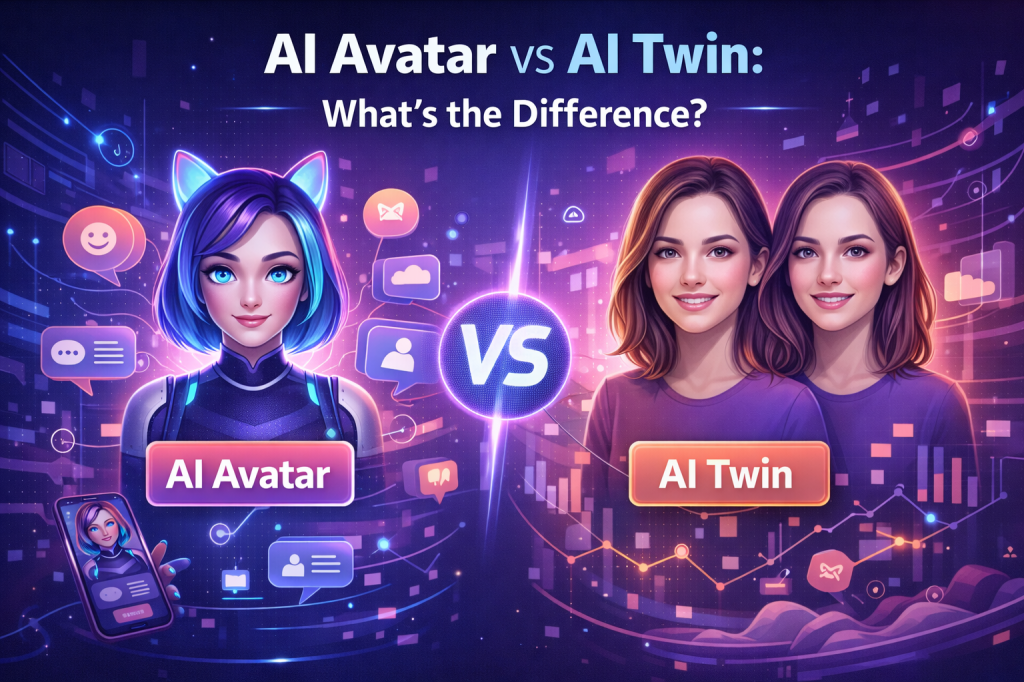
Confused between AI avatars and AI twins? Discover the differences, benefits, and which option fits your brand and video strategy.
Artificial intelligence has completely transformed how we create video content. What once required cameras, lighting setups, actors, and hours of editing can now be generated with a few clicks. But as AI video technology evolves, two terms are often confused: AI Avatar and AI Twin.
If you’ve been exploring an Avatar Maker AI, you’ve probably seen both options and wondered which one you actually need.
Are they the same thing?
Is one better than the other?
Which one works best for marketing, branding, or content creation?
In this in-depth guide, we’ll clearly explain the difference between AI avatars and AI twins, how they work, and which one makes sense for your goals in 2026.
What Is an AI Avatar?
An AI avatar is a digitally generated character created using artificial intelligence. It may look realistic like a human presenter or stylized depending on the platform, but it is not based on a specific real person unless intentionally trained.
When you use an Avatar Maker AI, you typically select or customize a digital character, add a script, choose a voice, and generate a video. The system animates the character to speak your script with synchronized lip movements and gestures.
The purpose of an AI avatar is scalability. Instead of recording yourself or hiring actors, you can generate professional-looking videos instantly.
Businesses use AI avatars for training videos, product explainers, ads, onboarding tutorials, and multilingual campaigns. Since the avatar is artificial, you can reuse it across unlimited content without worrying about scheduling shoots or re-recording updates.
AI avatars are designed to be flexible, fast, and cost-efficient.
What Is an AI Twin?
An AI twin is more personal.
Instead of creating a generic digital character, an AI twin is a digital replica of a real person. It is trained using your images, videos, and voice samples to mimic your appearance, expressions, and speech patterns.
If an AI avatar is a created presenter, an AI twin is a cloned version of you.
AI twins are popular among founders, influencers, coaches, and personal brands who want to scale their presence without constantly filming new videos. For example, instead of recording daily updates, an entrepreneur can use their AI twin to deliver scripted content in their own voice and likeness.
The goal of an AI twin is not just scalability, but identity preservation. It allows a person to remain the face of their brand while leveraging automation.
The Core Difference: Identity vs Representation
The biggest difference between AI avatars and AI twins comes down to identity.
An AI avatar represents a brand or message. It is a digital presenter designed to communicate information clearly and professionally.
An AI twin represents a specific human being. It is tied to that individual’s identity and personal brand.
If you use an Avatar Maker AI to generate a professional presenter for product demos, that avatar does not belong to a real human identity. It is a digital spokesperson.
If you train an AI twin using your face and voice, the system is replicating you.
This distinction becomes important in marketing and branding.
Personalization and Realism
AI avatars can be customized in terms of appearance, clothing, background, and voice. However, they are still template-based or system-generated characters.
AI twins go deeper. They attempt to capture micro-expressions, natural blinking patterns, subtle voice tone changes, and even speaking rhythm.
In other words, AI avatars offer flexibility. AI twins offer authenticity.
For many brands, flexibility is enough. But for personal brands and influencers, authenticity plays a critical role in building trust.
Technical Complexity
From a technical standpoint, using an Avatar Maker AI is usually straightforward. You choose an avatar, enter your script, and generate a video. The system handles lip-sync and animation automatically.
Creating an AI twin is more complex. It often requires high-quality video samples, clean voice recordings, and facial data training. The system must analyze and replicate natural human motion accurately.
Because of this, AI twins can take longer to set up compared to AI avatars. However, once trained, they offer powerful personalization capabilities.
Cost and Accessibility
AI avatars are generally more accessible for small businesses and startups. Since they do not require individual training data, they are faster and more affordable to deploy.
AI twins may involve additional costs for data processing and personalization. They are typically used by individuals who see strong value in maintaining their personal digital presence.
For companies focused on running performance ads at scale, an Avatar Maker AI is often the more practical choice.
Marketing Applications in 2026
In 2026, video content dominates digital marketing. Brands are no longer producing one major campaign and hoping it performs well. Instead, they generate multiple variations and test them quickly.
AI avatars are ideal for this environment. You can create different hooks, angles, and calls to action without reshooting anything. The speed of production allows for faster experimentation and optimization.
AI twins, on the other hand, shine in authority-driven niches. If your audience connects with you personally, seeing your face—even digitally replicated—creates continuity and familiarity.
For example, a SaaS company might use an AI avatar for product walkthroughs. Meanwhile, a life coach might use an AI twin to deliver motivational content in their own voice.
Which One Converts Better?
Conversion depends heavily on context.
In performance marketing and ecommerce, viewers often care more about the offer and value proposition than the presenter’s identity. In such cases, AI avatars perform effectively because they deliver the message clearly and professionally.
In personal branding and relationship-driven industries, trust is key. An AI twin can strengthen that trust because the audience recognizes the individual behind the message.
Ultimately, it is not about which technology is superior. It is about which one aligns with your goals.
Which One Converts Better?
Conversion depends on context.
AI avatars perform well in:
- Product ads
- Short-form UGC-style content
- Informational videos
AI twins perform better in:
- Authority-driven niches
- Coaching and consulting
- Personal storytelling
If your audience connects with a personality, a twin may drive stronger trust.
If your audience focuses on value and offer, an avatar is usually sufficient.
The Blurring Line Between Avatar and Twin
Technology is advancing rapidly. Modern Avatar Maker AI tools are becoming increasingly realistic. At the same time, AI twin platforms are becoming easier to set up and more accessible to the average user.
In the near future, the distinction between AI avatars and AI twins may blur even further. We may see hybrid systems where brands use avatars for scalability and twins for authority-building.
This hybrid strategy allows businesses to combine efficiency with authenticity.
Final Thoughts: Choosing the Right Approach
When deciding between an AI avatar and an AI twin, ask yourself one key question:
Is your identity central to your brand?
If not, an Avatar Maker AI is likely the smarter choice. It offers speed, scalability, cost efficiency, and flexibility for ads, tutorials, and marketing campaigns.
If your face and personality are central to your brand, an AI twin may provide a deeper connection and continuity.
In 2026, both technologies are shaping the future of digital content creation. The real advantage lies in understanding how to use them strategically.
Platforms like Tagshop AI are making it easier for businesses to leverage AI-powered video creation at scale, helping brands produce avatar-driven content efficiently for ads and marketing campaigns.
AI is not replacing creativity. It is enhancing execution.
And whether you choose an AI avatar or an AI twin, the goal remains the same — scalable, engaging, and impactful digital storytelling. 🚀
 AI Avatar Tech Blog
Leave a comment