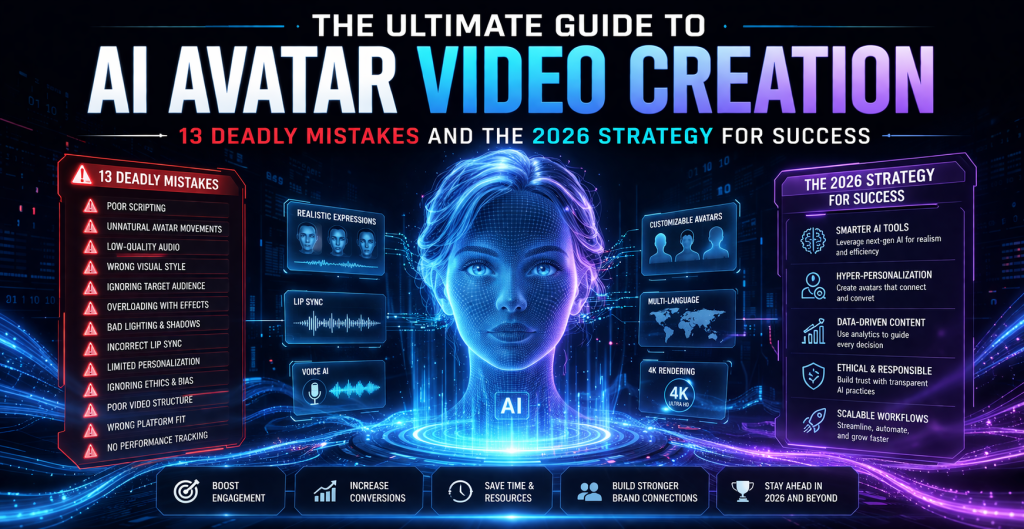
The Master Guide to AI Avatar Video Creation: 13 Deadly Mistakes and the 2026 Method for Success
The digital landscape of 2026 has gone through a seismic shift. With the explosion of generative AI, the technical boundaries that when made video manufacturing pricey and time-ingesting have efficaciously disappeared. Whether or not you are an e-trade entrepreneur operating out of Jaipur or a SaaS marketer in Silicon Valley, AI avatars now assist you to deliver scalable, professional, and multilingual content with minimal effort. However, a harsh reality remains: about ninety% of AI-generated movies fail to hold viewers for greater than ten seconds. The purpose is straightforward. Most creators deal with AI as a “magic button” that replaces the need for concept, in place of a strategic tool that calls for guidance.
That will help you bridge this hole, we have recognized the 13 biggest errors creators make and supplied the deep, professional answers wanted to turn typical clips into high-converting assets. This manual serves as your blueprint for navigating the future of video advertising and marketing.
1. Writing Poor, Popular, or Directionless Scripts
The foundational rule of any technology is “Garbage In, Garbage Out.” A vulnerable script will continually result in a vulnerable video, irrespective of how realistic the avatar looks. Many creators make the error of asking AI to write down a script with out presenting unique context or a completely unique voice, leading to medical and dull consequences that feel like a Wikipedia access. While a script lacks a soul, the avatar’s shipping feels doubly robotic.
To restore this, you should master the art of the narrative structure. Every successful video follows a particular drift that respects the viewer’s time. You need to start with a effective commencing that addresses a selected ache point straight away. As an instance, in preference to a ordinary greeting like “Today we will talk about transport,” you ought to use a high-stakes starting including “Stop overpaying for delivery in India; here is how I saved 30% this month through optimizing my packaging.”
As soon as the hook is established, you crouch into the fee section, where you provide actionable insights that the viewer can use. Finally, a clean name to movement ensures the viewer knows exactly what to do subsequent, whether that is touring a website or subscribing for extra pointers. Without this shape, your video is simply noise in a crowded virtual global.
2. Ignoring Voice Tone and Emotion
One of the quickest approaches to lose an audience is by using the use of a flat, monotone AI voice. Even in 2026, while artificial voices are enormously superior, the default settings often lack the “prosody” or the natural upward thrust and fall of human speech. Whilst a voice sounds robotic, it triggers a subconscious feel of distrust within the viewer, making them sense like they’re being advertised to by using a system in preference to helped through a person.
To make your content material feel human, you should actively control the “performance” of the AI. This entails more than just picking a voice; it requires “phonetic tuning.” You have to manually insert pauses and breaths into the script to simulate herbal notion styles. In expert video editing, these are known as “beat pauses.” Moreover, you need to emphasize key words—which include costs or precise blessings—to pressure domestic crucial points.
For an Indian target audience, utilising a “Hinglish” transport regularly feels plenty more true and relatable than a widespread, impartial Western accessory. It signals to the viewer that the content material changed into made mainly for them, which builds on the spot rapport.
3. Wrong Avatar Selection and Brand Dissonance
A not unusual branding errors is choosing an avatar that does not align together with your brand identity or the expectations of your goal demographic. If your avatar feels out of place, it creates a visible disconnect that hurts your credibility. For example, the use of a completely younger, casually dressed avatar to provide critical monetary or prison advice can confuse the viewer and result in excessive drop-off prices.
Before choosing your virtual spokesperson, you must define their specific “Character Profile.” This consists of determining their authority level—ought to they appear to be a pro professional or a relatable peer? You ought to also recollect the environmental context. Does the avatar appear like in a professional workplace, a clean laboratory, or a vibrant innovative studio? Every of these backgrounds tells a silent story about your brand’s values. After you discover an avatar that suits your logo’s “DNA,” use them continuously across your campaigns. Simply as a movie franchise uses the equal lead actor, your logo have to use a constant face to build lengthy-time period brand keep in mind and accept as true with.
4. Overloading Videos with Too Much On-Screen Text
Many creators try to pack every word of the script onto the screen, leading to what psychologists name “cognitive overload.” Whilst a viewer is forced to read a paragraph whilst concurrently being attentive to an avatar speak, the brain struggles to process each streams of data. Generally, the viewer succeeds at neither and truly closes the video out of frustration.
The solution is to comply with the “Billboard Rule.” This rule states that you need to use a maximum of seven words consistent with scene. Your on-screen textual content ought to not be a transcript; it must be a highlight reel. Use key phrases solely to act as a visible anchor for the audio.
As an instance, in case your avatar is explaining a 50% discount, the textual content have to definitely say “50% OFF” in a massive, bold font. Pick fonts which are thick and smooth to read, ensuring there is excessive contrast between the text and the historical past. This minimalism improves comprehension and guarantees that your message is brought without a doubt, even at the small monitors of mobile devices.
5. Negative Visible Layout and Static Scene Shape
A main mistake that kills engagement is the “Talking Head” lure. This takes place whilst a author locations an avatar in the middle of the frame and permits them to talk for 2 mins without any visual changes. Humans are biologically stressed to note movement and exchange; a static picture, even one that is speaking, ultimately will become heritage noise to our brains.
To keep your target audience engaged, you should put in force a dynamic scene structure, regularly known as the “Rule of Three Scenes.” This includes a constant rotation of visible perspectives. You start with the grasp shot of the avatar talking directly to the digicam to set up a private connection. Then, you switch to B-roll photos, product visuals, or screen recordings to illustrate your points visually. Subsequently, use occasional “emotional zooms”—digitally cropping into the avatar’s face—whilst handing over a especially critical or private piece of recommendation.
This variety mimics the enhancing fashion of high-finances tv and continues the viewer’s eyes transferring, which substantially extends your average view duration.
6. Not Optimizing for Platform-Specific Cultures
A video designed for a weblog put up will not often perform properly on TikTok with out extensive changes. A major mistake is the usage of a “one-size-suits-all” method to video production. Every social media platform has its own unique way of life, technical necessities, and user expectations. If you ignore those, the platform’s algorithm will probable suppress your content.
Your platform approach must be intentional. For YouTube, a 16:9 horizontal layout is the standard, bearing in mind lengthy-form, deep-dive content where you may provide an explanation for complicated subjects in detail. Then again, Instagram Reels and TikTok require a 9:16 vertical layout. Those movies ought to be rapid-paced, with the “hook” taking place in the first seconds. For professional platforms like LinkedIn, a 1:1 square or 4:5 vertical ratio works great, specializing in expert insights and go back on investment.
Through tailoring your format and pacing to the unique platform, you make sure that your video feels local to the environment, which inspires more likes, shares, and remarks.
7. Ignoring Search Engine Optimization and Video Discoverability
Even the most lovely AI video is useless if no person ever sees it. Many creators cognizance absolutely at the visuals and absolutely overlook that search engines and social algorithms want text-based statistics to understand what a video is about. In 2026, AI algorithms are incredibly superior, but they nonetheless rely on metadata to categorize and rank your content.
To optimize for discoverability, you ought to be strategic along with your language. Make certain your number one key phrases are noted obviously inside the first 100 words of your audio script. Additionally, you must continually encompass “difficult-coded” captions and provide a full transcript in the video description. This isn’t just about accessibility for the hearing impaired; it’s approximately imparting a text map for search engines like google to index.
The usage of huge textual content overlays for your most important factors additionally facilitates, as cutting-edge laptop imaginative and prescient can “read” the text on your video to determine its relevance to a person’s search query. Without those search engine optimization steps, your video stays invisible to the very folks who want it maximum.
8. Loss of a Standardized Automation Workflow
The number one advantage of the usage of AI is the ability to produce content material at a scale that was previously not possible. However, many creators nonetheless treat each video as a manual, one-off mission. This results in burnout and stops you from retaining a consistent posting time table. If you are spending four hours on a unmarried one-minute video, you are not making use of the era to its complete potential.
To restoration this, you have to broaden a “Content Pipeline.” This starts offevolved with an automated workflow in which your existing assets—like weblog posts or product descriptions—are the raw substances. For example, you may use AI equipment to take a URL from your blog and routinely summarize it into a punchy, 60-second video script.
From there, the script is fed into your avatar generator, which makes use of a pre-stored logo template. Via batch-creating your content material, you could produce a month’s worth of films in a unmarried afternoon. This performance allows you to dominate your niche through being the maximum consistent writer in the area.
9. Lack of Branding and Visible Identity
In an generation of countless content material, universal films are forgotten right away. In case your AI motion pictures appearance exactly just like the “stock” templates furnished with the by the software program, your logo will in no way increase a completely unique identity. This is a commonplace mistake for entrepreneurs who are in a hurry to post. They turn out to be with videos that seem like “spam” because they lack the particular visual cues of a legitimate commercial enterprise.
To build a professional identity, you need to deal with your AI video as a branded asset. This includes adding a subtle emblem watermark in a regular nook of the body. You have to additionally make certain that all textual content stickers, backgrounds, and transitions use your specific brand shade palette.
Creating a consistent “Intro” and “Outro”—perhaps a two-second animation of your brand with a signature sound—allows the viewer straight away understand your content in a crowded feed. This visible consistency builds a feel of professionalism and authority, making it more likely that visitors will agree with your suggestions.
10. Not Testing and Monitoring Overall Performance Information
Creation is simplest step one; the second step is rigorous analysis. Many people put up their AI motion pictures and never look at the facts once more, missing out at the “remarks loop” that is vital for increase. Without statistics, you are truly guessing what your target audience likes. Inside the e-trade and advertising world of 2026, information is the most effective factor that separates the winners from the losers.
You should in particular cognizance on three key metrics. First is the “Common View Period.” If you see a pointy drop-off within the first three seconds, your hook isn’t always operating and needs to be greater aggressive. Second is the “Click-thru Rate.” If humans aren’t clicking at the video, your thumbnail or name is probably the hassle.
In the end, tune “Shareability.” Does your video provide a selected “aha!” second that human beings need to send to their friends? Via continuously testing different scripts, avatars, and hooks, you could refine your process until you’ve got a “formulation” that constantly generates views and income.
11. Expecting AI to Be Perfect Without Human Oversight
A commonplace trap is the “Set It and Forget It” mentality. A few creators assume that due to the fact the tool is powered by means of artificial intelligence, it would not want a human editor. This results in embarrassing mistakes, such as the AI mispronouncing a brand call, a lip-sync glitch, or the avatar making an inappropriate gesture during a severe second.
The fact is that AI currently receives you approximately ninety five% of the way to a completed product. The final five%—the “Human Polish”—is what makes the video professional. You ought to manually audit each video before it goes live. Test for pronunciation mistakes, in particular with technical jargon or neighborhood Indian names.
Make sure the pacing of the voice matches the visuals. This small greater effort in pleasant control is what separates high-price content from low-best AI noise. It indicates your target audience that you care sufficient approximately them to offer a refined revel in.
12. Over-Automation Without Personalization
While a video feels adore it become 100% generated by means of a gadget with zero human enter, the target audience can feel it. In 2026, as artificial media becomes more commonplace, viewers are growing a “sixth sense” for identifying low-effort content material. In case your video feels bloodless and impersonal, people will not hook up with your logo on an emotional level.
To restore this, you need to inject “Humanity” into your automated workflows. That is performed through personalization. Add precise nearby references that a worldwide AI would not understand—citing a selected market in Jaipur or a nearby competition like Diwali.
Share non-personal anecdotes or particular enterprise insights that best you possess. For example, instead of simply giving a delivery tip, say “Once I first started out transport from Rajasthan, I struggled with those costs till I discovered this trick.” This creates a bridge of empathy and believe between you and the viewer, proving that there’s a real man or woman in the back of the digital avatar.
13. Lack of a Coherent Content Strategy
The final mistake is “Random Acts of Content.” This occurs when a writer posts a video approximately search engine optimization at some point, a cooking tip the following, and a product overview the day after. This confuses the audience and, greater importantly, it confuses the platform algorithms. If the algorithm would not understand who to expose your video to, it will show it to no person.
Your AI video introduction must be guided by a clean strategy. Forestall chasing “virality” and begin chasing “relevance.” Your approach have to be constructed on three pillars: teaching your target market on a way to resolve their troubles, interesting them to build rapport, and empowering them with the gear they need to succeed. Remember that 100 perspectives from your perfect customers are infinitely extra valuable than a million views from people who’ve no interest on your niche. A centered method turns your video content into a lead-era gadget instead of just a digital interest.
AI vs. Traditional Video Production: The 2026 Reality
| Feature | Traditional Video | AI Avatar Video |
| Cost | High (tools, Actors, Studio) | Low (Subscription/credits) |
| Speed | 1–2 Weeks | 15–30 minutes |
| Scalability | Limited by Human Time | Unlimited |
| Updates | Requires a full Reshoot | Really edit the script |
Strategic Use Cases for AI Avatars
- E-commerce Mastery: For marketers selling products like Ayurvedic supplements or home made goods, AI avatars can act as “element professionals.” You can create a library of brief motion pictures explaining the blessings of each unmarried aspect for your label, offering gigantic cost to the customer on the factor of sale.
- Corporate Training: HR departments can update uninteresting, 50-page manuals with a sequence of brief, attractive films brought with the by a friendly AI “workplace manager.” This ensures that compliance and onboarding facts is in reality retained by personnel.
- The Blogger’s Secret Weapon: High-traffic bloggers are now setting an “AI Video Precis” on the very top of their long-shape articles. This caters to one-of-a-kind mastering patterns and has been proven to boost on-web page engagement by way of as much as 400%, as many customers pick to look at a summary before committing to a long study.
FAQs
Will Google penalize my weblog for the use of AI-generated videos?
No. Google’s algorithms are designed to prioritize “beneficial content.” As long as your video offers proper value, solutions a consumer’s question, and keeps them engaged on your page, it is going to be treated as a valuable asset. The technique of manufacturing is less crucial than the excellent of the information.
Can I use my personal voice for the avatar?
Yes. Most expert-grade AI structures now offer “Voice Cloning.” You definitely document a couple of minutes of your personal speech, and the AI creates a virtual map of your voice. This allows your avatar to speak along with your genuine tone, cadence, and persona.
How do I deal with “Hinglish” or local languages?
AI avatars are natively multilingual. To use Hinglish, you in reality write your script within the herbal manner you would communicate—mixing Hindi and English—and pick a “neutral Indian” voice profile. The AI is state-of-the-art enough to handle the phonetics and slang of current Indian digital tradition.
Final Verdict
AI does not replace creativity; it amplifies it. As we move through 2026, the winners inside the content space may not be those who certainly use AI, however individuals who realize how to guide it. At the same time while the AI handles 90% of the logistics, manufacturing, and technical heavy lifting, you must awareness your electricity at the ultimate 10%: the method, the storytelling, and the emotional connection. The future of content belongs to folks who combine the velocity of the machine with the coronary heart of a storyteller.
Read other Blogs : How AI Twins Are Used in Marketing: Benefits and Examples
 AI Avatar Tech Blog
Leave a comment