Artificial intelligence is changing the way people and brands create digital content. From virtual presenters to personalized video creators, AI-powered technologies are making it easier to produce realistic digital experiences without traditional production.
Two terms that are becoming increasingly common are AI Twin and Digital Avatar. While they may sound similar, they are not exactly the same. Both can represent a person digitally, but they differ in how they are created, how they behave, and how closely they are connected to a real person.
Understanding the difference is important for creators, marketers, influencers, businesses, and anyone exploring AI-powered video creation.
In this guide, we’ll explain what an AI Twin is, what a digital avatar is, how they differ, where each technology is useful, and how AI Twins could change personalized content creation.
What Is an AI Twin?
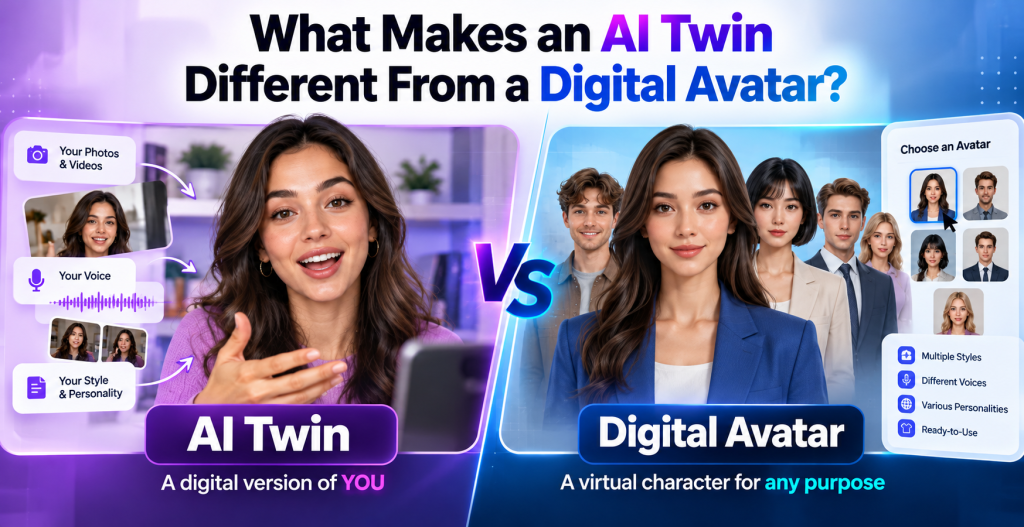
An AI Twin is an AI-powered digital representation of a real person designed to replicate aspects of that person’s appearance, voice, communication style, or behavior.
Think of an AI Twin as a digital version of yourself that can potentially help you create content or communicate with an audience.
Depending on the technology, an AI Twin can be trained or configured using information such as:
- Photos or videos of a person
- Voice recordings
- Speech patterns
- Writing style
- Personal preferences
- Brand information
- Knowledge or instructions
- Communication patterns
The goal is to create a digital representation that feels more personalized than a generic AI character.
For example, a content creator could create an AI Twin that looks and sounds like them. Instead of recording every product video manually, they could use their AI Twin to produce certain types of content.
This can be particularly useful for creators and brands that need to produce a large amount of video content.
What Is a Digital Avatar?
A digital avatar is a computer-generated representation of a person or character.
Digital avatars have existed long before generative AI became popular. They can be realistic humans, animated characters, 3D models, virtual influencers, or fictional personalities.
In AI-powered video platforms, digital avatars are commonly used as virtual presenters.
For example, a business might select an AI avatar from a library of presenters and use it to create:
- Training videos
- Product demonstrations
- Marketing videos
- Social media content
- Educational videos
- Presentations
- Explainer videos
The avatar doesn’t necessarily represent a real person.
It can simply be a digital character created to deliver information.
This is one of the biggest differences between a traditional digital avatar and an AI Twin.
AI Twin vs Digital Avatar: The Main Difference
The simplest way to understand the difference is this:
A digital avatar is a digital representation, while an AI Twin is designed to represent a specific real person more closely.
A digital avatar may be created from scratch or selected from a predefined collection.
An AI Twin is generally based on an individual and attempts to replicate some recognizable characteristics of that person.
For example, imagine a company wants to create a social media video.
With a digital avatar, the company could select a professional-looking AI presenter and provide it with a script.
With an AI Twin, the company’s founder could create a digital version of themselves and use it to deliver the message.
Both can create videos, but the relationship between the digital representation and the real person is different.
AI Twin vs Digital Avatar: Key Differences
| Feature | AI Twin | Digital Avatar |
| Based on a real person | Usually | Not necessarily |
| Personalized appearance | High | Varies |
| Voice replication | Often available | May use generic voices |
| Personality replication | Possible | Usually limited |
| Brand representation | Highly personalized | General |
| Content scalability | High | High |
| Best for | Creators, founders, personal brands | Businesses, education, marketing |
| Identity connection | Strong | Can be fictional or generic |
The exact capabilities depend on the AI platform being used, because the terms are sometimes used differently by different companies.
How Is an AI Twin Created?
Creating an AI Twin generally requires more personalization than creating a standard digital avatar.
1. Capture Your Appearance
The first step is usually providing images or video of the person.
The AI system analyzes visual characteristics such as facial structure, expressions, skin appearance, hair, and other identifying visual details.
The quality of the source material can influence the quality of the resulting digital representation.
2. Create or Clone the Voice
Many AI Twin platforms can also replicate a person’s voice.
The system analyzes voice characteristics such as:
- Tone
- Pitch
- Pronunciation
- Rhythm
- Speaking speed
- Vocal patterns
Once generated, the voice can potentially be used to narrate scripts without requiring the person to record every video manually.
3. Define Communication Style
Some advanced systems can incorporate information about how a person communicates.
For example, a creator might want their AI Twin to use a friendly, educational, or professional communication style.
The AI can then generate content according to predefined instructions.
4. Generate Content
Once the AI Twin is created, users can provide a script, prompt, product description, or content idea.
The platform can then combine the person’s digital appearance, voice, and instructions to generate a video.
This makes AI Twins particularly interesting for content creators who want to scale their personal presence.
How Are Digital Avatars Created?
Digital avatars generally require less personalization.
A user may simply choose an avatar from an available library.
For example, an AI video platform could offer dozens or hundreds of presenters with different appearances, clothing styles, ages, and voices.
The user then selects an avatar, enters a script, chooses a voice, and generates the video.
This makes digital avatars extremely useful for businesses that don’t need the presenter to represent a specific individual.
Why AI Twins Are Becoming Popular
One of the biggest reasons AI Twins are gaining attention is personalization.
People often connect more strongly with content when it comes from a recognizable individual.
For personal brands, founders, influencers, consultants, and creators, their identity is part of their content strategy.
However, creating videos manually takes time.
A creator may need to:
- Prepare a script.
- Set up lighting.
- Record the video.
- Retake mistakes.
- Edit the footage.
- Add captions.
- Export different versions.
- Publish the content.
An AI Twin can potentially reduce some of these repetitive steps.
Instead of recording every video personally, creators can use their digital representation for certain content formats.
AI Twins for Marketing
AI Twins can have significant applications in marketing.
A founder could use an AI Twin to create product announcements, educational videos, social media ads, or personalized messages.
For example, a SaaS founder could create one video explaining a new feature and then generate different versions for different audiences.
An ecommerce founder could also use an AI Twin to introduce products without recording every product video manually.
This creates an interesting combination of personal branding and AI-powered content production.
AI Twins for UGC Video Creation
AI Twins can also be used for UGC-style content.
Traditional UGC requires real creators to record videos. While this can produce authentic content, working with multiple creators can take time and increase production costs.
An AI Twin can provide a consistent digital presenter for a brand or creator.
For example, a company could create multiple product videos featuring the same recognizable digital personality.
The content could include different:
- Hooks
- Scripts
- Products
- CTAs
- Languages
- Backgrounds
- Video lengths
This can make creative testing more scalable.
However, brands should be transparent when content uses an AI-generated representation, particularly when audiences could reasonably assume that a real person recorded the content.
Digital Avatars Are Still Extremely Useful
The growing popularity of AI Twins doesn’t mean digital avatars are becoming obsolete.
Digital avatars can actually be the better choice for many use cases.
Suppose a company needs an internal training video.
There may be no reason to create an AI Twin of the CEO. A professional digital avatar can deliver the information efficiently.
Similarly, an ecommerce company may want several presenters for different campaigns.
Using a library of digital avatars can give marketers greater flexibility.
Digital avatars are especially useful when the identity of the presenter isn’t an important part of the message.
Which One Should You Choose?
The right option depends on your objective.
Choose an AI Twin When:
You want the digital presenter to represent a specific person.
AI Twins can be useful for:
- Personal branding
- Founder-led marketing
- Influencer content
- Creator businesses
- Personalized video
- Social media content
- Educational content
- UGC-style advertising
Choose a Digital Avatar When:
You simply need a professional virtual presenter.
Digital avatars can work well for:
- Training
- Corporate communication
- Product explainers
- Educational videos
- Presentations
- Internal communications
- General marketing content
The decision comes down to one fundamental question:
Does the identity of the presenter matter?
If the answer is yes, an AI Twin may be more appropriate. If the answer is no, a digital avatar may be the simpler solution.
What Makes AI Twins More Advanced?
The next generation of AI Twins is likely to move beyond appearance and voice.
Future systems may become better at understanding a person’s:
- Knowledge
- Preferences
- Communication style
- Brand guidelines
- Audience
- Content strategy
- Product information
This could make AI Twins more interactive.
Instead of simply reading a script, an AI Twin could potentially generate different responses based on a specific audience or situation.
For example, a business consultant could use an AI Twin to create educational videos for beginners and advanced professionals while maintaining a consistent personal identity.
The Future of AI Twins and Digital Avatars
AI Twins and digital avatars are likely to become increasingly common as AI-generated video improves.
The distinction between the two may also become more sophisticated.
Digital avatars will continue to provide scalable virtual presenters for businesses, educators, and marketers.
AI Twins, meanwhile, could become more focused on creating digital extensions of real people.
This could transform how creators approach content production.
Instead of thinking about video creation as “recording myself every time,” creators may increasingly think about building a digital version of themselves that can assist with content production.
The technology could eventually support personalized marketing, multilingual communication, virtual customer interactions, and always-on content creation.
Final Thoughts
So, what makes an AI Twin different from a digital avatar?
The biggest difference is the connection to a real person’s identity.
A digital avatar is a digital character or presenter that can be used to deliver content. It doesn’t necessarily need to represent a specific individual.
An AI Twin is designed to create a more personalized digital representation of a real person, potentially replicating their appearance, voice, communication style, and other characteristics.
Both technologies have valuable applications.
For businesses that need scalable video production, digital avatars can provide an efficient solution. For creators, founders, influencers, and personal brands, AI Twins can offer a way to scale their presence while maintaining a recognizable identity.
As AI video technology continues to develop, these digital representations will become increasingly useful for marketing, UGC content, social media, education, and communication.


Leave a Reply