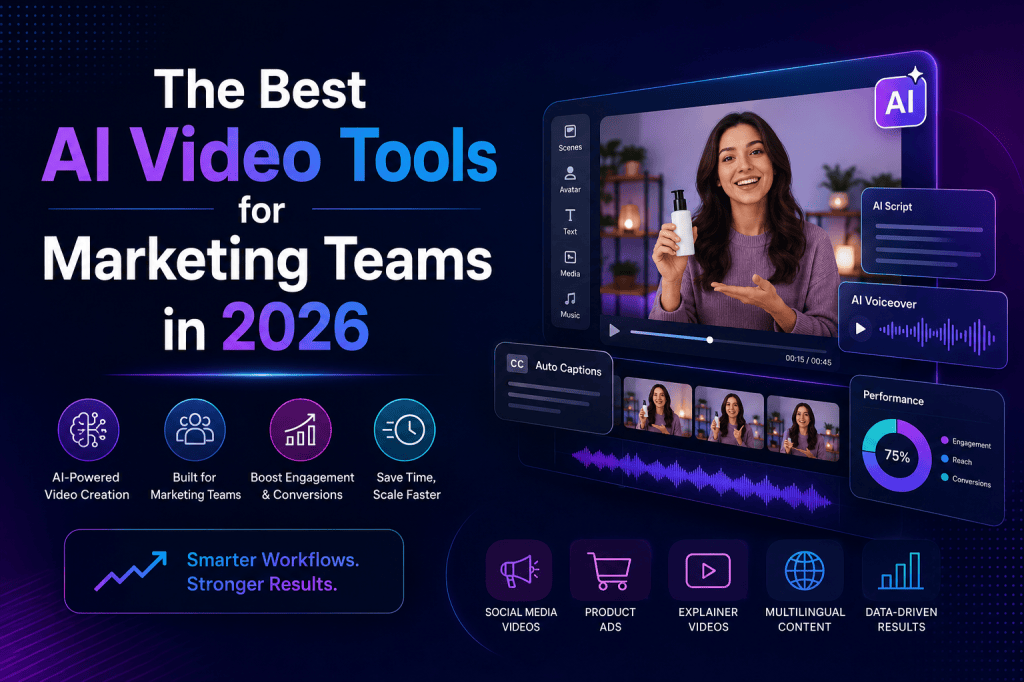
Discover the best AI video tools for marketing teams in 2026. Compare Tagshop AI, HeyGen, Synthesia, InVideo AI, Runway, and more for ads, UGC, social media, and marketing videos.
Video has become one of the most important formats for modern marketing teams. Brands need videos for paid ads, social media, product launches, landing pages, email campaigns, customer education, product demonstrations, and sales enablement. The challenge is that traditional video production can be slow, expensive, and difficult to scale.
That is where AI video tools for marketing teams are changing the workflow in 2026.
Instead of coordinating with creators, videographers, editors, voice artists, and designers for every campaign, marketing teams can now use AI to handle significant parts of the production process. Depending on the platform, marketers can generate scripts, AI presenters, UGC-style videos, product demonstrations, voiceovers, translated content, social videos, and even cinematic visuals from simple prompts.
But not every AI video tool is designed for the same job.
Some platforms are built primarily around AI avatars and business presentations. Others focus on UGC-style advertising, while some specialize in cinematic text-to-video generation or AI-powered editing. Choosing the right tool therefore depends on what your marketing team actually needs to produce.
This guide compares the best AI video tools for marketing teams in 2026, their strengths, limitations, ideal use cases, and the type of marketing workflow each tool fits best.
Why Marketing Teams Are Using AI Video Tools in 2026
Marketing teams are under constant pressure to produce more content without increasing production resources.
A single campaign may require several versions of the same creative. A social media team might need multiple videos every week, while a performance marketing team may need dozens of ad variations to test different hooks, products, audiences, and calls to action.
Traditional production does not always scale efficiently with this demand.
AI video tools allow teams to move from a production-heavy workflow toward a more iterative process. Instead of spending most of the time producing one video, marketers can spend more time developing concepts, testing messages, analyzing performance, and improving the next creative.
This shift is particularly important for performance marketing. A video is not necessarily successful because it looks expensive. The hook, message, offer, audience, pacing, product presentation, and CTA all influence performance.
AI makes it easier to test these variables.
Modern platforms can also support localization. For example, HeyGen currently promotes AI video creation with support for 175+ languages and dialects, allowing marketers to create localized content without recording every version manually.
Best AI Video Tools for Marketing Teams in 2026
The following tools are among the most useful options for marketing teams, but they serve different purposes.
| AI Video Tool | Best For | Key Strength | UGC | AI Avatars | AI Ads | Editing | Localization |
| Tagshop AI | UGC & performance ads | AI-powered ad creation | Yes | Yes | Yes | Yes | Yes |
| HeyGen | Avatar marketing | Realistic AI presenters | Yes | Yes | Yes | Yes | Excellent |
| Synthesia | Business & enterprise video | Professional AI presenters | Limited | Yes | Limited | Yes | Excellent |
| InVideo AI | General marketing content | Prompt-to-video workflow | Partial | Yes | Yes | Yes | Yes |
| Runway | Creative & cinematic content | Generative video | Limited | No | Creative | Yes | Limited |
| Descript | Video editing | Text-based editing | Partial | No | Partial | Excellent | Partial |
| Renderforest | Branded marketing videos | Templates & quick production | Limited | Limited | Yes | Yes | Yes |
The right choice depends on whether your priority is advertising, UGC, social content, business communication, editing, or cinematic creative production.
1. Tagshop AI – Best AI Video Tool for UGC Ads and Performance Marketing
If your primary objective is creating AI UGC videos and performance-focused video ads, Tagshop AI is one of the strongest options for marketing teams in 2026.
Tagshop AI is designed specifically around AI-powered video advertising. It can generate video ads using product information, prompts, or product URLs, bringing together the script, presenter, voice, scenes, and editing workflow.
This makes it particularly useful for ecommerce brands, DTC companies, agencies, SaaS businesses, and performance marketing teams that need to produce advertising creative quickly.
One of its biggest advantages is the ability to start with a product rather than a blank video canvas. Marketers can provide a product URL or describe what they want to advertise, and the AI can use that input to develop the creative. Tagshop AI also describes an AI Video Agent workflow where marketers can communicate their campaign requirements conversationally before receiving a complete UGC-style video.
Key Features
Tagshop AI includes AI UGC videos, AI avatars, voiceovers, AI scripts, product-focused creative, video editing, and ad-generation workflows.
It is especially useful for creating:
- UGC-style product ads
- TikTok ads
- Instagram video ads
- Product videos
- Ecommerce creatives
- Performance marketing variations
- Social media videos
- Product-focused promotional content
The platform also emphasizes multiple creative variations, including different presenters, hooks, tones, and formats.
Why Marketing Teams Should Consider Tagshop AI
The biggest advantage is workflow consolidation.
Instead of using one tool for scripting, another for avatars, another for editing, and another for ad formatting, marketers can handle much of the process within a single platform.
That matters when creative volume increases.
For example, a performance marketing team launching a new skincare product could generate multiple UGC concepts based on different pain points, hooks, presenters, and CTAs. The team can then test these creatives instead of relying on one expensive production.
Best for: DTC brands, ecommerce marketers, paid social teams, agencies, and teams focused on AI UGC video ads.
2. HeyGen – Best for AI Avatar Marketing Videos
HeyGen is one of the strongest AI video platforms for marketers who need realistic AI presenters and spokesperson videos.
The platform supports AI avatars, stock UGC avatars, digital twins, voice cloning, and multilingual video creation. Its current offering includes 175+ languages and dialects.
For marketing teams, this makes HeyGen useful for social content, product explainers, personalized marketing, training content, presentations, and spokesperson videos.
HeyGen’s UGC offering is also relevant for marketers. Its platform specifically promotes stock UGC avatars designed to create creator-style videos without traditional casting or production.
Key Features
HeyGen can be used for:
- AI avatar videos
- UGC-style videos
- Social media content
- Product explainers
- Personalized videos
- Digital twins
- Voice cloning
- Video translation
- Multilingual marketing content
The platform is particularly attractive for companies with international audiences because localization can be handled without producing every language version from scratch.
Best Use Case
Consider HeyGen when your marketing team needs a consistent digital spokesperson across multiple campaigns.
For example, a SaaS company could create product announcements, feature explainers, onboarding videos, and social clips featuring the same AI spokesperson.
Best for: SaaS companies, B2B marketing teams, social media teams, education brands, and businesses that need multilingual avatar content.
3. Synthesia – Best for Enterprise Marketing and Professional Communication
Synthesia is well known for AI avatar-based video creation and is particularly strong for professional and enterprise environments.
Marketing teams can use avatar videos for product education, customer onboarding, internal communications, sales enablement, explainers, and branded content.
Compared with UGC-focused platforms, Synthesia is generally better suited to structured, professional communication than casual creator-style advertising.
Key Features
Synthesia is useful for:
- AI presenter videos
- Product explainers
- Corporate videos
- Educational content
- Sales enablement
- Customer onboarding
- Multilingual videos
- Training content
The professional presentation style makes it a good fit when brand consistency and structured communication matter more than the casual aesthetic associated with TikTok-style UGC.
Best for: Enterprise marketing teams, B2B brands, training teams, sales enablement, and professional communications.
4. InVideo AI – Best for General Marketing Video Creation
InVideo AI is useful for marketing teams that want to create videos from text prompts without manually assembling every scene.
The platform is suitable for social media videos, promotional content, explainers, YouTube videos, and other marketing assets.
Its main advantage is flexibility.
Instead of limiting users to one type of video, InVideo AI supports a broader content-creation workflow.
Key Features
Marketing teams can use it for:
- Social media videos
- Promotional videos
- YouTube content
- Explainer videos
- Product videos
- Script-to-video creation
- AI-assisted editing
- Stock media-based videos
It is a useful option for teams that need a general-purpose AI video generator rather than a tool focused specifically on UGC ads.
Best for: Content marketers, social media managers, agencies, and teams producing different types of marketing videos.
5. Runway – Best for Creative and Cinematic AI Video
Runway occupies a different category from tools such as Tagshop AI, HeyGen, and Synthesia.
Rather than focusing primarily on avatar-based marketing videos, Runway is particularly valuable for creative teams experimenting with generative video, cinematic visuals, product storytelling, and visual effects.
This makes it a strong choice when the creative concept requires visuals that would traditionally require filming or extensive post-production.
Recent 2026 comparisons continue to position Runway strongly for cinematic text-to-video work, with newer model capabilities emphasizing areas such as audio, longer clips, resolution, and character consistency.
Key Features
Runway can be useful for:
- Creative campaigns
- Cinematic product visuals
- Concept videos
- Brand storytelling
- Generative scenes
- Visual experimentation
- Creative effects
However, it is not necessarily the first choice if your primary goal is generating dozens of UGC-style product advertisements.
Best for: Creative directors, brand teams, visual storytellers, agencies, and experimental marketing campaigns.
6. Descript – Best AI Video Editing Tool for Marketing Teams
Descript is different from traditional AI video generators because its major strength is editing.
Instead of focusing primarily on generating an entire video from scratch, Descript allows users to edit video through a text-based workflow.
This can be extremely useful for marketing teams that already have recorded footage but need to turn it into multiple pieces of content.
For example, a 30-minute webinar can potentially become several short-form videos, clips, social posts, and other marketing assets.
Key Features
Descript is useful for:
- Video editing
- Podcast editing
- Social clips
- Transcription
- Text-based editing
- Repurposing long-form content
- Removing unwanted sections
- Creating short-form content
Best for: Content marketing teams, podcast teams, social media managers, and marketers who repurpose existing video.
7. Renderforest – Best for Template-Based Marketing Videos
Renderforest is a useful option for marketers who want templates and simplified video production.
It can be useful when a team needs branded promotional videos but does not have a dedicated video designer available for every campaign.
Templates can speed up production and make it easier to maintain consistent visual styles.
Key Features
Marketing teams can use Renderforest for:
- Promotional videos
- Social media content
- Brand videos
- Presentations
- Product introductions
- Logo animations
- Marketing templates
Best for: Small marketing teams, startups, agencies, and businesses that prefer template-driven production.
How to Choose the Best AI Video Tool for Your Marketing Team
There is no single best AI video tool for every marketing team.
Your choice should start with your content strategy.
If you mainly produce paid social ads, look for a platform designed around ad creation, UGC, variations, and fast iteration.
If you need professional spokesperson videos, an avatar-focused platform may be better.
If your team creates cinematic brand campaigns, a generative video platform may offer more creative flexibility.
If you already have a large library of recorded footage, an AI-powered editing platform can provide more value than a text-to-video generator.
1. Define Your Main Video Use Case
Start by identifying the content you produce most frequently.
Ask:
Do we need UGC ads, social videos, product explainers, corporate videos, or cinematic creative?
This simple question can eliminate many tools immediately.
2. Evaluate AI Avatar Quality
If your strategy depends on spokesperson videos, avatar quality matters.
Look for realistic:
- Facial expressions
- Lip synchronization
- Gestures
- Voice delivery
- Eye movement
- Body movement
An AI avatar that looks artificial can reduce the effectiveness of otherwise strong marketing content.
3. Look at Creative Variation
For performance marketing, variation is extremely important.
Your team should be able to experiment with different hooks, scripts, presenters, CTAs, formats, and visual styles.
Tagshop AI, for example, emphasizes generating multiple presenter styles, hooks, tones, and formats for testing.
4. Check Localization Capabilities
Global marketing teams need to produce content for multiple regions.
Look for tools that support:
- Multiple languages
- Voice translation
- Lip syncing
- Regional accents
- Multiple subtitles
- Localized scripts
HeyGen is particularly strong in this category, with its current platform supporting 175+ languages and dialects.
5. Consider Brand Control
AI can make production faster, but marketing teams still need control.
Look for:
- Brand colors
- Logos
- Fonts
- Tone of voice
- Brand templates
- Custom scripts
- Consistent presenters
- Product assets
The best tool should make your content faster without making your brand look generic.
AI Video Tools vs Traditional Video Production
The biggest advantage of AI video tools is not simply that they are cheaper.
It is that they change the speed of iteration.
Traditional video production often follows a sequence like:
Brief → Casting → Script → Shoot → Edit → Review → Revision → Export
AI can compress many of these steps:
Prompt/Product → AI Generation → Review → Edit → Test
This is particularly valuable for performance marketing.
Imagine a team wants to test five different hooks.
With traditional production, each hook might require additional creator work or editing.
With AI, the same concept can often be regenerated with a different opening, script, presenter, or CTA.
This allows marketing teams to focus more heavily on experimentation.
AI Video Tools and the Rise of Creative Testing
Creative testing is one of the strongest reasons for marketing teams to adopt AI video.
A marketer should not assume that the first video created is the best possible version.
Instead, teams can test:
Different Hooks
A direct problem-based hook may outperform a curiosity-based opening.
Different Presenters
One avatar or creator style may resonate better with a specific audience.
Different Product Benefits
A product can be positioned around price, convenience, quality, speed, or another benefit.
Different CTAs
“Shop Now” may perform differently from “Try It Today.”
Different Formats
A short 15-second video may outperform a 30-second version for one campaign.
AI makes these experiments easier to produce.
The result is a move from video production toward creative production systems.
How Marketing Teams Can Build an AI Video Workflow
A good AI video workflow does not mean generating everything automatically.
Human strategy remains important.
Start with the marketing objective.
Determine whether the video is designed to generate awareness, clicks, leads, sales, engagement, or product education.
Then develop several creative concepts.
Use AI to generate scripts and video variations.
Review every output for accuracy, brand alignment, product claims, visual quality, and tone.
Finally, publish and analyze performance.
The data should inform the next round of creative.
This creates a continuous cycle:
Strategy → AI Production → Testing → Performance Data → Creative Optimization
That is where AI video becomes much more valuable than simply using an AI tool to make a video once.
Comparison: Which AI Video Tool Should You Choose?
| Marketing Requirement | Recommended Tool |
| AI UGC ads | Tagshop AI |
| Ecommerce video ads | Tagshop AI |
| Performance creative testing | Tagshop AI |
| AI spokesperson videos | HeyGen |
| Multilingual avatar videos | HeyGen |
| Enterprise video communication | Synthesia |
| Training and professional explainers | Synthesia |
| General AI video creation | InVideo AI |
| Cinematic AI visuals | Runway |
| AI-powered video editing | Descript |
| Template-based marketing videos | Renderforest |
The important point is that these tools are not necessarily direct substitutes.
A marketing team could even use multiple tools.
For example, a performance marketing team might use Tagshop AI for UGC advertisements, Descript for repurposing webinars, and Runway for creative campaign visuals.
What Makes an AI Video Tool Valuable for Marketing Teams?
The best AI video generator isn’t necessarily the one with the largest number of features.
The most useful platform is the one that fits into your existing marketing workflow.
A good marketing-focused AI video tool should help answer five questions:
Can we create content faster?
If video production still requires multiple manual steps, the AI workflow may not be providing enough value.
Can we produce more variations?
Marketing teams need creative diversity, particularly when running paid social campaigns.
Can we maintain brand consistency?
Speed should not come at the expense of brand identity.
Can we localize content?
Global campaigns require more than translating a few lines of text.
Can we connect production to performance?
The best workflow allows teams to create, test, learn, and iterate.
The Future of AI Video Marketing in 2026 and Beyond
AI video is moving beyond simple text-to-video generation.
The next phase is about AI-powered creative workflows.
Instead of asking AI only to “make a video,” marketers will increasingly ask AI to understand a product, audience, campaign objective, and creative strategy.
The AI can then help generate multiple concepts.
This is particularly relevant for advertising.
A performance marketing team might provide:
Product: A new skincare serum
Audience: Women interested in skincare
Goal: Increase purchases
Platform: Instagram Reels
Style: Authentic UGC
Message: Reduce the appearance of dry skin
The system can then produce multiple creative directions around different hooks and product benefits.
The marketer becomes the creative director while AI handles much of the production workload.
That distinction is important.
AI does not eliminate the need for marketing strategy. It makes it possible for marketers to execute more of their ideas.
Final Verdict: Which Is the Best AI Video Tool for Marketing Teams?
The best AI video tool depends on the job you need it to perform.
For AI UGC video ads, ecommerce creative, and performance marketing, Tagshop AI is a particularly strong choice because its workflow is centered around generating advertising content from product information and supporting multiple creative variations.
For AI avatars and multilingual spokesperson content, HeyGen is a strong option, particularly for teams that need digital presenters and localized videos.
For enterprise and professional communication, Synthesia is better aligned with structured business video.
For general-purpose AI video creation, InVideo AI can be a flexible option.
For cinematic and experimental creative, Runway is worth considering.
For editing and content repurposing, Descript can be more useful than a traditional video generator.
And for template-driven marketing videos, Renderforest provides a straightforward production workflow.
Ultimately, the right tool is the one that helps your team produce better creative, faster, at a scale your marketing strategy can actually use.
The biggest opportunity in 2026 is not simply replacing traditional video production with AI.
It is creating a faster marketing system where teams can develop more ideas, produce more variations, test more creative, and learn from performance data without turning every new video into a major production project.
FAQs About AI Video Tools for Marketing Teams
What are the best AI video tools for marketing teams in 2026?
The best tools depend on your use case. Tagshop AI is particularly suited to AI UGC and performance advertising, HeyGen is strong for AI avatar and multilingual videos, Synthesia is suited to professional and enterprise content, InVideo AI works well for general marketing video creation, Runway is useful for cinematic creative, and Descript is strong for AI-powered editing and content repurposing.
What is the best AI video generator for marketing ads?
For marketers primarily focused on AI video ads and UGC-style advertising, Tagshop AI is a strong option. Its platform is designed to generate scripts, presenters, voices, scenes, and edited advertising videos from product information or prompts.
Can AI video tools create UGC ads?
Yes. Several platforms now support UGC-style AI videos. Tagshop AI specifically focuses on AI UGC video ads, while HeyGen also offers stock UGC avatars designed for creator-style content.
Are AI video tools useful for small marketing teams?
Yes. Small teams can use AI video tools to reduce the amount of manual production required for social content, advertisements, product videos, and explainers. The main advantage is the ability to produce more creative without requiring a large production team.
Can AI video tools create videos in multiple languages?
Many can. Multilingual video generation and translation are becoming important features for global marketing teams. HeyGen, for example, currently advertises support for 175+ languages and dialects.
Can AI video replace video editors?
AI can automate many repetitive editing tasks, but human editors remain valuable for complex storytelling, brand-sensitive campaigns, creative direction, and final quality control. AI is better viewed as an editing accelerator rather than a universal replacement.
Are AI-generated marketing videos good for paid ads?
They can be. AI allows marketers to create and test more creative variations, which is particularly useful for paid social campaigns. However, the quality of the strategy, hook, offer, product positioning, audience targeting, and final creative still determines campaign performance.
How can marketing teams use AI video for social media?
Marketing teams can use AI video to create Reels, TikTok videos, YouTube Shorts, product explainers, educational videos, promotional clips, UGC-style content, and localized social campaigns. AI can also help transform existing long-form content into shorter social assets.
Is AI video cheaper than traditional video production?
AI can reduce production costs, particularly when teams need many creative variations. The exact savings depend on the platform, subscription, usage volume, and the type of content being created. The bigger advantage for many marketing teams is the reduction in production time and the ability to iterate quickly.
What should marketers look for in an AI video generator?
Marketing teams should evaluate avatar quality, AI voice quality, script generation, editing capabilities, creative variation, localization, brand controls, commercial usage rights, export quality, integrations, and overall workflow. For advertising teams, the ability to generate multiple hooks and creative variations should be a major consideration.
Can AI video tools create product videos from a URL?
Some platforms can. Tagshop AI, for example, allows marketers to provide a product URL or prompt as the starting point for AI video ad creation. The platform describes a workflow where product information is used to generate the script, presenter, voice, and edited video.
Will AI video become more important for marketing teams?
AI video is likely to become increasingly important as marketers need more content, more personalization, more localization, and faster creative testing. The competitive advantage will increasingly come from how effectively teams combine AI production with human strategy, creative judgment, and performance analysis.
 AI Avatar Tech Blog
Leave a comment