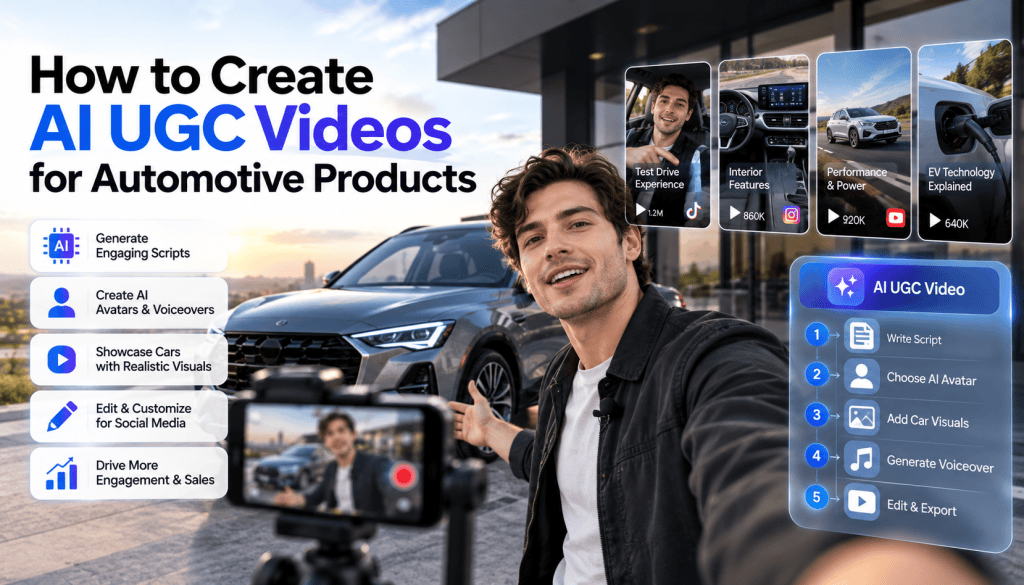
Automotive marketing is becoming increasingly visual. Car buyers no longer rely only on dealerships, brochures, television commercials, or traditional automotive websites to discover vehicles. They explore cars through social media videos, product reviews, short-form content, virtual demonstrations, and creator-style advertisements.
This shift has created a growing opportunity for AI UGC videos for automotive products.
AI-generated user-generated content, commonly known as AI UGC, allows automotive brands, dealerships, and marketers to create videos that have the conversational style of traditional UGC while using artificial intelligence for scripting, avatars, voiceovers, visuals, and editing.
Instead of organizing a complete production shoot for every marketing idea, brands can use AI video tools to create multiple creative variations around a vehicle, feature, or campaign.
From new car launches and electric vehicles to accessories and dealership promotions, AI UGC can help automotive businesses create engaging content for modern digital channels.
In this guide, we’ll explain how to create AI UGC videos for automotive products, what elements to include, how to structure your videos, and the best practices for creating effective automotive UGC content.
What Are AI UGC Videos for Automotive Products?
AI UGC videos are marketing videos created with artificial intelligence that imitate the conversational and relatable style of user-generated content.
For automotive products, these videos can showcase vehicles, features, accessories, services, and automotive technologies through AI-generated presenters, virtual creators, voiceovers, product visuals, and scripts.
For example, instead of producing a traditional car commercial, an automotive brand could create a short video featuring an AI presenter saying:
“Looking for an SUV that’s practical for everyday driving? Here are three features you should check before choosing your next vehicle.”
The video could then show the vehicle’s interior, technology, storage, design, and other relevant features.
The format feels more like social content than a conventional commercial.
The key difference is that AI UGC should not falsely present an AI-generated person as a real customer. It is better used as a scalable creative format inspired by UGC.
Why Should Automotive Brands Use AI UGC Videos?
Creating traditional automotive advertising can require substantial resources. Professional photography, locations, vehicles, models, production teams, editing, voiceovers, and post-production can make each campaign time-consuming.
AI UGC can provide an additional content production workflow.
Automotive marketers can create multiple versions of a campaign, experiment with different hooks, and adapt content for different platforms.
Some common applications include:
- New vehicle launches
- Car feature demonstrations
- Electric vehicle education
- Dealership marketing
- Automotive accessories
- Service campaigns
- Social media advertisements
- Product explainers
- Test-drive promotions
- Retargeting campaigns
The biggest advantage is flexibility. Instead of creating one piece of content for everyone, brands can develop different videos for different customer segments and marketing channels.
How to Create AI UGC Videos for Automotive Products
Step 1: Define Your Automotive Marketing Goal
Before creating an AI UGC video, determine exactly what you want the video to accomplish.
A vehicle video designed to generate awareness will look different from one designed to drive test-drive bookings.
Your goal could be:
- Generate vehicle awareness
- Introduce a new model
- Explain a feature
- Promote an EV
- Drive dealership visits
- Generate test-drive requests
- Promote automotive accessories
- Educate potential buyers
- Increase website traffic
Having a specific goal makes it easier to choose the right script, visuals, presenter, and call to action.
Step 2: Choose One Automotive Product or Feature
Avoid trying to explain everything in a single short video.
Modern vehicles can have dozens of features, but short-form UGC works better when each video focuses on one central idea.
For example, instead of creating a video titled:
“Everything You Need to Know About Our New SUV,”
create separate videos such as:
“3 Interior Features That Make This SUV Family-Friendly.”
“How the New Infotainment System Works.”
“What Makes This EV Different?”
“3 Technology Features You Should Know About.”
Breaking content into individual topics makes it easier for viewers to understand the message.
Step 3: Identify Your Target Audience
Different automotive customers have different priorities.
A family purchasing an SUV may care about space and convenience, while an EV buyer may focus on charging and range. A younger driver may be more interested in technology and design.
Define your audience before writing the script.
For example:
Families: Focus on space, comfort, convenience, and practical features.
EV buyers: Focus on charging, battery technology, efficiency, and ownership education.
Technology enthusiasts: Highlight infotainment, connectivity, digital features, and driver-assistance technology.
Performance-focused buyers: Discuss performance-related features using verified specifications.
Audience-specific messaging can make AI UGC videos more relevant.
Step 4: Write a Conversational Script
The script is one of the most important parts of an AI UGC video.
Avoid writing the video like a traditional corporate advertisement.
Instead, use natural language.
For example, a traditional advertisement might say:
“Experience next-generation automotive technology designed for modern mobility.”
A UGC-style version could say:
“If you’re looking for a car with smarter technology, here are three features worth checking out.”
The second version sounds more conversational and fits social media better.
A simple AI UGC script structure can include:
Hook → Problem → Product → Features → Benefit → Call to Action
For example:
“Still struggling to find an SUV that works for your daily routine? This model combines flexible interior space, connected technology, and driver-focused features. Here’s a quick look at what makes it different. Want to see it in person? Schedule a test drive.”
Step 5: Select an AI Avatar or Digital Presenter
The presenter can strongly influence the overall style of the video.
Choose an AI avatar that matches your target audience and brand identity.
For a premium automotive brand, you may want a polished and professional presenter.
For a social-first campaign, a more casual creator-style avatar may work better.
The important thing is consistency.
The avatar should complement the vehicle instead of distracting from it.
Step 6: Add High-Quality Automotive Visuals
The vehicle should remain the focus of the content.
Include relevant visuals such as:
- Exterior shots
- Interior views
- Dashboard displays
- Infotainment systems
- Seats and storage
- Lighting
- Wheels
- Safety features
- Charging interfaces
- Connected technology
For an AI-generated video, product accuracy is particularly important.
AI-generated visuals can sometimes change vehicle proportions, badges, colors, or design elements. Whenever possible, use approved product images, real vehicle footage, screen recordings, or verified product assets.
Step 7: Generate the Voiceover
AI voice generation can make automotive content easier to produce in different languages and formats.
Choose a voice that matches your campaign.
A conversational voice can work well for UGC-style videos, while a more polished voice may suit premium automotive advertising.
Pay attention to:
- Pronunciation
- Speed
- Tone
- Pauses
- Natural delivery
- Brand terminology
Technical automotive terms should be reviewed carefully to ensure the AI voice pronounces them correctly.
Step 8: Add Captions and On-Screen Text
Many social media users watch videos without sound.
Adding captions can make the message easier to understand.
You can also use short text overlays to highlight important points.
For example:
3 Features to Know
Smart Connected Technology
Flexible Interior
Advanced Driver Assistance
Keep text concise and easy to read.
Step 9: Add a Strong Call to Action
Every automotive UGC video should have a clear next step.
Depending on your campaign objective, your CTA could be:
- Explore the vehicle
- Learn more
- Book a test drive
- Visit a dealership
- View available models
- Compare vehicles
- Discover the features
- Request more information
Don’t overload the video with multiple calls to action. Choose one primary action that matches the campaign goal.
AI UGC Video Ideas for Automotive Products
Once you’ve created your basic workflow, you can develop multiple automotive content formats.
1. Vehicle Feature Videos
Create short videos explaining one specific feature.
2. “3 Things to Know” Videos
Highlight three useful features or benefits of a vehicle.
3. EV Education
Create videos explaining charging, battery technology, range considerations, and EV ownership.
4. Interior Walkthroughs
Show the dashboard, seats, storage, infotainment, and other interior features.
5. Automotive Accessories
Promote accessories such as roof racks, floor mats, charging equipment, or other compatible products.
6. Dealership Content
Create videos for new arrivals, seasonal campaigns, service offers, and test-drive promotions.
7. Automotive FAQs
Answer common questions buyers ask before purchasing a vehicle.
This type of content can also support search visibility because it directly addresses customer questions.
How to Optimize AI UGC Videos for Social Media
Different social platforms require different creative approaches.
For TikTok, Instagram Reels, and YouTube Shorts, vertical video is generally the natural format. Keep the opening strong and communicate the main idea quickly.
Start with a hook such as:
“Thinking about buying an EV?”
“Here’s something you should know about this SUV.”
“Three features I didn’t expect in this car.”
The first few seconds should make the viewer understand why they should continue watching.
For longer YouTube content, you can provide more detailed demonstrations and explanations.
The same automotive campaign can therefore be adapted into multiple versions rather than using one video everywhere.
Best Practices for Creating Automotive AI UGC
Keep Product Claims Accurate
Automotive advertising involves important specifications and purchasing decisions.
Always verify information about pricing, fuel economy, range, safety systems, warranties, financing, performance, and other product claims before publishing.
Don’t Fake Customer Experiences
If an AI avatar is not a real customer, don’t present it as one.
AI UGC should recreate a content style, not manufacture false testimonials.
Authentic customer reviews should remain clearly distinguished from AI-generated marketing content.
Keep the Vehicle Authentic
Check AI-generated content for changes to the vehicle’s:
- Shape
- Color
- Logo
- Wheels
- Interior
- Controls
- Features
Product accuracy matters because misleading visuals can create confusion.
Test Different Hooks
One video doesn’t have to be your final version.
Create multiple openings around the same product.
For example:
“Is this the right SUV for families?”
“3 things I like about this SUV.”
“Before buying an SUV, check these features.”
Testing different creative approaches can help marketers understand what resonates with their audience.
How Tagshop AI Can Help Create AI UGC Videos
AI video platforms such as Tagshop AI can help marketers streamline the process of creating UGC-style video content.
Automotive marketers can use AI-powered workflows to develop scripts, create AI avatar videos, generate voiceovers, and produce creative variations for social media and advertising campaigns.
For automotive brands and dealerships, this can make it easier to turn one vehicle or product into multiple pieces of content.
The goal isn’t simply to generate more videos. It is to build a repeatable content workflow where automotive marketers can create, test, and improve creative concepts continuously.
Common Mistakes to Avoid
AI UGC can be powerful, but there are several mistakes automotive marketers should avoid.
The first is making every video look identical. If every campaign uses the same avatar, voice, hook, and structure, audiences may quickly lose interest.
Another mistake is focusing too heavily on the AI presenter while barely showing the vehicle.
A third mistake is using generic scripts that don’t address real customer questions.
Finally, brands should avoid publishing AI-generated automotive visuals without checking them for product accuracy.
Human review remains important even when most of the production process is automated.
The Future of AI UGC in Automotive Marketing
AI UGC is likely to become an increasingly important part of automotive content marketing as AI video generation becomes more capable.
Brands may increasingly create personalized content for specific vehicle categories, customer segments, locations, and marketing stages.
For example, one vehicle could have separate creative campaigns for first-time buyers, families, commuters, EV shoppers, and technology-focused customers.
AI could also help automotive marketers localize campaigns into different languages and adapt content for different platforms.
However, human creativity will remain important.
The strongest automotive campaigns will likely combine AI-powered production with professional photography, authentic customer stories, real vehicle footage, influencer content, and strong creative direction.
Conclusion
Learning how to create AI UGC videos for automotive products can give automotive brands and dealerships a scalable way to create modern digital content.
From vehicle feature demonstrations and EV education to dealership campaigns and short-form social advertisements, AI UGC can help transform product information into engaging video experiences.
The most effective approach is to start with a clear marketing objective, choose one product or feature, understand the target audience, write a conversational script, select an appropriate AI presenter, use accurate vehicle visuals, and finish with a strong call to action.
AI can make video production faster and more flexible, but successful automotive marketing still depends on accurate information, strong storytelling, and audience relevance.
When these elements come together, AI UGC can become a valuable addition to an automotive brand’s social media and digital advertising strategy.
Frequently Asked Questions
What is AI UGC for automotive products?
AI UGC for automotive products is user-generated-content-style video created using artificial intelligence. It can combine AI avatars, voiceovers, scripts, product visuals, and automated editing to promote vehicles and automotive products.
How do you create an AI UGC car video?
Start by choosing a vehicle or feature, defining the target audience, writing a conversational script, selecting an AI avatar and voice, adding accurate vehicle visuals, generating the video, adding captions, and including a relevant call to action.
Can AI UGC be used for car dealerships?
Yes. Dealerships can use AI UGC for vehicle arrivals, feature videos, service campaigns, promotional offers, FAQs, test-drive campaigns, and social media advertising.
Can AI UGC be used for electric vehicles?
Yes. AI UGC can be used to explain EV features, charging, battery technology, ownership considerations, and other educational topics, provided that all product claims are accurate.
Is AI UGC better than traditional automotive advertising?
AI UGC and traditional advertising serve different purposes. AI UGC can make it easier to produce frequent, social-first creative variations, while traditional automotive campaigns can provide high-production brand storytelling. Many brands can use both approaches together.
What makes a good automotive AI UGC video?
A strong automotive AI UGC video should have a clear hook, conversational script, accurate vehicle visuals, relevant product information, natural presentation, readable captions, and a clear call to action.


Leave a comment