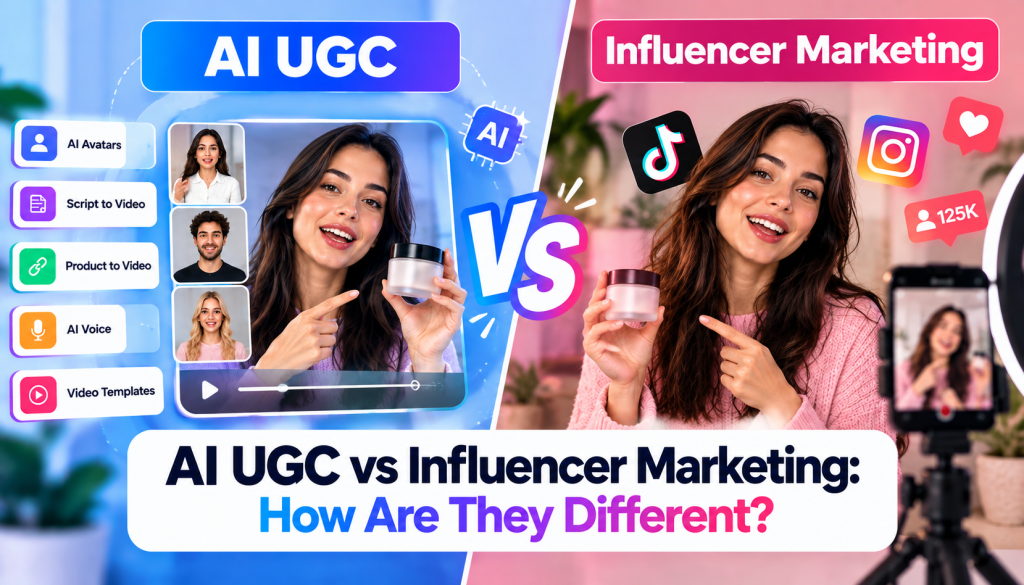
Brands are constantly looking for better ways to create engaging content, reach new audiences, and scale their digital advertising. Two strategies that have become increasingly important are AI UGC and influencer marketing.
At first glance, they may appear similar because both can produce creator-style content for platforms such as TikTok, Instagram, Facebook, and YouTube. However, the way the content is created, distributed, managed, and measured can be very different.
Influencer marketing depends on real people who have built audiences and communities around their content. AI UGC uses artificial intelligence to create user-generated-content-style videos, often with AI avatars, synthetic voices, product visuals, scripts, and automated editing.
The rise of AI UGC Video generators has made it possible for brands to produce multiple creator-style videos without coordinating with a different creator for every piece of content.
But does that mean AI UGC replaces influencer marketing? Not necessarily.
Both approaches have different strengths, use cases, and limitations. The right choice depends on your campaign objectives, audience, budget, creative requirements, and production needs.
In this guide, we’ll explain the difference between AI UGC and influencer marketing, how both strategies work, their advantages and limitations, and when brands may consider using each approach.
What Is AI UGC?
AI UGC refers to user-generated-content-style marketing videos created with the help of artificial intelligence.
Instead of asking a real creator to record every video, brands can use AI technology to generate creator-style content using digital avatars, AI voices, scripts, product images, animations, and other creative assets.
For example, an eCommerce brand selling skincare products could create an AI UGC video featuring a virtual creator explaining a skincare problem, introducing a product, demonstrating how it works, and ending with a call to action.
The content can be designed to resemble the style of organic social media videos while remaining controlled by the brand.
Modern AI UGC Video generators can automate multiple parts of this workflow, including:
- Script generation
- AI avatar selection
- Voice generation
- Product visualization
- Scene creation
- Captions
- Video editing
- Background generation
- Multiple creative variations
This makes AI UGC particularly useful for marketers who need to produce large amounts of video content quickly.
What Is Influencer Marketing?
Influencer marketing involves partnering with real individuals who have an established audience on social media or other digital platforms.
Influencers create content around a brand, product, or service and publish it to their followers.
Depending on the campaign, an influencer may:
- Review a product
- Demonstrate a product
- Create a tutorial
- Share a personal experience
- Publish a sponsored post
- Create short-form videos
- Mention a product in existing content
- Participate in a brand campaign
The value of influencer marketing comes partly from the relationship between the creator and their audience.
For example, a fitness influencer may have an audience that trusts their recommendations about workout equipment. A beauty creator may have followers who regularly watch their skincare or makeup content.
Because the creator already has an audience, brands can use that existing reach as part of their marketing strategy.
AI UGC vs Influencer Marketing: Key Differences
Although both approaches can produce creator-style content, there are several important differences.
1. Content Creation
The biggest difference is who or what creates the content.
Influencer marketing relies on a real person creating the content. The influencer records themselves, demonstrates the product, speaks to the audience, and publishes the content according to the campaign agreement.
AI UGC uses artificial intelligence to generate the content or assist with production.
With AI UGC, marketers can select an AI avatar, generate a script, create a voiceover, add product visuals, and produce the final video using an AI video platform.
This gives brands greater control over the production process.
2. Audience Reach
Influencer marketing usually comes with an existing audience.
An influencer may have thousands or millions of followers across platforms. When they publish sponsored content, the brand can potentially reach that audience.
AI UGC does not automatically come with an audience.
An AI-generated video must be distributed through channels such as paid advertising, organic social media, websites, landing pages, or other marketing channels.
This distinction is important.
Influencer marketing combines content creation and audience distribution, while AI UGC is primarily a content creation and creative production strategy.
3. Production Speed
Influencer campaigns can require significant coordination.
Brands may need to:
- Find suitable creators.
- Negotiate pricing.
- Send product samples.
- Share creative guidelines.
- Wait for content production.
- Review the content.
- Request revisions.
- Coordinate publishing.
AI UGC can reduce many of these steps.
Using AI UGC Video generators, marketers can create new concepts and variations within a much shorter production workflow.
This can be especially useful when brands need dozens of creative variations for paid advertising.
4. Creative Control
Influencer marketing gives creators a certain level of creative freedom.
This can be beneficial because authentic creator content may feel more natural than highly controlled brand advertising. However, it also means that the final content may not look exactly like the original concept envisioned by the brand.
AI UGC gives marketers more direct control over:
- Scripts
- Avatars
- Voices
- Scenes
- Product placement
- Branding
- Captions
- CTAs
- Video length
- Creative variations
This makes AI UGC useful for brands that need consistency across large creative libraries.
5. Scalability
Scalability is one of the major differences between these strategies.
Suppose a brand wants to create 50 different video advertisements.
With influencer marketing, producing 50 videos could require coordinating with multiple creators, negotiating contracts, shipping products, reviewing content, and managing deadlines.
With AI UGC, the same basic campaign concept can be adapted into numerous versions using different hooks, scripts, avatars, voices, and visuals.
This is where AI UGC Video generators can become particularly valuable.
Brands can build a repeatable creative workflow rather than treating every video as an individual production project.
Advantages of AI UGC
Faster Creative Production
AI can automate several parts of the video creation process, allowing marketers to move from an idea to a finished creative more quickly.
This is especially useful for performance marketing teams that constantly need fresh advertisements.
More Creative Variations
AI UGC allows marketers to experiment with different concepts.
For example, one product can have:
- A problem-solution video
- A product demonstration
- A review-style video
- A tutorial
- A comparison video
- A testimonial-style concept
- A feature-focused advertisement
This creates more opportunities for creative testing.
Consistent Branding
AI-generated content can follow predefined brand guidelines.
Marketers can maintain consistent messaging, product positioning, colors, visual styles, and CTAs across multiple videos.
Lower Production Complexity
Traditional video production can involve cameras, locations, creators, editors, and production teams.
AI UGC can simplify the workflow by bringing many of these creative functions into one digital environment.
Easy Localization
AI-powered video workflows can also make it easier to create variations for different languages and markets, provided the generated translations, pronunciation, cultural references, and claims are reviewed carefully.
A single campaign concept can potentially be adapted for different audiences without recording an entirely new video for every market.
Advantages of Influencer Marketing
Existing Audience
One of the biggest benefits of influencer marketing is access to an established audience.
A relevant influencer can introduce a product to followers who already consume their content.
Human Connection
Real creators can share personal experiences, opinions, demonstrations, and stories.
That human element can be valuable for products where personal experience is an important part of the buying decision.
Community Engagement
Influencers often have ongoing conversations with their audiences through comments, livestreams, direct messages, and other interactions.
This can give brands additional opportunities to engage with potential customers.
Social Proof
A genuine creator recommendation can function as a form of social proof.
When someone a viewer already follows discusses a product, the recommendation may carry context that a newly created advertisement does not automatically have.
Limitations of AI UGC
AI UGC offers scalability, but it also has limitations.
The biggest challenge is authenticity.
If an AI-generated creator looks unnatural or the script sounds robotic, the content may fail to capture attention.
Brands also need to be transparent and responsible when using synthetic media. They should avoid creating fake customer experiences or presenting AI-generated testimonials as genuine experiences.
Another limitation is that AI UGC does not automatically provide distribution. Creating a great video is only one part of marketing. Brands still need a strategy for getting that content in front of the right audience.
Limitations of Influencer Marketing
Influencer campaigns can be more difficult to scale because every creator relationship requires management.
Costs can also vary significantly depending on the creator, audience size, platform, campaign requirements, exclusivity, content usage rights, and other factors.
There can also be less control over production timelines and creative execution.
Another consideration is audience fit. A creator with a large following may not necessarily be the right match for a specific product or target market.
Brands therefore need to evaluate audience relevance rather than relying only on follower count.
AI UGC vs Influencer Marketing for Paid Ads
AI UGC can be particularly useful for paid advertising because advertisers often need many creative variations.
For example, a Meta or TikTok campaign may use multiple videos with different hooks and messaging angles.
A brand could create:
Creative A: “The problem nobody talks about…”
Creative B: “I tried this for 30 days…”
Creative C: “Here’s the easiest way to…”
Creative D: Product demonstration
Creative E: Feature comparison
Using AI UGC Video generators, these concepts can be produced without coordinating separate influencer shoots for every variation.
Influencer content can also be repurposed for paid advertising when the brand has appropriate usage rights.
Therefore, the two strategies can work together rather than being treated as mutually exclusive.
Can AI UGC and Influencer Marketing Work Together?
Yes.
Instead of choosing between AI UGC and influencer marketing, brands can use both as part of a broader content strategy.
For example, a brand could collaborate with real influencers to produce authentic product experiences and then use AI UGC to create additional advertising variations.
A campaign might look like this:
Step 1: Partner with relevant creators.
Step 2: Produce authentic product-focused content.
Step 3: Identify the strongest messaging themes.
Step 4: Develop additional AI UGC variations around those themes.
Step 5: Test different creative concepts through paid advertising.
Step 6: Analyze performance and create additional variations.
This approach combines human creativity with AI-powered production scalability.
How to Choose Between AI UGC and Influencer Marketing
Your decision should depend on your specific campaign requirements.
Consider AI UGC when you need:
- Large volumes of video content
- Fast creative production
- Multiple ad variations
- Greater creative control
- Consistent brand messaging
- Frequent creative testing
- Content for paid advertising
Consider influencer marketing when you need:
- Access to an existing audience
- Creator relationships
- Personal product experiences
- Community engagement
- Authentic creator storytelling
- Social reach through established accounts
For many brands, using both approaches may provide a broader content ecosystem.
How AI UGC Video Generators Are Changing Content Production
The growth of AI UGC Video generators is changing how marketers think about video production.
Previously, producing a creator-style advertisement often required finding a creator, preparing a script, recording footage, editing the video, and managing revisions.
AI tools can compress several of these stages into a single workflow.
A marketer can start with a product description or URL, develop a script, select an AI presenter, add product visuals, generate voiceovers, and produce a finished video.
Platforms such as Tagshop AI are built around AI-powered creative workflows and include features such as AI Video Agent, AI Ad Clone, URL-to-Video, and AI Twin.
An AI Video Agent can help marketers develop video concepts through conversational workflows.
URL-to-Video can help transform product-page information into a starting point for video creation.
AI Ad Clone can help marketers analyze the structure of an existing advertisement and develop an adapted creative concept.
AI Twin technology can also help eligible users create personalized digital-presenter content using their own likeness and voice, subject to appropriate consent and permissions.
These capabilities can make AI UGC more useful for brands that need to scale creative production.
AI UGC vs Influencer Marketing: A Simple Comparison
| Factor | AI UGC | Influencer Marketing |
| Content creator | AI-generated or AI-assisted | Real creator |
| Existing audience | No | Usually yes |
| Production speed | Generally faster | Depends on creator |
| Scalability | High | More coordination required |
| Creative control | High | Shared with creator |
| Personal experience | Simulated/brand-created | Real creator experience |
| Creative testing | Easy to produce variations | More resource-intensive |
| Distribution | Brand-managed | Creator audience + brand channels |
| Brand consistency | High control | Depends on creator |
| Community interaction | Limited | Creator-driven |
The table highlights that these approaches solve different marketing problems.
Best Practices for Using AI UGC
If you decide to use AI UGC, focus on the quality of the creative rather than simply producing a large quantity of videos.
Start with a strong concept and audience insight.
Use conversational scripts instead of generic advertising language.
Choose AI avatars that match the intended audience and campaign.
Show the product clearly.
Use captions and mobile-friendly layouts.
Create multiple hooks rather than repeatedly publishing the same opening.
Most importantly, review AI-generated content before publishing it. Check product claims, visual accuracy, pronunciation, subtitles, pricing information, and other important details.
The Future of AI UGC and Influencer Marketing
AI is unlikely to make influencer marketing irrelevant. Instead, both approaches are likely to continue evolving.
Influencers provide human identity, community, personal experience, and audience relationships.
AI provides speed, scalability, creative experimentation, and production efficiency.
As AI video technology improves, brands may increasingly combine creator-generated content with AI-assisted creative production.
For example, a brand might use real creators for awareness campaigns and community building while using AI-generated videos for performance marketing and creative testing.
This creates a more flexible marketing ecosystem where human creativity and AI production capabilities complement each other.
Final Thoughts
The difference between AI UGC and influencer marketing comes down largely to how content is created, who distributes it, and what the campaign is designed to accomplish.
Influencer marketing uses real creators with established audiences to produce and distribute branded content. AI UGC uses artificial intelligence to create creator-style videos that brands can use across paid and organic marketing channels.
AI UGC Video generators can be particularly useful when brands need to produce multiple creative variations quickly, maintain greater control over messaging, and scale their video advertising workflows.
Influencer marketing, meanwhile, can provide access to established communities and authentic creator experiences.
Rather than viewing AI UGC and influencer marketing as direct replacements for one another, brands can evaluate how each fits into their broader content strategy.
For some campaigns, influencer-created content may be the central asset. For others, AI UGC may provide the speed and scalability needed for continuous creative testing. In many cases, combining both approaches can create a more diverse content strategy.
The key is to match the production method to the campaign objective, audience, budget, and distribution strategy—and then use performance data to improve the next round of content.


Leave a comment