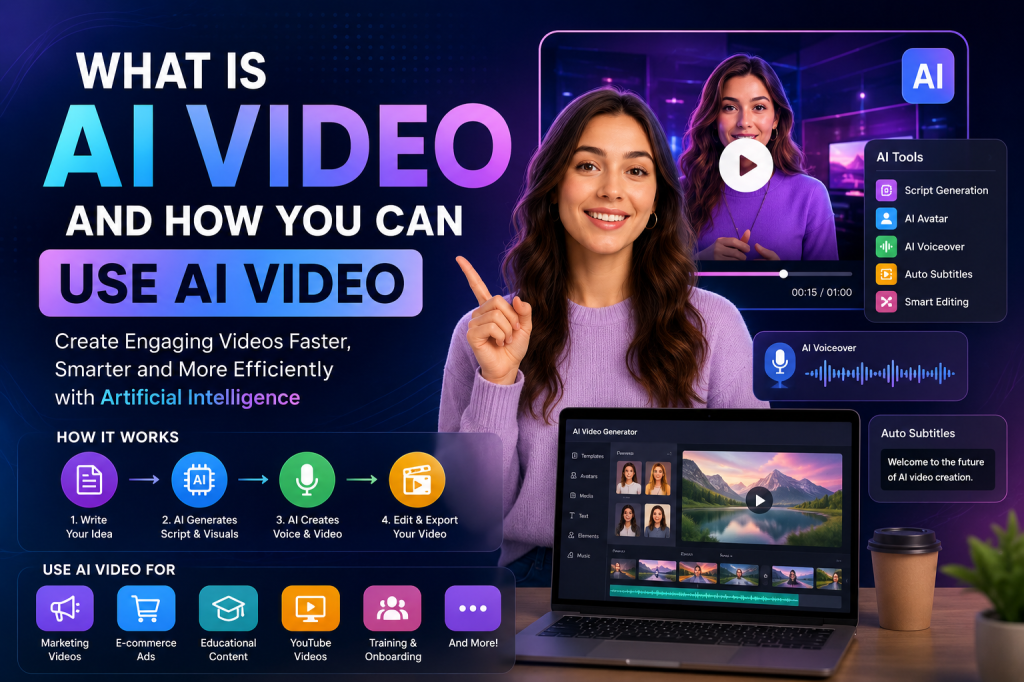
The internet is changing rapidly, and video content has become the most powerful way to communicate online. Whether you scroll through TikTok, Instagram Reels, YouTube Shorts, Facebook, LinkedIn, or e-commerce websites, you will notice that videos dominate almost every platform. Businesses, creators, influencers, educators, and marketers are all competing for attention through engaging video content. However, traditional video production is often expensive, time-consuming, and difficult for beginners. This is where AI Video generation is completely transforming the digital world.
Artificial intelligence has made it possible for anyone to create professional-quality videos without requiring advanced editing skills or expensive production equipment. Modern AI tools can now generate scripts, realistic voiceovers, subtitles, AI avatars, animations, transitions, product showcases, and even complete videos from simple text prompts. What previously required an entire production team can now be done by one person using AI-powered software.
The rise of AI Video generation is not just a temporary trend. It is becoming one of the biggest shifts in digital marketing, social media content creation, e-commerce advertising, and online education. Brands are using AI-generated videos to produce advertisements faster, creators are using AI to publish content consistently, and businesses are saving thousands of dollars on production costs.
Many people still have questions about how AI video technology actually works. Some wonder whether AI can completely replace traditional creators, while others want to know how beginners can start using these tools effectively. In this detailed guide, you will learn everything about AI Video generation, including how it works, why it is growing rapidly, how businesses are using it, its advantages and limitations, and how you can use AI-powered video tools for your own projects.
What is AI Video?
AI video refers to any video that is created, edited, enhanced, or generated using artificial intelligence technology. Instead of relying fully on manual production methods, AI automates many of the tasks involved in video creation. These tasks can include script generation, video editing, voiceovers, scene generation, animation, subtitle creation, lip synchronization, and realistic avatar presentation.
Traditional video production usually involves cameras, actors, editors, lighting, audio equipment, and multiple stages of post-production work. AI Video generation simplifies much of this process by using machine learning and generative AI systems to automate repetitive and complex tasks.
For example, if someone wants to create a product advertisement, they can simply enter a prompt like:
“Create a 30-second skincare advertisement featuring a young female creator explaining product benefits.”
The AI tool can automatically generate:
- A complete marketing script
- Human-like voiceovers
- A realistic AI avatar
- Product scenes and transitions
- Captions and subtitles
- Background music
- Social-media-friendly formatting
This level of automation is changing how digital content is created across industries.
AI Video generation is becoming especially popular because modern consumers prefer video content over text. Research consistently shows that videos improve engagement, retention, and conversions compared to static content. AI makes video production more accessible, allowing businesses and creators to meet the growing demand for visual content at scale.
How AI Video Generation Works
AI Video generation may seem magical at first, but behind the scenes, several advanced technologies work together to create video content. Artificial intelligence systems are trained using massive datasets containing videos, audio clips, animations, facial expressions, speech patterns, and editing styles. These datasets help AI models learn how humans communicate visually and verbally.
One of the most important technologies involved in AI video creation is Natural Language Processing, often called NLP. NLP allows AI systems to understand written instructions and prompts. When a user types a command like “Generate a fitness motivation video for Instagram,” the AI analyzes the request and identifies the purpose, tone, visual style, and intended audience.
Machine learning models are another critical component of AI Video generation. These models learn from millions of video examples and gradually improve their ability to generate realistic visuals and animations. The more advanced the AI system becomes, the better it understands movement, storytelling, scene composition, and editing patterns.
Computer vision technology also plays a major role. Computer vision allows AI to analyze visual elements such as faces, objects, body movement, backgrounds, and lighting. This technology helps create realistic AI avatars, background removal effects, motion tracking, and automated scene transitions.
Generative AI models are perhaps the most exciting part of modern AI video systems. These models can generate entirely new images, animations, and video sequences from scratch. Instead of simply editing existing footage, generative AI creates original content based on prompts and learned visual patterns.
The combination of these technologies allows AI tools to create videos much faster than traditional production methods.
Why AI Video Generation is Becoming So Popular
The explosive growth of AI Video generation is happening for several reasons. One of the biggest factors is the increasing demand for short-form video content. Platforms like TikTok, Instagram Reels, and YouTube Shorts have completely changed how audiences consume information online. Businesses and creators now need large amounts of engaging video content to stay relevant.
Creating videos manually every day is difficult and expensive. AI solves this problem by making content production faster and more scalable. Instead of spending days filming and editing, marketers can create multiple video variations within minutes.
Another major reason AI video tools are growing rapidly is cost reduction. Traditional video production often requires cameras, lighting equipment, editing software, actors, voice artists, and professional editors. AI dramatically reduces these costs by automating most production tasks.
Small businesses especially benefit from AI Video generation because it allows them to compete with larger companies that previously had bigger production budgets. A startup can now create professional-looking advertisements and social media videos without hiring a full production team.
Speed is another important factor. Social media trends change quickly, and brands need to react fast. AI tools allow businesses to create content rapidly while trends are still relevant. This speed gives companies a major competitive advantage in digital marketing.
AI-powered personalization is also driving adoption. Brands can create customized videos for different audiences, languages, locations, and demographics without starting from scratch every time. Personalized content often improves engagement and conversion rates significantly.
Types of AI Video Generation
AI Video generation is not limited to one specific format. Different tools specialize in different styles of content creation, and understanding these categories can help businesses choose the right platform for their needs.
One of the most popular categories is text-to-video generation. These tools allow users to type descriptions, and the AI creates corresponding video scenes automatically. This technology is rapidly improving and becoming more cinematic every year.
AI avatar videos are another major category. These tools create realistic digital humans capable of speaking scripts naturally. Businesses often use AI avatars for product demos, corporate training, educational content, customer support videos, and marketing campaigns.
AI UGC Video generation has become one of the fastest-growing trends in ecommerce advertising. These tools create user-generated-content style videos that resemble influencer or creator content. AI-generated UGC ads often perform extremely well because they feel more authentic and relatable than traditional polished commercials.
AI editing tools focus on automating repetitive post-production tasks. These systems can remove silence, generate subtitles, improve audio quality, add transitions, crop clips, and optimize videos for different platforms automatically.
AI animation tools are also becoming increasingly powerful. These platforms generate animated videos, explainer content, motion graphics, and 3D scenes using artificial intelligence.
Each category serves different purposes, and many modern platforms combine multiple AI capabilities into one system.
How Businesses Use AI Video Generation
Businesses across industries are finding creative ways to use AI Video generation to improve marketing, communication, and customer engagement. Ecommerce brands are among the biggest adopters because AI-generated videos help them create product advertisements quickly and cost-effectively.
Online stores use AI-generated videos for product showcases, customer testimonials, unboxing videos, and TikTok-style advertisements. Since social media advertising requires constant creative testing, AI helps brands produce multiple ad variations without expensive production cycles.
Digital marketers are using AI Video generation to improve campaign performance. Instead of relying on one or two advertisements, marketers can generate dozens of variations with different hooks, scripts, calls-to-action, and visual styles. This allows faster A/B testing and optimization.
Educational platforms are also benefiting from AI video technology. Teachers and online educators can create tutorials, lessons, explainers, and multilingual training content using AI avatars and automated editing systems. This makes online education more scalable and accessible.
Corporate companies use AI videos for onboarding, employee training, internal communication, and presentations. AI-generated training videos save organizations significant time and resources.
Real estate businesses are creating AI-powered property walkthroughs and promotional videos. Healthcare organizations use AI-generated educational videos to explain medical concepts, treatment plans, and wellness tips.
The flexibility of AI Video generation makes it useful across nearly every industry.
Advantages of AI Video Generation
One of the biggest benefits of AI Video generation is efficiency. AI dramatically reduces the time required to create high-quality video content. What once took days or weeks can now be completed within minutes or hours.
Cost reduction is another major advantage. Businesses no longer need large production teams, expensive cameras, studios, or professional editors for every project. AI automation lowers production costs while maintaining professional output quality.
Scalability is perhaps the most valuable advantage for marketers. AI allows brands to create multiple versions of advertisements quickly. This ability is extremely important in performance marketing, where testing different creatives can significantly improve results.
AI video tools also support multilingual content creation. Brands can generate voiceovers and subtitles in different languages, helping them reach international audiences more effectively.
Accessibility improves as well. AI-generated captions and subtitles make content easier to consume for viewers watching without sound or for users with hearing impairments.
Another important advantage is ease of use. Many modern AI platforms are designed for beginners and do not require advanced editing experience. This democratizes content creation and allows more people to participate in digital marketing and media production.
Challenges and Limitations of AI Video Generation
Despite its advantages, AI Video generation still has limitations. Some AI-generated videos may appear unrealistic or robotic, especially if the platform lacks advanced rendering capabilities. Poor facial expressions, unnatural movements, or robotic voiceovers can reduce audience trust.
Creativity is another challenge. While AI can automate production tasks, it still struggles with emotional storytelling and deeply human creative concepts. Human creativity remains essential for compelling narratives and authentic emotional connection.
Ethical concerns also exist. Deepfake technology and AI-generated misinformation have raised serious questions about authenticity and digital manipulation. Responsible AI usage is becoming increasingly important as these tools become more advanced.
Copyright and licensing issues are another challenge. Some AI systems are trained on publicly available data, which creates debates around ownership and originality.
Additionally, AI-generated content quality depends heavily on prompt quality. Users must learn how to provide clear and effective instructions to achieve strong results.
Even with these limitations, AI Video generation continues improving rapidly every year.
The Future of AI Video Generation
The future of AI Video generation looks incredibly promising. AI systems are becoming more realistic, creative, and efficient at an astonishing pace. In the coming years, AI-generated videos may become nearly indistinguishable from traditionally produced content.
Future AI tools are expected to generate:
- Fully cinematic scenes
- Realistic emotions
- Interactive storytelling
- Personalized advertising
- Virtual actors
- AI influencers
- Dynamic video experiences
Brands will likely use AI to create highly customized advertisements tailored to individual users in real time. Imagine ecommerce websites generating personalized product videos instantly based on user preferences and shopping behavior.
The entertainment industry is also exploring AI-generated films, animations, and virtual production environments. Social media platforms will continue driving demand for scalable short-form video content, making AI tools even more valuable.
Businesses that adopt AI Video generation early may gain significant advantages in content speed, scalability, and marketing efficiency.
How Tagshop AI Supports AI Video Generation
Modern brands need fast, scalable, and engaging content creation systems to compete in digital marketing. Tagshop AI helps businesses streamline video content production, especially for social media advertising and AI-powered UGC-style campaigns.
The platform supports brands looking to create engaging creator-style content optimized for platforms like TikTok, Instagram Reels, and YouTube Shorts. By simplifying production workflows, businesses can focus more on creative testing and performance optimization instead of complex editing processes.
As AI Video generation continues growing, platforms focused on scalable content creation will become increasingly valuable for marketers and ecommerce brands.
Final Thoughts
AI Video generation is transforming how digital content is created, distributed, and consumed. Artificial intelligence has made video production faster, cheaper, and more accessible than ever before. Businesses, creators, educators, and marketers can now create high-quality video content without requiring large budgets or advanced technical expertise.
The rise of short-form video platforms has accelerated demand for scalable content production, and AI is solving this challenge effectively. From AI-generated avatars and text-to-video systems to automated editing and UGC-style advertisements, artificial intelligence is reshaping the future of media creation.
Although AI still has limitations, its capabilities are improving rapidly. Human creativity remains essential, but AI acts as a powerful tool that enhances efficiency and scalability.
Companies that learn how to use AI Video generation strategically will gain significant advantages in digital marketing, audience engagement, and content production. As technology continues evolving, AI-generated videos will become an even bigger part of the online world.
FAQs About AI Video Generation
1. What is AI Video generation?
AI Video generation is the process of creating videos using artificial intelligence tools that automate scripting, editing, animations, voiceovers, subtitles, and visual production. These tools help creators and businesses make videos faster without traditional production setups.
2. How does AI Video generation work?
AI Video generation works using machine learning, computer vision, natural language processing, and generative AI models. The AI analyzes prompts, scripts, or images and converts them into video content automatically.
3. Can AI create videos from text prompts?
Yes, modern AI tools can generate videos directly from text prompts. Users simply describe the scene or video idea, and the AI creates visuals, animations, voiceovers, and transitions based on the instructions.
4. What are the best uses of AI Video generation?
AI Video generation is commonly used for:
- Social media videos
- AI UGC ads
- Product demos
- Explainer videos
- YouTube content
- Training videos
- E-commerce advertisements
- Educational tutorials
5. Is AI Video generation good for marketing?
Yes, AI Video generation is becoming one of the most effective tools for digital marketing because it allows brands to create high-volume, engaging video content quickly and cost-effectively.
6. Can beginners use AI Video generation tools?
Absolutely. Most modern AI video platforms are beginner-friendly and designed for users without professional editing skills or video production experience.
7. What is AI UGC Video generation?
AI UGC Video generation refers to creating user-generated-content style videos using AI avatars, AI voiceovers, and automated editing systems that imitate real creators and influencers.
8. Are AI-generated videos realistic?
Many advanced AI-generated videos are highly realistic, especially AI avatar videos and cinematic AI-generated scenes. However, quality varies depending on the platform being used.
9. What industries use AI Video generation the most?
Industries actively using AI Video generation include:
- Ecommerce
- Marketing
- Education
- Real estate
- Healthcare
- SaaS
- Entertainment
- Corporate training
10. Can AI Video generation replace video editors?
AI can automate many repetitive editing tasks, but human creativity, storytelling, and strategic direction are still extremely important in professional video production.
11. Is AI Video generation expensive?
AI Video generation is usually much cheaper than traditional video production because it reduces the need for cameras, actors, studios, editors, and production teams.
12. Which social media platforms work best with AI-generated videos?
AI-generated videos perform especially well on:
- TikTok
- Instagram Reels
- YouTube Shorts
- Facebook Ads
- LinkedIn video content
- Snapchat Spotlight
13. Can AI generate voice-overs automatically?
Yes, many AI video tools can generate realistic human-like voiceovers in multiple languages, accents, and tones.
14. What is the future of AI Video generation?
The future of AI Video generation includes more realistic avatars, cinematic AI scenes, personalized videos, AI influencers, automated storytelling, and interactive video experiences.
15. How do businesses use AI Video generation?
Businesses use AI-generated videos for advertising, product demonstrations, customer education, social media campaigns, e-commerce marketing, onboarding, and brand storytelling.
16. Can AI-generated videos rank on Google and YouTube?
Yes, AI-generated videos can rank well on Google and YouTube when combined with strong SEO strategies, engaging storytelling, optimized titles, descriptions, and audience retention.
17. Are AI-generated videos allowed on YouTube?
Yes, YouTube allows AI-generated videos as long as they follow platform guidelines and do not violate spam, misinformation, or copyright policies.
18. What are the benefits of AI Video generation for e-commerce brands?
AI Video generation helps e-commerce brands create scalable ad creatives, product showcases, UGC-style ads, and personalised marketing videos while reducing production costs.
19. Can AI Video generation help content creators grow faster?
Yes, AI tools help creators publish content consistently, automate editing workflows, create Shorts and Reels quickly, and save time during production.
20. Which AI Video generation tool is best for AI UGC ads?
The best AI Video generation tool depends on your goals, but platforms focused on realistic avatars, social media optimization, and creator-style video workflows are usually the most effective for AI UGC ads.


Leave a comment