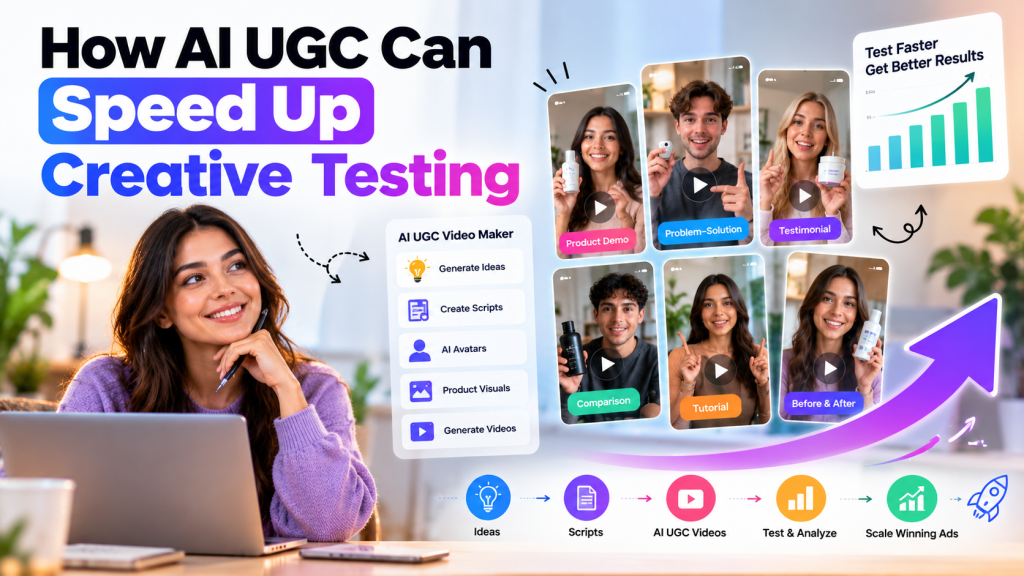
Creative testing is one of the most important parts of modern digital advertising. A brand can have a great product, a strong landing page, and a well-defined audience, but if the advertising creative does not capture attention, the campaign may struggle to generate results.
The challenge is that traditional creative testing can be slow.
Marketers need to brainstorm concepts, write scripts, find creators, record videos, edit content, create different variations, launch campaigns, and analyze performance. By the time several variations are ready, the market may already have moved on to a new trend or messaging angle.
This is where an AI UGC Video Maker can change the creative testing process.
AI-powered UGC tools allow marketers to create creator-style videos, experiment with different hooks, test multiple messages, and produce creative variations without starting every production cycle from scratch.
Instead of spending weeks creating a small number of UGC assets, brands can use AI to increase the number of concepts they can test and learn from.
What Is Creative Testing?
Creative testing is the process of creating and comparing different advertising assets to understand which messages, formats, hooks, visuals, or calls to action perform better with a target audience.
For example, an ecommerce brand could create five versions of the same product advertisement.
One video could focus on the product’s price.
Another could highlight a common customer problem.
A third could demonstrate the product.
A fourth could use a testimonial-style approach.
The fifth could focus on a specific product benefit.
The objective is not simply to create more advertisements. It is to identify which creative elements generate stronger engagement and conversions.
This makes creative testing an ongoing process rather than a one-time campaign activity.
Why Traditional Creative Testing Can Be Slow
Traditional UGC production involves several steps.
First, marketers need to develop a creative concept. Then they may need to find a suitable creator, negotiate pricing, send a product, prepare a brief, write or approve a script, and wait for the creator to record the content.
After recording, the video may require editing and revisions.
If a marketer wants five different versions, much of this process may need to be repeated.
This creates a production bottleneck.
Even when a brand knows that testing multiple creatives is important, producing enough variations can require significant time and resources.
An AI UGC Video Maker can reduce some of these production barriers by allowing marketers to generate new video concepts and variations much faster.
How an AI UGC Video Maker Speeds Up Testing
AI can accelerate several stages of the creative testing workflow.
Instead of treating video creation as a single task, marketers can use AI throughout the process, from ideation and scripting to video generation and editing.
1. Generate More Creative Ideas
Creative testing starts with ideas.
AI can help marketers brainstorm different angles for the same product or campaign.
For example, a skincare product could be promoted through:
- Problem-focused content
- Before-and-after storytelling
- Product demonstrations
- Customer-style reviews
- Educational videos
- Frequently asked questions
- Founder-style messaging
- Trend-based concepts
- Comparison videos
Rather than spending hours brainstorming each concept manually, marketers can quickly generate a larger creative testing pool.
The human marketer still decides which ideas are relevant, but AI can make the ideation stage faster.
2. Test Multiple Hooks
The first few seconds of a social video can strongly influence whether someone continues watching.
That makes hooks particularly important for creative testing.
An AI UGC Video Maker can help create multiple introductions for the same core advertisement.
For example:
Hook 1:
“I wish I had discovered this sooner.”
Hook 2:
“If you’re struggling with this, try this.”
Hook 3:
“Here’s what changed everything for me.”
Hook 4:
“I didn’t expect this product to work this well.”
The main product message can remain similar while the opening changes.
This allows marketers to test whether a different hook improves viewer retention and engagement.
3. Create Multiple Scripts Faster
Writing individual scripts for every creative variation can become repetitive.
AI can help marketers create multiple script versions based on a single creative brief.
A marketer could provide the product information, target audience, key benefit, tone, and CTA. The AI can then generate several UGC-style script variations.
For example, one script could sound like a personal recommendation, another could focus on education, and another could use a problem-solution structure.
This makes it easier to test messaging without creating every script from scratch.
4. Experiment With Different Presenters
Traditional UGC campaigns usually require different creators for different personalities and styles.
AI-generated presenters and avatars can provide another way to experiment.
Marketers can test different presenter styles, appearances, voices, and delivery approaches to understand which creative presentation resonates with their audience.
This does not mean that AI should completely replace real creators.
Instead, AI can complement traditional UGC by giving marketers another production option for experimentation and variation.
5. Produce More Video Variations
Creative fatigue is a common challenge for advertisers.
When audiences repeatedly see the same advertisement, engagement can decline over time.
Creating fresh variations helps marketers maintain a larger creative library.
An AI UGC Video Maker makes this easier because marketers can adapt an existing concept into multiple variations.
For example, one winning concept could be transformed into:
- A 15-second version
- A 30-second version
- A testimonial version
- A product demonstration
- A problem-solution video
- A different hook
- A different CTA
- A different presenter
The underlying idea remains the same, but the creative execution changes.
6. Test Different CTAs
The call to action is another element that can be tested.
A video might end with:
“Shop now.”
Another could say:
“Try it today.”
A third might encourage users to:
“Learn more.”
Although the difference seems small, different CTAs can influence how viewers respond to an advertisement.
AI can make it easier to create these variations without rebuilding the entire video from the beginning.
7. Localize Creative Testing
Brands operating across multiple markets often need localized advertising content.
Creating traditional UGC for every language and region can be expensive and time-consuming.
AI can help marketers adapt scripts, voiceovers, presenters, and messaging for different markets.
For example, a brand could take a successful UGC concept and create localized versions for English-speaking, European, or Asian audiences.
Localization can expand the number of creative tests a brand can run across different markets.
However, localization should go beyond literal translation. Cultural context, expressions, pacing, and audience expectations should also be considered.
AI UGC Makes Iteration Faster
The biggest benefit of AI for creative testing may be iteration.
Traditional production often follows this pattern:
Create → Publish → Wait → Analyze → Create Again
AI can shorten the cycle:
Create → Test → Analyze → Modify → Test Again
The faster this feedback loop becomes, the more opportunities marketers have to learn.
Suppose an advertisement performs well because viewers respond strongly to its opening hook.
Instead of creating an entirely new campaign, the marketer can create several variations around that winning concept.
This creates a continuous creative optimization process.
What Should You Test With AI UGC?
Not every test needs to involve an entirely new video.
In fact, testing individual creative elements can often provide more useful insights.
Marketers can experiment with:
Hooks
Test different opening statements and attention-grabbing concepts.
Scripts
Compare educational, testimonial, storytelling, and product-focused messaging.
Presenters
Test different AI avatars, creators, voices, or presentation styles.
Visuals
Compare product demonstrations, lifestyle footage, screen recordings, and close-ups.
Video Length
Test short-form and longer versions of the same concept.
Captions
Experiment with different caption styles and messaging.
CTAs
Compare action-oriented calls to action.
Offers
Test different promotions, discounts, bundles, or value propositions.
The more systematically these variables are tested, the easier it becomes to understand what influences campaign performance.
Measuring the Results of Creative Testing
Creating more content is only valuable when marketers learn from the results.
The exact metrics will depend on the campaign objective, but several measurements can be useful.
Hook or thumb-stop rate can help indicate whether the opening captures attention.
Video watch time can show whether viewers remain engaged.
Completion rate can indicate how many people watch most or all of the video.
Click-through rate (CTR) can show whether the creative encourages users to visit the next step.
Conversion rate can help determine whether the traffic generated by the creative turns into desired actions.
Cost per acquisition (CPA) can help marketers evaluate advertising efficiency.
The important point is to look beyond views.
A video may receive many views but produce few conversions, while another creative may receive fewer views but generate stronger purchasing intent.
Creative testing should therefore connect content performance with the actual campaign objective.
Avoid Creating AI Content Just for Volume
There is one important mistake marketers should avoid.
AI makes it easy to create more videos, but more content does not automatically mean better marketing.
Generating hundreds of nearly identical videos can make testing less useful.
The goal should be meaningful variation.
For example, changing a few words in a script may not create a meaningful creative test.
Changing the hook, storytelling structure, presenter, visual approach, and CTA can produce a much more informative comparison.
AI should increase the quality and speed of experimentation—not simply increase the number of files in your content library.
Combining AI UGC With Human Strategy
AI can accelerate production, but marketers still need to provide strategy.
A successful AI UGC campaign requires an understanding of:
- The target audience
- Customer pain points
- Product benefits
- Brand positioning
- Platform behavior
- Creative trends
- Campaign objectives
- Performance data
AI can help execute ideas, but humans still need to decide which ideas are worth testing.
This combination can make the creative process more efficient.
The marketer develops the strategy, AI helps produce variations, and campaign data determines what should be tested next.
The Future of AI-Powered Creative Testing
As AI video technology continues to develop, creative testing is likely to become increasingly iterative.
Instead of producing a small number of advertisements and running them for long periods, brands may continuously generate and evaluate new creative concepts.
An AI UGC Video Maker can become part of this workflow by helping marketers move from a creative idea to a finished video more quickly.
The future is not necessarily about replacing every human creator.
It is about giving marketing teams more ways to experiment.
Brands could combine real creator content, AI-generated UGC, product demonstrations, AI avatars, customer testimonials, and traditional brand advertisements within the same creative testing strategy.
This creates a broader creative ecosystem.
Final Thoughts
Creative testing has always been about learning.
The problem is that producing enough content to test can be slow, expensive, and operationally difficult.
AI UGC changes that equation.
With an AI UGC Video Maker, marketers can brainstorm more concepts, generate multiple scripts, experiment with different hooks, test presenters, create video variations, localize content, and iterate more quickly.
The most valuable advantage is not simply speed.
It is the ability to create a faster feedback loop between creative production and marketing performance.
Instead of spending most of the campaign cycle waiting for new content, teams can spend more time testing ideas and learning what their audience responds to.
The winning approach is to combine AI’s production speed with human creativity, strategic thinking, and performance analysis.
When used this way, AI UGC can turn creative testing from a slow production process into a continuous experimentation engine.
And for brands competing for attention across TikTok, Instagram, YouTube, Meta, and other social platforms, the ability to test and iterate faster can become an important part of a modern creative strategy.


Leave a comment