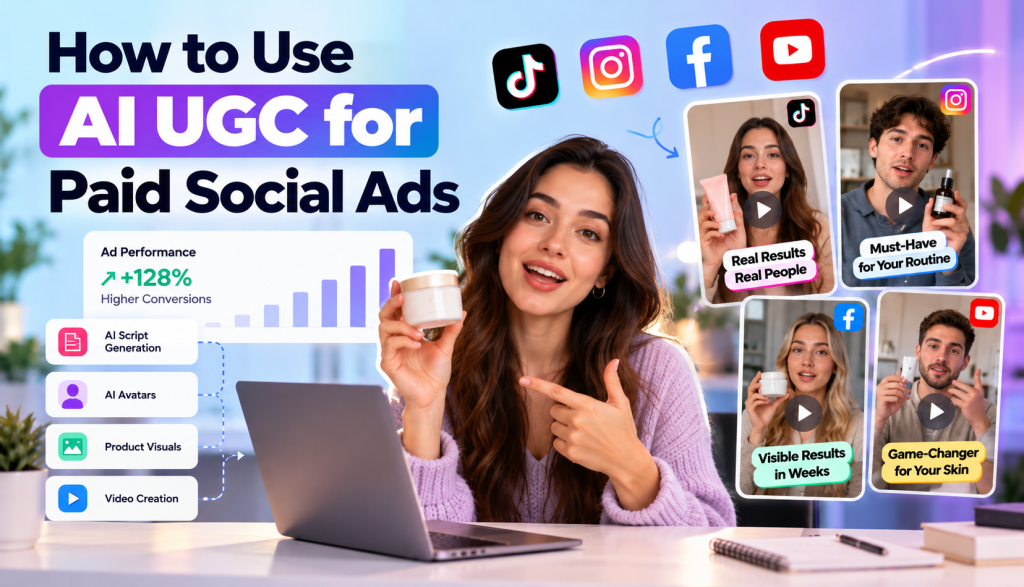
Paid social advertising has become one of the most important ways for brands to reach potential customers online. Platforms such as TikTok, Instagram, Facebook, and YouTube allow businesses to reach highly targeted audiences, but standing out in crowded feeds has become increasingly difficult.
Traditional polished advertisements do not always capture attention in the same way as authentic, creator-style content. This is one reason why user-generated content (UGC) has become so popular in paid advertising.
However, producing traditional UGC at scale can be time-consuming. Brands need to find creators, negotiate partnerships, send products, coordinate recordings, review footage, and create multiple versions for different campaigns.
This is where AI UGC for social media can help.
AI-powered UGC tools allow marketers to create creator-style videos using AI avatars, AI voices, automated scripts, product visuals, and video editing features. Instead of relying entirely on traditional production, businesses can use artificial intelligence to create, test, and scale social ad creatives more efficiently.
In this guide, we’ll explain what AI UGC is, how to use AI UGC for paid social ads, how to create high-performing AI UGC ads, and the best practices marketers should follow.
What Is AI UGC for Social Media?
AI UGC for social media refers to user-generated-content-style videos and creatives created with the help of artificial intelligence.
Traditional UGC typically comes from real customers or creators who record themselves talking about a product or service. AI UGC uses technologies such as AI avatars, synthetic voices, automated scripting, AI video generation, and product visualization to create similar creator-style content.
The objective is to reproduce the characteristics that make UGC effective:
- Conversational storytelling
- Relatable presentation
- Product demonstrations
- Personal recommendations
- Short-form video formats
- Strong hooks
- Social proof
- Clear calls to action
AI UGC can be particularly useful for paid social advertising because marketers often need multiple creative variations to test different audiences and messages.
For example, an ecommerce brand could create several versions of the same product advertisement using different hooks, AI creators, scripts, product benefits, and calls to action.
Why Use AI UGC for Paid Social Ads?
Paid social campaigns depend heavily on creative performance. Even with precise targeting, a campaign may struggle if the advertisement does not capture attention or communicate value quickly.
AI UGC can help solve several creative production challenges.
Faster Creative Production
Traditional UGC production can take days or weeks. Finding creators, sending products, organizing shoots, editing videos, and requesting revisions all add time to the workflow.
An AI UGC video can be created much faster.
Marketers can generate a script, select an AI avatar, add product visuals, create a voiceover, and produce a video without coordinating a complete physical production process.
This makes it easier to respond quickly to trends, product launches, seasonal campaigns, and changing advertising strategies.
More Creative Variations
Paid social advertising requires experimentation.
A brand may want to test:
- Different hooks
- Different creators
- Different product benefits
- Different offers
- Different CTAs
- Different video lengths
- Different visual styles
- Different audience segments
Creating all of these variations through traditional UGC can become expensive and complicated.
AI UGC makes creative variation much easier.
Scalable Advertising Content
When a campaign starts performing well, brands often want more variations of the winning creative.
Instead of creating a completely new production for every variation, marketers can use an AI UGC video maker to modify the script, avatar, hook, product presentation, or CTA.
This allows teams to build larger creative libraries for their paid social campaigns.
Which Social Platforms Can Use AI UGC Ads?
AI UGC can be adapted for most major social advertising platforms.
TikTok
TikTok is strongly focused on short-form, native-looking video content.
AI UGC ads can use creator-style storytelling, quick hooks, captions, product demonstrations, and conversational messaging.
Vertical videos are particularly suitable for TikTok because they occupy most of the mobile screen.
Instagram Reels and Stories are also useful environments for AI UGC.
Brands can create short product demonstrations, testimonial-style videos, educational clips, and direct-response advertisements.
AI UGC can help businesses create multiple creative variations without producing every video from scratch.
Facebook remains useful for ecommerce, lead generation, retargeting, and other advertising campaigns.
AI UGC videos can be used in feeds, Stories, and other placements, depending on the campaign structure.
Because Facebook audiences can vary significantly by age and interest, brands can experiment with different AI avatars and messaging styles.
YouTube Shorts
YouTube Shorts provides another opportunity to distribute short-form UGC-style advertising content.
Brands can adapt existing vertical AI UGC videos for Shorts while adjusting the messaging and creative approach to match the platform.
How to Create AI UGC Ads for Paid Social
Creating an AI UGC ad does not have to be complicated. A structured workflow can help marketers move from an initial product idea to a finished advertisement.
Step 1: Define Your Campaign Objective
Before creating the video, decide what you want the advertisement to accomplish.
Your objective could be:
- Increase product sales
- Generate leads
- Drive website traffic
- Increase app installs
- Generate free trials
- Build product awareness
- Promote a limited-time offer
Your objective should influence the script, visuals, and CTA.
For example, an awareness ad may focus on explaining a problem, while a conversion-focused advertisement may emphasize product benefits, social proof, pricing, and a direct CTA.
Step 2: Identify Your Target Audience
The next step is understanding who should see your advertisement.
Consider:
- Age group
- Interests
- Pain points
- Buying behavior
- Product awareness
- Common objections
- Desired outcome
The more specific your audience understanding, the more relevant your AI UGC content can become.
Instead of creating one generic video, consider creating different versions for different audience segments.
Step 3: Create a Strong Hook
The first few seconds of a paid social advertisement are extremely important.
A strong hook gives viewers a reason to continue watching.
Examples include:
Problem-focused hook:
“Still spending hours creating product videos?”
Curiosity hook:
“I found a much faster way to create ads.”
Benefit-focused hook:
“You can turn a product page into a video ad in minutes.”
Experience-focused hook:
“I tried this AI video tool for my ecommerce store, and here’s what happened.”
The hook should be relevant to the audience rather than simply trying to create shock or clickbait.
Step 4: Build the UGC Script
A simple AI UGC ad structure can look like this:
Hook → Problem → Solution → Product Benefits → Proof → CTA
For example:
“Creating social ads for every product used to take me hours. Then I started using an AI UGC video maker. I can now turn product information into creator-style videos, test multiple hooks, and create different versions for social campaigns. If you want to produce more ad creatives without increasing your production workload, check it out.”
The exact script should be adapted to the product and target audience.
Step 5: Select an AI Creator or Avatar
Choose an AI avatar that fits your target audience and brand.
For example, a fashion brand targeting younger consumers may use a casual creator-style avatar, while a B2B software company may choose a more professional presenter.
The avatar should feel consistent with the campaign.
Do not choose an avatar simply because it looks impressive. Consider whether the person, presentation style, voice, and tone make sense for your audience.
Step 6: Add Product Visuals
The product should remain central to the advertisement.
Depending on your campaign, you can include:
- Product images
- Product demonstrations
- Screen recordings
- Website screenshots
- Product packaging
- Before-and-after visuals
- Lifestyle imagery
- AI-generated product shots
For ecommerce brands, product visuals can help viewers understand exactly what is being promoted.
Step 7: Add Captions and Text
Captions are important for social advertising because many people consume video content without sound.
Use short text overlays to emphasize important points.
For example:
Create UGC Videos Faster
No Camera Setup Required
Generate Multiple Ad Variations
Turn Products Into Video Ads
Avoid filling the screen with too much text. The visual hierarchy should remain easy to understand on a small mobile display.
Step 8: Add a Clear CTA
Every paid social advertisement should provide a logical next step.
Depending on the campaign, your CTA could be:
- Shop Now
- Learn More
- Try It Free
- Get Started
- Sign Up
- Download Now
- See How It Works
The CTA should match the campaign objective.
How to Optimize AI UGC Ads for Better Performance
Creating an advertisement is only the beginning. Optimization is what helps marketers identify which creative concepts work best.
Test Multiple Hooks
Instead of producing one video and using it everywhere, create multiple versions with different openings.
For example:
Version A: Focuses on a pain point.
Version B: Focuses on a product benefit.
Version C: Uses a curiosity-driven opening.
Version D: Uses a customer problem or common question.
Keep other variables relatively consistent when testing hooks so that you can better understand what is influencing performance.
Test Different Creators
The same message can perform differently depending on who presents it.
Experiment with different AI avatars, voices, presentation styles, and demographics where appropriate.
This can help you identify which creator style resonates with a particular audience.
Experiment With Video Length
Not every product needs the same video length.
Short advertisements may work well for simple products, while more complex software or services may need additional time to explain the value proposition.
Test different lengths while keeping the core message clear.
Test Different CTAs
Your CTA can also affect campaign performance.
For example, an ecommerce advertisement may use “Shop Now,” while a SaaS advertisement could use “Start Free.”
Test CTAs that match the user’s stage in the buying journey.
AI UGC Ads vs Traditional UGC Ads
Traditional UGC and AI UGC can both be valuable for paid social campaigns, but they have different production characteristics.
Traditional UGC involves real creators recording real content. This can provide genuine personal experiences, real product interactions, and authentic testimonials.
AI UGC provides greater production flexibility. Brands can create videos without coordinating every shoot with a human creator and can generate variations quickly.
Traditional UGC may be particularly useful when genuine customer experiences are central to the campaign.
AI UGC can be useful when brands need scalable creative production, rapid testing, localization, or frequent variations.
Many marketing teams can use both approaches as part of the same creative strategy.
Using AI UGC for Ecommerce Advertising
Ecommerce businesses can benefit significantly from AI UGC for social media because product advertising requires a continuous supply of fresh creative.
A single product can be promoted using several different creative angles.
For example, a skincare product could have:
- A problem-focused video
- A product demonstration
- A routine-style video
- A benefit-focused advertisement
- A comparison video
- A testimonial-style creative
- A limited-time offer
- A frequently-asked-question video
AI can make it easier to create these variations from the same product information.
Some AI platforms also support URL-to-video workflows, where marketers provide a product URL and the system uses information from the product page to help create video content.
This can be particularly useful for stores with many products.
AI UGC for Social Media With Tagshop AI
Platforms such as Tagshop AI are designed to help marketers create AI-powered video content for advertising and social media campaigns.
Tagshop AI combines several AI creative capabilities, including AI Video Agent, AI Ad Clone, URL-to-Video, AI Twin, AI avatars, AI voice generation, and AI video editing.
The AI Video Agent can help users create video content through a conversational workflow. Instead of manually managing every stage, marketers can describe the video they want and use AI assistance throughout the creative process.
With AI Ad Clone, marketers can use an existing Meta or TikTok advertisement as a creative reference and recreate its overall structure for their own brand, adapting the messaging and product information.
The URL-to-Video workflow can help turn product pages into video creative by using product information and visuals as inputs.
The AI Twin feature can also allow creators and marketers to develop a digital version of themselves for content production.
These capabilities can be useful for brands that need to create multiple AI UGC videos for paid campaigns while reducing repetitive production work.
Common Mistakes When Using AI UGC for Paid Ads
AI can make video production easier, but marketers should still avoid several common mistakes.
Making the Video Too Promotional
UGC-style content should feel conversational.
If every sentence sounds like a traditional advertisement, viewers may immediately recognize the promotional intent.
Focus on the audience’s problem and explain how the product helps solve it.
Using Weak Hooks
A beautiful video will not compensate for a weak opening.
Spend time developing several hooks before finalizing your creative.
Ignoring Product Relevance
AI-generated visuals should support the product rather than distract from it.
Make sure product names, features, pricing, and claims are accurate.
Creating Generic Content
The best AI UGC ads are built around specific audiences and problems.
Avoid creating one generic video for everyone.
Failing to Test
Do not assume that the first creative will be the best-performing one.
Create variations and use campaign data to understand which concepts generate stronger results.
Best Practices for AI UGC Social Advertising
To build a scalable AI UGC strategy, keep the following principles in mind:
Prioritize authenticity: Make scripts conversational and avoid unnecessarily polished language.
Lead with the problem: Explain a relevant pain point before presenting the product.
Show the product: Use product visuals whenever possible.
Create variations: Test hooks, creators, scripts, CTAs, and formats.
Optimize for mobile: Use vertical video and readable captions for mobile-first platforms.
Keep claims accurate: AI should never be used to create misleading product claims or fake experiences.
Match content to the platform: Adapt pacing, format, and messaging for TikTok, Instagram, Facebook, and YouTube.
Review every AI-generated video: Human review is still important before publishing paid advertisements.
The Future of AI UGC for Social Media Advertising
AI is changing how marketers approach creative production.
Instead of treating video creation as a slow, one-off production process, brands can increasingly treat creative as an ongoing testing system.
A marketer might generate multiple concepts, launch different variations, analyze performance, identify promising creative patterns, and then produce additional variations based on those insights.
AI can also make localization easier. The same campaign can potentially be adapted into different languages, voices, avatars, and messaging styles for different markets.
As AI video technology continues to develop, the distinction between creative strategy and production may become increasingly automated.
However, human creativity will remain important. AI can help produce content, but marketers still need to understand their audience, develop compelling ideas, choose the right positioning, and interpret campaign performance.
Conclusion
AI UGC for social media provides marketers with a scalable approach to creating creator-style video content for paid advertising.
By using AI avatars, AI voices, automated scripts, product visuals, editing tools, and creative automation, brands can produce more video variations without relying entirely on traditional production workflows.
The key is to use AI strategically.
Start with a clear campaign objective, understand your audience, create strong hooks, develop conversational scripts, showcase the product, add captions, and test multiple variations. Then use campaign data to identify which creative approaches deserve further investment.
For ecommerce brands, SaaS companies, agencies, creators, and performance marketers, AI UGC can become an important part of a modern paid social advertising strategy.
The goal is not simply to create more videos. It is to create more relevant, engaging, and testable creative content that helps brands communicate their value to the right audience at the right moment.


Leave a comment