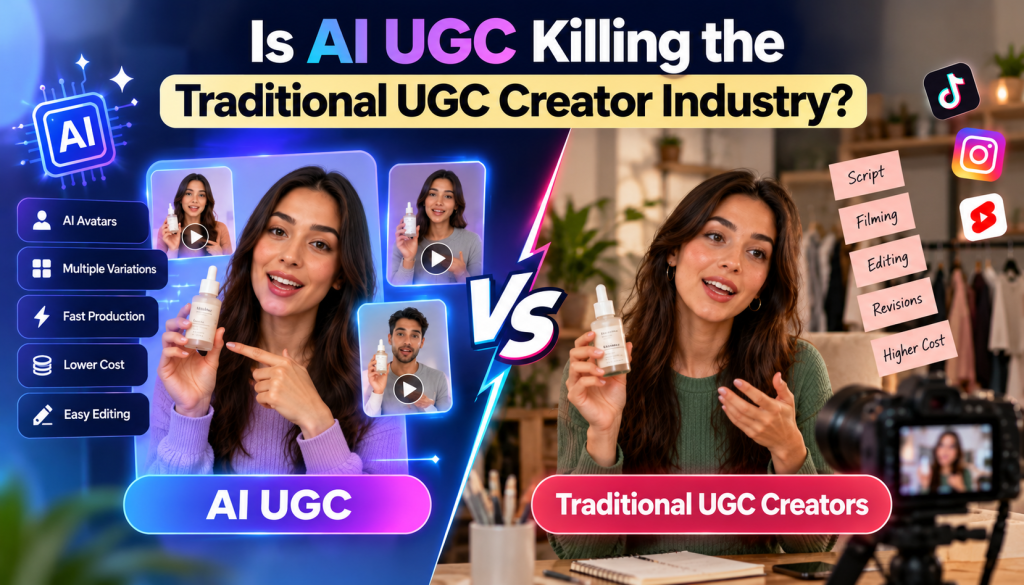
User-generated content (UGC) has become one of the most popular formats in digital marketing. Brands use creator-style videos to showcase products, explain features, share customer experiences, and connect with audiences across TikTok, Instagram Reels, YouTube Shorts, and Facebook. For years, businesses have hired UGC creators to produce relatable videos that feel more natural than traditional advertisements.
But the industry is changing rapidly.
AI-powered video creation tools now allow marketers to generate UGC-style advertisements using AI avatars, synthetic voices, automated scripts, and product images. Instead of coordinating a shoot with a human creator for every campaign, brands can produce multiple video variations using AI-powered workflows.
This raises an important question: Is AI UGC killing the traditional UGC creator industry, or is it creating a new opportunity for creators and brands?
The answer is more complicated than it might seem. AI is changing how brands produce advertising content, but it cannot automatically replace every benefit that human creators bring to a campaign. While some repetitive production tasks are becoming easier to automate, genuine experiences, creative storytelling, and trusted creator relationships remain valuable.
In this article, we will explore how AI UGC is transforming the creator economy, which tasks are most exposed to automation, what the future looks like for traditional creators, and how brands can use AI tools such as Tagshop AI to improve their video production workflows.
What Is AI UGC?
AI UGC refers to creator-style content produced with the assistance of artificial intelligence. These videos are designed to resemble the conversational, informal presentation commonly associated with user-generated content, but they may use digital presenters, generated scripts, synthetic voiceovers, or AI-assisted editing.
For example, an eCommerce brand selling skincare products might use an AI tool to create a video featuring a digital presenter introducing a moisturizer, explaining its verified features, and directing viewers to the product page.
An AI UGC video generator may also help marketers create different versions of the same advertisement. One version might focus on a product’s main benefit, another might demonstrate how it is used, and a third might address a common customer question.
The production process depends on the tool. Some platforms generate presenter-led videos, while others combine product images, voiceovers, scripts, and editing features to create advertising assets.
AI UGC can reduce the need for repeated filming, particularly when marketers need many creative variations. However, AI-generated content should not be confused with genuine customer-generated content or authentic testimonials.
If a digital presenter claims to have personally used a product when no such experience occurred, the content may mislead viewers. Brands must distinguish generated advertising from genuine customer experiences.
What Is the Traditional UGC Creator Industry?
Traditional UGC creators are people who produce brand-focused content featuring products, services, or customer experiences. Unlike influencers, who typically monetize access to their own audiences, UGC creators may be hired primarily to produce content that brands publish on their own social media accounts or use in paid advertising.
A creator might record a product unboxing, demonstrate how an item works, explain its benefits, or produce a short testimonial based on genuine experience.
The traditional UGC workflow often involves several stages:
- A brand identifies a suitable creator.
- The creator receives a brief and product information.
- The creator records the required content.
- The footage is edited and submitted for review.
- The brand requests revisions if necessary.
- The final video is published organically or used in advertising.
This process creates opportunities for creators with strong communication skills, product knowledge, video production abilities, and an understanding of advertising.
However, it can also involve challenges. Brands may need to coordinate multiple creators, manage deadlines, pay production fees, and organize additional shoots when they want to test new creative ideas.
These challenges have made AI-powered video creation attractive to businesses looking for faster and more flexible production workflows.
Why Are Brands Turning to AI UGC?
The growing interest in AI UGC is not simply about replacing people. It is also about helping marketing teams produce more content, test ideas efficiently, and adapt creative assets to different audiences.
1. Faster Video Production
Traditional UGC production depends on creator availability, filming schedules, editing, and revisions. Even a relatively simple campaign can require coordination across multiple people.
AI-powered tools can simplify several production stages. Marketers may be able to generate a script, select a digital presenter, create a video, and revise the output without arranging a new shoot for every version.
This is particularly useful for businesses that run frequent advertising campaigns or need to refresh their creative assets regularly.
However, AI-generated videos still require review. Complex scenes, inaccurate product details, unnatural movements, or poorly written scripts can create additional editing work.
2. Lower Production Costs for Certain Workflows
Hiring creators may involve content fees, product shipping, editing costs, licensing arrangements, and additional charges for revisions or usage rights.
AI tools can reduce some of these expenses when brands need many variations of relatively straightforward advertisements.
For example, a company may use an AI UGC video maker to create several versions of a product introduction rather than paying for a separate filming session for each version.
That does not mean AI is always cheaper. Subscription fees, usage credits, editing requirements, and the cost of human review must also be considered.
For campaigns that depend on genuine product experiences or specialized creative work, hiring a human creator may provide greater value.
3. Easier Creative Testing
Advertising performance depends on several factors, including the opening hook, the offer, the product, the audience, and the message.
Brands frequently test multiple versions of an advertisement to identify which creative approaches produce the strongest results.
AI UGC can make it easier to generate alternative hooks, scripts, presentation styles, and calls to action from a common starting point.
Instead of asking a creator to record an entirely new video every time a message changes, a marketing team may be able to produce several versions through an AI-powered workflow.
The main advantage is not simply generating more videos. It is making creative experimentation easier to manage.
4. Scaling Content Across Markets
Brands operating in multiple countries may need advertising content in different languages and cultural contexts.
AI-powered tools can help adapt scripts and voiceovers for different markets without necessarily requiring a separate recording for every language.
However, translation alone is not enough. Marketers must review cultural references, product claims, pronunciation, local advertising rules, and the suitability of the presentation.
Human creators remain valuable when a campaign requires local knowledge, cultural authenticity, or a recognizable regional personality.
Is AI UGC Killing Traditional UGC Creators?
The short answer is no, but it is changing the type of work brands need from creators.
AI can automate or simplify some production tasks, especially those involving repeatable scripts, standardized product presentations, and routine creative variations.
But the traditional UGC creator industry includes much more than recording a person speaking in front of a camera.
Creators can provide genuine product experiences, original concepts, storytelling, audience insights, demonstrations, and a recognizable personality. These contributions are not automatically replicated by generating a digital presenter.
The more realistic outcome is a shift in demand.
Some brands may reduce spending on repetitive, easily standardized videos. Others may continue hiring creators because real people demonstrate products more convincingly, offer distinctive perspectives, or have established relationships with specific audiences.
Creators who rely entirely on producing generic videos may face greater competition. Creators who combine authentic storytelling, strong creative strategy, and an understanding of advertising performance may be better positioned to adapt.
AI is therefore more likely to reshape parts of the industry than eliminate the entire profession.
Which UGC Creator Tasks Are Most Vulnerable to AI?
Not every part of the UGC production process is equally easy to automate.
Repetitive Product Introduction Videos
Simple videos that introduce a product, list its features, and deliver a standard call to action may be relatively easy to reproduce using AI tools.
For example, an advertisement explaining a product’s basic features might not require a unique human experience if the same information can be communicated accurately through approved product visuals and a digital presenter.
This does not mean every product introduction should be automated. The effectiveness of AI depends on the product, the audience, and the creative concept.
Script Variations and Hook Testing
AI writing tools can help generate multiple introductions, alternative scripts, and different messaging angles from a product brief.
This may reduce the amount of repetitive writing and reshooting required during advertising experiments.
However, human creative direction remains important. Someone must identify compelling ideas, assess audience relevance, verify claims, and determine which scripts deserve further testing.
Basic Editing and Localization
AI-assisted editing, captioning, voice generation, and translation can simplify parts of video production.
Tasks such as adapting a script for another language or creating a shorter version of an existing advertisement may require less manual work than before.
Creators who also offer specialized editing or localization services may need to adapt their offerings to focus on quality, cultural understanding, and creative problem-solving.
Standardized Avatar-Led Content
AI avatars can present information in a consistent format without requiring a human presenter to record every version.
This makes them useful for certain product explainers, educational videos, and advertising workflows.
However, digital presenters cannot independently establish that a customer genuinely experienced a product’s benefits. Human creators remain important when an advertisement depends on real use, personal opinion, or physical interaction.
What Can Real UGC Creators Do Better Than AI?
Despite advances in AI video generation, human creators continue to offer several important advantages.
1. Genuine Product Experiences
Real creators can use products, observe their limitations, and describe their actual experiences.
A skincare creator can explain how a product feels during application. A fitness creator can demonstrate how equipment works during a workout. A technology reviewer can test a device and discuss its practical advantages and drawbacks.
These experiences can provide useful evidence that a generated presenter cannot create merely by looking realistic.
2. Natural Storytelling and Personality
Successful creators often develop distinctive communication styles. Their humor, personality, delivery, and storytelling can help their videos stand out.
A creator may identify an unexpected use case or explain a customer problem in a way that feels natural to the intended audience.
AI can assist with brainstorming and production, but human judgment remains valuable for developing original concepts and recognizing subtle audience expectations.
3. Audience Relationships and Influence
Some creators have established communities that value their recommendations and opinions.
When brands work with these creators, they may benefit from access to an existing audience, although results depend on relevance, trust, engagement, and the nature of the partnership.
A synthetic presenter does not automatically bring the same audience relationship.
For this reason, influencer partnerships and creator-led campaigns may remain important even as AI-generated advertising becomes more accessible.
4. Real-World Demonstrations
Certain products require physical interaction to communicate their value.
Examples include wearable devices, fitness equipment, cooking tools, beauty products, and products with complex installation or usage requirements.
AI can help explain these products, but real footage can demonstrate how they behave in actual conditions.
Brands should choose the production format based on what customers need to see and understand.
How AI UGC Tools Like Tagshop AI Are Changing Video Production
AI-powered platforms are giving marketers new ways to create advertising videos without organizing every stage of a traditional production workflow.
Tagshop AI is one option for businesses exploring AI-powered UGC-style video creation. Its available workflows can help marketers develop video concepts, work with digital presenters, and create advertising assets from product-related inputs.
Depending on the features and plan available, marketers can explore capabilities such as:
- URL-to-video: Use an eligible product URL as the starting point for generating video content from accessible product information and imagery.
- AI avatars: Create presenter-led video concepts using digital presenters.
- AI Video Agent: Explore conversational workflows for developing video ideas and creative outputs.
- AI voice features: Use supported voice options for different presentation styles.
- Video editing: Refine generated videos and prepare creative assets for different advertising placements.
For example, an eCommerce brand could start with a product page, create a benefit-focused video, and then develop alternative versions for different audience segments.
The brand could also commission a real creator to produce a genuine product demonstration and use AI-generated videos for additional product explainers or messaging tests.
This hybrid approach allows marketers to use AI for production efficiency while preserving human experiences where they matter.
Explore Tagshop AI to see whether its current features suit your video production needs.
How Traditional UGC Creators Can Adapt to the AI Era
Creators do not necessarily need to compete with AI on speed or production volume. Instead, they can focus on the strengths that make their work valuable.
Develop a Distinctive Creative Style
Creators who develop recognizable storytelling, humor, editing, or presentation styles can differentiate themselves from generic content.
Brands often need original creative concepts rather than another video that repeats the same product features.
Specialize in a Particular Industry
Industry knowledge can help creators produce more relevant content.
For example, a creator specializing in skincare may understand how to demonstrate product texture and explain cosmetic terminology. A technology creator may know how to communicate technical features in simple language.
Specialization can make it easier to produce useful content that meets a brand’s specific needs.
Offer Performance-Focused Creative Services
Creators can expand beyond recording videos by learning about advertising hooks, audience research, creative testing, retention, and conversion-focused storytelling.
Instead of delivering only a finished video, they can help brands develop creative concepts, suggest alternative openings, and recommend improvements based on campaign feedback.
These services require strategic thinking and cannot be reduced to simply producing more clips.
Use AI as a Production Assistant
Creators can use AI to brainstorm concepts, organize scripts, develop storyboards, generate captions, and simplify repetitive editing tasks.
Using AI does not automatically make a creator’s work less authentic. The important distinction is whether the final content accurately represents the product and any claimed personal experience.
Creators who combine human creativity with efficient AI workflows may be able to deliver more value to clients.
What Does the Future of the UGC Creator Industry Look Like?
The future will likely include a mixture of traditional creator content, AI-generated videos, and hybrid production workflows.
Brands may use AI for routine product explainers, rapid creative testing, and content localization. They may hire real creators for product demonstrations, genuine testimonials, influencer partnerships, and distinctive storytelling.
This could change how creators charge for their services. Some may move from one-off video production toward creative strategy, campaign development, usage rights, and long-term brand partnerships.
At the same time, AI-generated content may increase competition for standardized advertising work. Creators who offer only basic production may need to develop new skills or specialize in higher-value services.
Transparency will also become increasingly important. Brands should not use AI to fabricate customer experiences or imply endorsements that never occurred. They should follow applicable advertising regulations, platform rules, and disclosure requirements.
Ultimately, the creator economy is not just about who can produce a video fastest. It is also about who can communicate a meaningful message, demonstrate value, and connect with the intended audience.
Final Verdict: Is AI UGC Killing the Traditional UGC Creator Industry?
AI UGC is changing the traditional creator industry, but it is not making human creators irrelevant.
AI tools can reduce repetitive production work, simplify creative testing, and help brands generate advertising variations more efficiently. These capabilities may create pressure on creators whose services focus on standardized videos that are easy to reproduce.
However, real creators continue to offer genuine product experiences, human storytelling, original perspectives, and audience relationships that AI-generated presenters cannot automatically replace.
For brands, the most effective strategy is to choose the production method that fits the campaign. Use AI when speed, repeatability, and creative flexibility are priorities. Work with real creators when authenticity, firsthand experience, and human connection are central to the message.
For creators, the opportunity is to adapt. Develop distinctive creative skills, understand marketing performance, build industry expertise, and use AI where it improves your workflow.
AI may change how UGC videos are made, but the value of relevant ideas, genuine experiences, and effective storytelling will remain important.
Frequently Asked Questions (FAQs)
1. Is AI UGC replacing traditional UGC creators?
AI UGC is automating or simplifying some repetitive video production tasks, but it is not replacing every creator service. Human creators remain valuable for genuine product experiences, original storytelling, and audience relationships.
2. Are AI UGC videos cheaper than traditional UGC videos?
They can be less expensive for campaigns requiring multiple standardized video variations. However, total costs depend on software subscriptions, usage credits, editing, quality control, and the complexity of the creative brief.
3. Can AI UGC ads perform as well as real creator videos?
AI UGC ads can support effective advertising campaigns, but performance varies. Brands should compare both approaches using consistent testing conditions and metrics such as watch time, click-through rate, conversion rate, and cost per acquisition.
4. Can UGC creators use AI tools?
Yes. Creators can use AI for brainstorming, scripting, storyboarding, captions, editing, and other repetitive tasks. They should ensure that AI-assisted content remains accurate and does not misrepresent personal experiences or endorsements.
5. What is the best AI UGC video generator for brands?
The right tool depends on your budget, video format, product requirements, and production workflow. Tagshop AI is one option to explore for AI-powered UGC-style video creation, digital presenters, and product-based creative workflows. Check current features and pricing before choosing a platform.
6. Should brands use AI UGC or real creators?
Brands should select the format based on their objectives. AI UGC can be useful for scalable production and testing, while real creators are valuable for authentic demonstrations and firsthand experiences. Combining both approaches may offer the best balance for some campaigns.


Leave a Reply