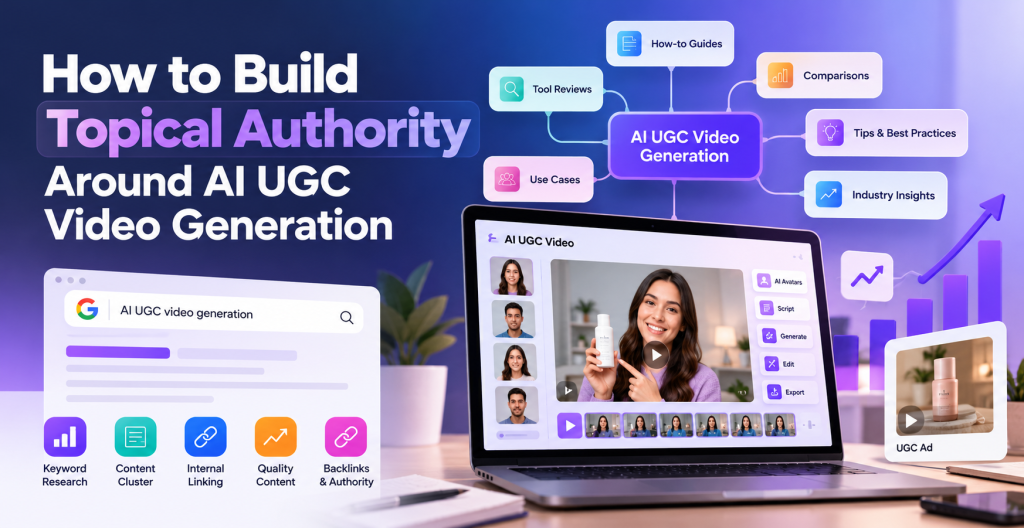
AI is transforming how brands create video content, especially user-generated content (UGC) ads for social media, eCommerce, and digital marketing campaigns. Businesses can now use artificial intelligence to produce product demonstrations, testimonial-style videos, talking-avatar content, and short-form advertisements without relying entirely on traditional video production.
As interest in AI UGC video generation grows, competition among software companies and content publishers is also increasing. Publishing a few articles targeting keywords such as AI UGC video generator or AI UGC video ads is no longer enough to establish a strong presence in search results. Websites need a comprehensive content strategy that demonstrates expertise across the entire topic.
This is where topical authority becomes important.
Building topical authority around AI UGC video generation involves creating interconnected, useful, and trustworthy content that answers your audience’s questions at every stage of the customer journey. Instead of focusing on individual keywords, you develop a content ecosystem that helps search engines and users understand the depth of your coverage.
In this guide, we will explore how to build topical authority around AI UGC video generation using keyword research, content clusters, internal linking, product-led content, and ongoing SEO optimization.
What Is Topical Authority in SEO?
Topical authority refers to a website’s demonstrated depth and relevance in a particular subject area. Rather than publishing isolated articles about unrelated topics, a website develops comprehensive coverage of a specific niche.
For example, a website targeting AI UGC video generation could publish content about AI UGC video generators, video creation workflows, AI avatars, product video advertising, creative testing, social media ad formats, and video performance optimization.
When these resources are organized into a logical structure, they create a connected knowledge base.
Topical authority is not a single Google ranking factor that website owners can directly optimize. However, comprehensive content coverage, helpful information, relevant internal links, and demonstrated experience can support SEO performance by helping search engines understand the website’s subject matter and helping users find relevant answers.
For SaaS companies, this strategy can also attract visitors with strong commercial intent. Someone searching for an AI UGC video generation tutorial may eventually become interested in trying a video creation platform.
Why Build Topical Authority Around AI UGC Video Generation?
The AI video creation market includes numerous tools, platforms, and use cases. Marketers are looking for solutions that help them produce more creative variations, reduce production time, and test different advertising approaches.
A focused topical authority strategy helps your website reach these audiences through multiple relevant searches.
First, it expands organic keyword coverage. Instead of targeting only one primary keyword, your website can appear for informational, commercial, and long-tail searches related to AI UGC video creation.
Second, it strengthens content relevance. Articles that connect naturally with one another provide users with clear paths to explore related topics. For example, a guide to creating AI UGC ads can link to tutorials about writing scripts, choosing AI avatars, and optimizing videos for TikTok.
Third, it supports product discovery. Content that explains real problems and practical solutions can introduce users to relevant software without making every article feel like a sales pitch.
Finally, it creates long-term content opportunities. As AI video technology evolves, you can expand existing clusters with new tutorials, comparisons, case studies, and workflow guides.
Step 1: Define Your Core Topic and Content Boundaries
The first step is identifying the main subject your website wants to own.
For this strategy, the core topic is AI UGC video generation. Every supporting article should contribute to a deeper understanding of this subject or address a closely related problem faced by the target audience.
Start by defining the main audience. It could include eCommerce businesses, DTC brands, performance marketers, advertising agencies, social media managers, and SaaS companies.
Next, identify their most important questions:
- How do you create AI UGC videos?
- Which AI UGC video generator should you choose?
- How can you create realistic AI product testimonials?
- What makes an AI UGC ad effective?
- How can brands produce multiple video variations?
- How do you optimize AI-generated videos for paid campaigns?
These questions reveal the different subtopics your content strategy needs to cover.
Avoid expanding into every AI-related subject simply because it has search demand. Topics such as general AI coding or unrelated image-generation techniques may dilute the focus unless they directly support your audience’s video creation needs.
Step 2: Conduct Comprehensive Keyword Research
Keyword research helps translate your core topic into specific content opportunities.
Begin with your primary keyword: AI UGC video generation. Then expand the research into related terms, search intents, and questions.
Organize keywords into four major groups.
| Keyword category | Example keywords | Search intent |
| Core topic | AI UGC video generation, AI UGC video generator | Informational and commercial |
| Educational | How to create AI UGC videos, AI UGC video tutorial | Informational |
| Commercial | Best AI UGC video tools, AI UGC generator pricing | Commercial investigation |
| Use cases | AI UGC ads for eCommerce, AI product testimonial videos | Informational and commercial |
Use SEO tools such as Ahrefs, Semrush, Google Keyword Planner, and Google Search Console to identify relevant queries, estimated search demand, competing pages, and existing keyword opportunities.
However, do not select keywords based on search volume alone. A low-volume keyword that closely matches your product and audience may generate more qualified traffic than a broad keyword with significant competition.
Search intent is equally important. Someone searching for a tutorial expects practical instructions, while someone searching for the best AI UGC video generator expects a comparison of tools and features.
Create separate pages when the intent and information needs are meaningfully different. Combine closely overlapping topics when one comprehensive page can satisfy both searches.
Step 3: Build a Topic Cluster Around a Pillar Page
A topic cluster is a group of related pages organized around one comprehensive pillar page. This structure helps you cover the subject in depth while creating clear internal relationships between resources.
Your pillar page should introduce AI UGC video generation, explain its benefits, outline the creation process, discuss important use cases, and direct readers to more detailed guides.
A practical content cluster could look like this:
Tier 1: Pillar page
AI UGC Video Generation: The Complete Guide
This page provides a broad overview of the topic and links to all major supporting resources.
Tier 2: Supporting content
Create detailed articles covering major subtopics:
- What Is AI UGC Video Generation?
- Best AI UGC Video Generators for Marketers
- How to Create AI UGC Video Ads
- AI UGC Videos vs. Traditional UGC Videos
- How to Create Realistic AI Product Testimonial Videos
- How AI Avatars Work in UGC Advertising
- How to Write Scripts for AI UGC Video Ads
- AI UGC Video Generation for eCommerce Brands
Each article should target a distinct search intent rather than repeating the same general explanation.
Tier 3: Long-tail supporting content
Expand the cluster with specific questions and practical use cases:
- How to Create AI UGC Videos for Skincare Products
- Best AI UGC Video Hooks for TikTok Ads
- How to Turn Product URLs Into UGC-Style Videos
- How to Create AI UGC Videos in Multiple Languages
- How to Test Different AI UGC Ad Creatives
- How to Make AI UGC Product Videos Look More Natural
- Common AI UGC Video Generation Mistakes
- How to Optimize AI UGC Videos for Mobile Landing Pages
These articles capture more specific user needs and link back to the relevant supporting guide or pillar page.
The objective is not to publish as many articles as possible. It is to build a coherent collection of resources that comprehensively answers the questions your target audience actually has.
Step 4: Create Helpful, Experience-Driven Content
A large content library will not automatically establish authority if every article repeats the same generic information.
Each page should offer something useful that readers cannot easily obtain from a superficial summary.
For example, an article about creating AI UGC video ads should include a practical workflow covering product selection, audience research, script creation, avatar selection, video generation, editing, and performance testing.
You can strengthen the content by including:
- Original screenshots of the creation process.
- Examples of prompts and scripts.
- Before-and-after creative comparisons.
- Practical advice about common generation errors.
- Realistic explanations of tool capabilities and limitations.
- Original experiments and clearly described results.
- Relevant expert commentary or documented case studies.
If you are reviewing an AI UGC video generator, explain how you evaluated it. Discuss factors such as output quality, editing flexibility, avatar realism, language support, workflow speed, and pricing.
Avoid inventing performance statistics or presenting hypothetical results as real experiments.
Google’s helpful-content principles emphasize creating content for people rather than producing pages primarily to manipulate rankings. Original experience, accuracy, clear explanations, and a useful answer to the searcher’s question are therefore more valuable than simply increasing word count.
Step 5: Optimize Every Article for Its Search Intent
On-page SEO helps search engines and readers understand what each page covers.
Start with a clear title tag that naturally includes the primary keyword. Use an H1 that accurately describes the page, and organize the content with descriptive H2 and H3 headings.
For example, an article targeting “how to create AI UGC video ads” could include sections such as:
- What You Need Before Creating an AI UGC Video
- How to Write an AI UGC Video Script
- How to Generate the Video
- How to Edit and Improve the Final Output
- How to Measure Ad Performance
Include related terms naturally where they help explain the subject. These might include AI UGC video generator, AI-generated product videos, UGC-style advertising, AI avatars, video ad creative, and social media video ads.
Do not force every keyword into every paragraph. Keyword stuffing can reduce readability and make your content appear unnatural.
Also optimize title tags, meta descriptions, image alt text, and descriptive URLs. Use canonical tags correctly, avoid unnecessary duplicate pages, and ensure important content can be crawled and indexed.
Structured data should accurately reflect the page. Article, BreadcrumbList, Organization, and applicable SoftwareApplication markup may be useful depending on the content and your site’s implementation. Structured data does not guarantee enhanced search appearances or higher rankings.
Step 6: Build a Strong Internal Linking Structure
Internal linking is essential for connecting your content cluster.
Your pillar page should link to its main supporting articles. Supporting articles should link back to the pillar page and to closely related resources when those links help readers.
For example, a guide about AI UGC video scripts could link to a tutorial about generating AI UGC ads. That tutorial could link to a comparison of AI UGC video generators and a guide to improving product video performance.
Use descriptive anchor text that communicates what the destination page offers. Phrases such as “how to create AI UGC video ads” are generally more useful than repeatedly using vague anchors such as “click here.”
A practical internal linking workflow is to:
- Identify the main pillar page.
- List all relevant supporting articles.
- Add contextual links from the pillar page to supporting resources.
- Link supporting pages back to the pillar where appropriate.
- Connect related articles when there is a genuine topical relationship.
- Review important pages for orphaned content and broken links.
Avoid linking unrelated articles simply to increase the number of internal links. Every link should serve a clear navigational or informational purpose.
Step 7: Use Tagshop AI to Demonstrate Real AI UGC Workflows
Product-led content can strengthen a topic cluster when the featured tool genuinely helps solve the problem being discussed.
For example, Tagshop AI can be introduced in relevant articles about AI UGC video creation, product-to-video workflows, AI avatars, and advertising creative production.
Rather than adding a product mention to every paragraph, demonstrate how the tool fits into a specific workflow.
A tutorial about creating UGC-style product videos could explain how a marketer starts with product information, develops a suitable script, selects an AI avatar, generates a video, and reviews the final creative.
Where supported by the current product features, you can show how a URL-to-video workflow helps turn product information into video concepts or how AI avatars can support testimonial-style creative production.
You can also develop focused content around practical use cases, such as creating product videos for eCommerce stores, producing multiple ad variations, or adapting video messaging for different audiences.
The most effective product-led content remains educational. Explain where the tool helps, what users still need to review manually, and which use cases may require additional editing or testing.
This approach helps connect informational searches with relevant commercial pages while giving readers a clearer reason to explore the product.
Step 8: Strengthen Authority With Relevant Backlinks and Brand Mentions
Backlinks can help search engines discover pages and evaluate how the wider web references your content. Relevant links from reputable websites can also bring referral traffic and improve brand visibility.
For AI UGC video generation, prioritize relationships with marketing publications, eCommerce blogs, SaaS websites, advertising communities, and creator-focused resources.
Useful approaches include publishing original research, contributing expert articles, sharing practical tutorials, and creating resources that other marketers genuinely want to reference.
For example, an original study comparing AI-generated video formats or a detailed guide to testing UGC-style ad creatives may attract relevant editorial links if it offers credible findings and practical value.
Avoid relying on large volumes of irrelevant directory submissions, automated backlinks, or manipulative link exchanges. The goal is to earn meaningful references, not simply increase a backlink counter.
Also monitor unlinked brand mentions and identify opportunities to turn appropriate references into useful links.
Step 9: Optimize Content for AI Search and Answer Engines
Search visibility increasingly involves more than traditional blue links. Users may discover brands through AI-generated search summaries, conversational search experiences, and answer engines.
Although there is no guaranteed formula for appearing in AI-generated answers, clear, trustworthy, well-structured content can make information easier to understand and reference.
To improve the accessibility and usefulness of your content:
- Answer the main question early in the article.
- Explain technical terms in straightforward language.
- Include specific examples and step-by-step instructions.
- Cite reliable sources for factual claims.
- Keep product features and pricing information accurate.
- Use headings that clearly describe each section.
- Include original insights, examples, and documented research.
- Maintain consistent brand information across relevant pages.
For example, a section answering “What is AI UGC video generation?” should provide a direct definition before moving into more detailed explanations.
Avoid creating dozens of nearly identical pages solely to target minor keyword variations. A smaller collection of distinct, useful resources can be more valuable than a large library of repetitive content.
Step 10: Measure Topical Authority and Improve the Content Cluster
Topical authority should be evaluated through multiple indicators rather than a single score.
Google Search Console can help you understand which queries generate impressions and clicks, which pages are gaining visibility, and where rankings or click-through rates may need improvement.
SEO platforms such as Semrush and Ahrefs can provide additional information about keyword rankings, competing pages, backlinks, and content gaps.
Monitor the following metrics:
| Metric | What it helps you understand |
| Organic impressions | Whether your pages are appearing for relevant searches |
| Organic clicks | How much search traffic your content attracts |
| Keyword coverage | Whether the site is gaining visibility across the topic |
| Relevant referring domains | Whether other websites reference your resources |
| Internal link coverage | Whether important pages are connected to the cluster |
| Organic conversions | Whether visitors take meaningful actions |
| Engagement and user feedback | Whether content meets audience needs |
Review the cluster monthly or quarterly, depending on publishing frequency and how quickly the topic changes.
Look for pages with high impressions but low click-through rates, articles that receive impressions but few clicks, and important queries for which your website lacks a useful resource.
Update existing content when new information materially improves it. Consolidate overlapping pages when appropriate, strengthen internal links, and create new articles only when they address a meaningful content gap.
Remember that rankings can fluctuate for many reasons, and topical authority cannot be measured reliably through one third-party metric.
A Practical 90-Day Topical Authority Roadmap
A focused 90-day plan can help you organize the work without publishing content randomly.
Days 1–30: Research and foundation
Audit existing content, identify keyword opportunities, analyze search intent, define the pillar page, and map supporting articles. Resolve important crawlability, indexability, canonical, and internal linking issues.
Days 31–60: Content development
Publish or improve the pillar page and prioritize supporting content based on search intent, business relevance, and existing ranking opportunities. Add original examples, contextual internal links, and relevant product demonstrations.
Days 61–90: Expansion and optimization
Develop long-tail articles that address uncovered questions. Improve pages using Search Console data, strengthen internal links, pursue relevant editorial backlinks, and review whether the content is attracting qualified traffic.
At the end of the 90 days, use the performance data to decide which subtopics deserve deeper coverage. Continue expanding the cluster according to audience needs rather than following an arbitrary publishing quota.
Common Mistakes to Avoid When Building Topical Authority
One common mistake is publishing too many articles before defining a clear content structure. This can lead to keyword cannibalization, duplicated information, and weak internal linking.
Another mistake is focusing entirely on search volume. Broad keywords may attract visitors who are unlikely to need your product, while specific use-case searches may bring more qualified audiences.
Many websites also overlook content quality by using repetitive AI-generated articles with few original insights. AI can assist with research, outlining, and drafting, but the final content should be reviewed for accuracy, usefulness, originality, and consistency.
Finally, avoid treating backlinks, structured data, or publishing frequency as shortcuts to authority. These activities support a broader SEO strategy; none can guarantee rankings independently.
Conclusion
Building topical authority around AI UGC video generation requires a structured approach to content planning, keyword research, internal linking, and continuous improvement.
Start with a comprehensive pillar page, develop supporting articles around distinct search intents, and expand into specific use cases that matter to your audience. Strengthen those resources with original examples, accurate information, relevant product demonstrations, and useful internal links.
For AI video software companies such as Tagshop AI, this strategy can connect educational content with product discovery while building a stronger organic search presence.
The long-term objective is simple: create the most useful and coherent collection of resources you can for your target audience. By consistently answering their questions and improving your content based on real performance data, you can build a sustainable SEO foundation around AI UGC video generation.


Leave a Reply