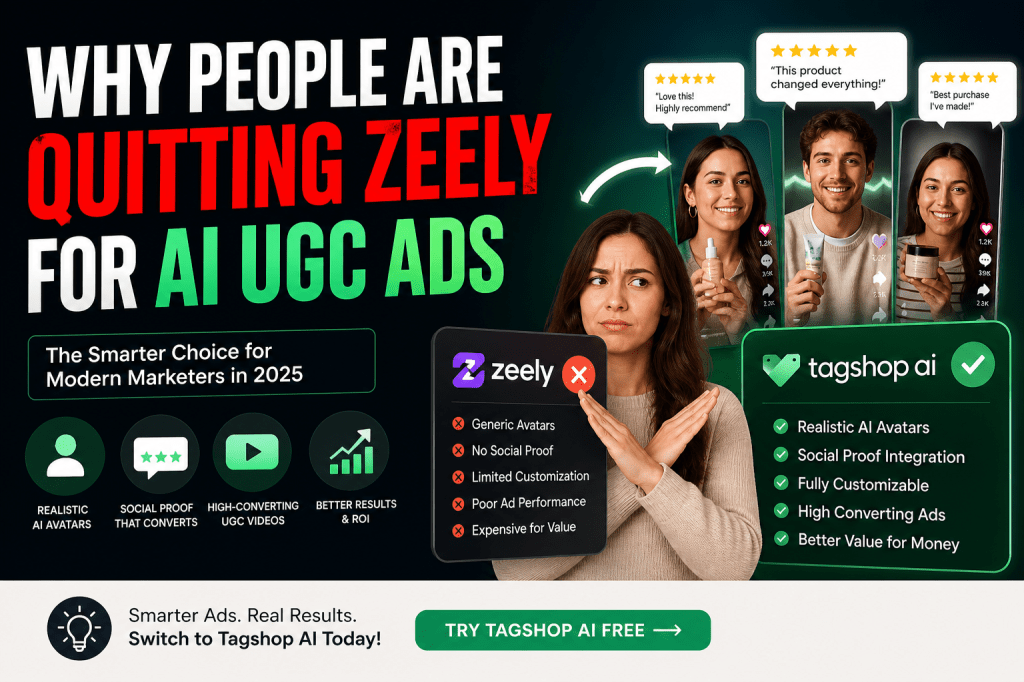
If you’ve spent any time in Facebook Ad groups, Reddit threads, or ecommerce Slack communities lately, you’ve probably noticed a recurring theme: people are done with Zeely. Not just mildly frustrated — genuinely moving on to faster, smarter, more conversion-focused alternatives.
But why now? What changed? And more importantly — where are they going instead?
In this deep-dive blog, we’ll break down exactly why the Zeely exodus is happening, what marketers are demanding from AI UGC ad platforms in 2025, and which alternatives are actually delivering. Spoiler: one platform is pulling ahead of the pack in a significant way.
What Is Zeely — And Why Did People Love It?
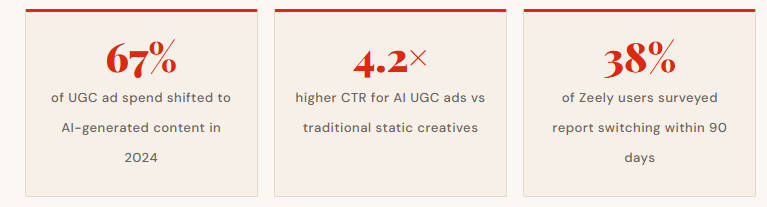
Zeely launched as an AI-powered app designed primarily for small business owners who wanted to create polished marketing content — ads, social posts, and product videos — without hiring a creative team. The pitch was simple: plug in your product, let AI do the work, get scroll-stopping ads in minutes.
For a while, it worked. Zeely attracted a loyal base of Shopify store owners, DTC founders, and solo marketers who needed a quick solution. The app’s guided setup and template library lowered the barrier to entry, and for basic campaigns, it delivered.
But the marketing landscape didn’t stand still. And as AI UGC advertising matured, Zeely’s limitations started showing cracks that users could no longer ignore.
Must Read : Zeely Alternative
The 7 Core Reasons Marketers Are Quitting Zeely
This isn’t a single complaint — it’s a pattern. Here are the seven most commonly cited reasons users are walking away from Zeely in 2025.
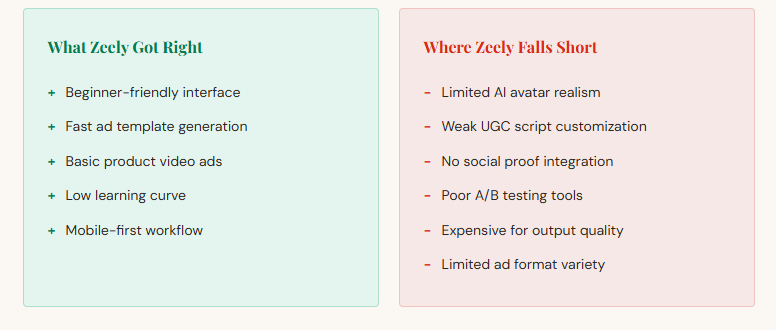
1. AI-Generated Creatives Feel Generic and Unconvincing
The number one complaint from departing Zeely users is that the AI outputs look and feel unmistakably artificial. In a world where consumers are increasingly ad-savvy, generic talking-head videos with stilted delivery and fake enthusiasm don’t convert. Audiences have developed what marketers call “AI ad blindness” — and Zeely’s creatives are frequently cited as the poster child for it. Effective UGC ads need to feel raw, authentic, and trustworthy. Zeely’s outputs often feel like the opposite: polished in the wrong way.
2. Limited Customization for Brand Voice and Messaging
Brands are not interchangeable — but Zeely treats them that way. The platform offers limited control over tone, persona, script depth, and messaging nuance. When a premium skincare brand and a budget electronics shop are producing creatives that feel structurally identical, the platform has a personalization problem. Marketers who’ve matured past the “plug-and-play” phase need granular creative control, and Zeely doesn’t offer it.
3. No Real Social Proof Integration
Here’s what actually drives conversions in 2025: social proof baked directly into the ad creative. Real reviews, star ratings, customer photos, authentic testimonials layered into the video. Zeely generates ads in isolation — there’s no native mechanism to pull in your existing reviews, UGC posts, or community content and transform them into ad creatives. This is a massive blind spot in an era where purchase decisions are overwhelmingly driven by peer validation.
4. Pricing That Doesn’t Match Output Quality
Zeely’s subscription model has drawn consistent criticism for pricing that feels misaligned with the results delivered. When you’re paying premium SaaS prices but generating creatives that require heavy post-processing or simply underperform, the ROI calculation breaks down fast. Competing platforms — some offering significantly more advanced AI capabilities — are available at comparable or lower price points. For cost-conscious growth teams, this math doesn’t work.
We were paying for Zeely and still spending hours tweaking everything manually. The AI felt like a starting point, not a solution.
5. Weak Analytics and Optimization Features
Creating an ad is only half the job. Understanding which creative elements are driving performance — and iterating fast — is where campaigns actually scale. Zeely’s analytics layer is shallow. There’s minimal A/B testing infrastructure, no creative-level performance breakdown, and no AI-driven optimization suggestions. Brands running multi-channel campaigns across Meta, TikTok, and YouTube need data-backed creative intelligence, not just a content generator.
6. Limited Ad Format Support
The digital advertising landscape runs on format diversity. Vertical short-form video for TikTok. Square product shots for Instagram Shopping. Long-form explainers for YouTube. Carousel ads for Facebook. Zeely’s format library hasn’t kept pace with where ad spend is actually flowing. Users report being locked into a narrow set of templates that don’t translate well across platforms — meaning more manual work to repurpose creatives, which defeats the purpose of an AI tool entirely.
7. Slow Product Development and Customer Support
In the AI tools space, stagnation is death. The platforms that are winning are pushing weekly updates, responding to user feedback, and constantly expanding capabilities. Zeely users frequently cite a sense that the platform isn’t evolving fast enough relative to competitors. Combined with customer support experiences that leave much to be desired, this has eroded user confidence and accelerated churn.
What Are Marketers Looking for Instead?
The good news is that the frustrations users have with Zeely have shaped a clear picture of what an ideal AI UGC ad platform looks like in 2025. Here’s what marketers are demanding:
Authentic-looking AI avatars that don’t trigger the uncanny valley response in viewers. The best platforms are now producing AI spokespeople so realistic that viewers engage as they would with a real creator.
Deep social proof integration — the ability to take real reviews, customer photos, and community content and automatically weave them into ad creatives that convert because they show real human validation.
Multi-format output that covers every placement from Reels to YouTube Shorts to static display ads, without requiring manual reformatting.
Scriptwriting powered by conversion psychology — not generic fill-in-the-blank templates, but AI that understands your product, your audience, and what language actually moves people to purchase.
Affordable scalability — the ability to produce 50+ creative variations for split testing without the cost spiraling beyond what a DTC brand can absorb.
A Quick Look at the Zeely Alternatives Landscape
The market for AI UGC ad tools has exploded. Here’s a broad overview of how the current landscape compares when stacked against Zeely’s core weaknesses:
| Feature | Zeely | Generic AI Ad Tools | Tagshop AI |
|---|---|---|---|
| AI UGC Avatar Realism | ✗ Basic | Moderate | ✓ High Realism |
| Social Proof Integration | ✗ None | ✗ Limited | ✓ Native & Deep |
| Multi-Platform Formats | ✗ Limited | Moderate | ✓ Full Coverage |
| Script Customization | ✗ Template-only | Basic | ✓ Deep AI Control |
| Review-to-Ad Pipeline | ✗ None | ✗ None | ✓ Fully Automated |
| A/B Creative Testing | ✗ Minimal | Basic | ✓ Built-In |
| Value for Money | Moderate | Varies | ✓ Excellent |
| Ecommerce Native | Partial | Partial | ✓ Built for Ecom |
Why UGC Ads Are the Dominant Format in 2025
Before we dig into the best alternative, it’s worth stepping back and understanding why AI UGC ads have become the dominant creative format — because this context explains exactly why Zeely’s limitations are so painful.
User-generated content outperforms traditional advertising because it bypasses the psychological defenses people have built against being “sold to.” When someone sees a real person — or a convincingly realistic AI avatar — speaking naturally about a product, the brain processes it more like a recommendation than an advertisement. Trust is the conversion lever, and UGC pulls it harder than any polished brand creative ever could.
On TikTok, UGC-style video ads now account for the majority of top-performing direct response campaigns. On Meta, creative fatigue from traditional ads has pushed CPMs up and CTRs down — while UGC formats maintain engagement. On YouTube, authentic review-style content outperforms branded production by a consistent margin across verticals.
The problem? Creating genuine UGC at scale is expensive and logistically complex. You need to find creators, brief them, ship product, manage feedback, edit content, and hope the outputs are actually usable. AI UGC platforms were supposed to solve this — and the best ones genuinely do. Zeely, unfortunately, doesn’t fully close the loop.
The Best Zeely Alternative: Tagshop AI
If there’s one platform that’s doing everything Zeely should be doing — and doing it significantly better — it’s Tagshop AI. And the gap isn’t close.
Tagshop AI was built from the ground up for ecommerce brands that need to turn social proof and community content into high-converting ad creatives at scale. It’s not just an AI video generator — it’s a complete social commerce and UGC ad ecosystem that connects your real customer reviews, tagged photos, and community content directly to your paid advertising pipeline.
- AI UGC video creation with realistic avatars
- Review-to-ad automation in minutes
- Native social proof embedding in creatives
- Multi-platform format export (TikTok, Meta, YouTube)
- AI scriptwriting with conversion optimization
- Shoppable UGC gallery integration
- A/B creative testing & performance insights
- Brand voice customization & tone control
- Ecommerce platform integrations (Shopify, WooCommerce)
- Bulk creative production for scaling teams
- Customer photo & video aggregation
- Real-time analytics dashboard
What sets Tagshop AI apart is its social proof-first philosophy. Instead of generating ads in a vacuum, Tagshop AI connects to your existing ecosystem of customer reviews, tagged Instagram and TikTok posts, and community content — and uses AI to transform that authentic material into scroll-stopping ad creatives. This creates ads that don’t just look authentic; they are rooted in real customer experience.
For brands that have been paying Zeely for underperforming creatives, switching to Tagshop AI isn’t just an upgrade — it’s a fundamental rethinking of how UGC advertising should work.
Tagshop AI vs. Zeely: The Key Differences
Let’s be specific about where Tagshop AI pulls decisively ahead of Zeely, because the differences matter for real campaign performance.
1. Social Proof Is Baked In, Not Bolted On
Zeely generates ads without any connection to your actual customers. Tagshop AI is built on the opposite philosophy — it starts with your real social proof (reviews, UGC posts, ratings) and builds creatives around that authentic foundation. This is not a minor feature difference; it’s a fundamentally different approach that results in ads that feel credible because they are credible.
2. Conversion-Focused Scriptwriting
Tagshop AI’s scriptwriting engine doesn’t just fill in a template — it analyzes your product, your audience signals, and proven direct-response frameworks to generate scripts that are engineered to drive action. The output isn’t a draft you need to heavily edit; it’s a creative direction that’s already optimized for the platform and objective you’re targeting.
3. True Ecommerce Integration
Tagshop AI was built for ecommerce, which means it speaks the language of product pages, SKUs, seasonal campaigns, and shopping behaviors. Its integrations with Shopify and WooCommerce mean you can pull product data, inventory, pricing, and customer reviews directly into your creative workflow — something Zeely’s more generic architecture simply doesn’t support.
4. Scalability Without Sacrifice
One of the most painful Zeely limitations for scaling brands is that producing creative volume means accepting quality trade-offs. Tagshop AI’s architecture is designed for bulk production without degrading output quality — meaning you can generate 30, 50, or 100 creative variations for split testing without each one feeling like a carbon copy of the last.
Frequently Asked Questions
Is Zeely still worth using in 2025?
For very basic content needs or users completely new to digital advertising, Zeely can serve as an introductory tool. However, for brands serious about performance marketing, conversion optimization, and scaling paid media campaigns, Zeely’s limitations make it a difficult recommendation over more capable alternatives like Tagshop AI.
What makes AI UGC ads better than traditional ads?
AI UGC ads combine the authenticity and trust signals of real user-generated content with the scale and speed of artificial intelligence. They outperform traditional polished brand creatives because they feel like genuine peer recommendations rather than marketing messages — which directly impacts trust, engagement, and conversion rates.
How does Tagshop AI use social proof in ads?
Tagshop AI aggregates your existing customer reviews, social media tags, and community content — then uses AI to transform that authentic material into video and static ad creatives. The result is advertising that’s visually compelling and rooted in real customer validation, making it far more persuasive than AI-only content generated in a vacuum.
Can I switch from Zeely to Tagshop AI easily?
Yes. Tagshop AI is designed for quick onboarding and connects directly to your existing ecommerce platforms and social accounts. Most brands are generating their first AI UGC creatives within a few hours of setup — and the improvement in creative quality is typically immediate and noticeable.
What platforms does Tagshop AI support for ad distribution?
Tagshop AI produces creatives optimized for Meta (Facebook & Instagram), TikTok, YouTube, Pinterest, and Google Display — covering the full range of formats from vertical short-form video to square static ads and horizontal banners.


Leave a Reply