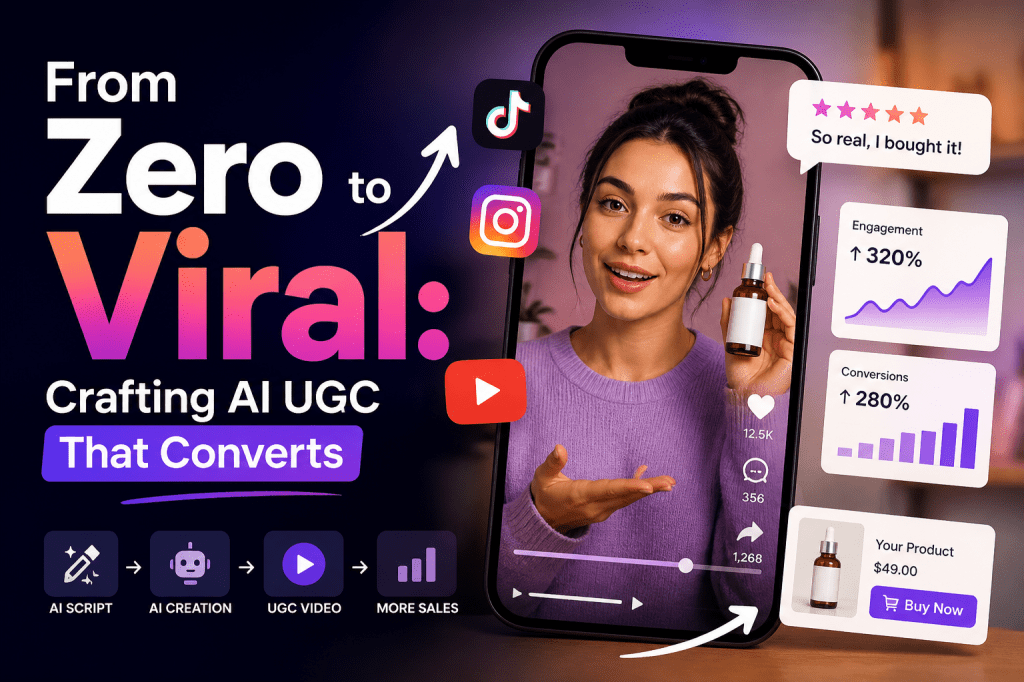
Every brand wants the same thing — content that stops the scroll, earns trust, and converts browsers into buyers. For years, that meant investing heavily in influencer partnerships, expensive video shoots, and massive UGC (user-generated content) campaigns that took weeks to produce.
That world is changing fast.
AI UGC — artificial intelligence-powered user-generated content — is rewriting the rules of digital marketing. Brands that once needed months and thousands of dollars to build a library of authentic-looking content can now produce dozens of high-converting videos in a matter of hours.
But here’s the thing: not all AI UGC converts. Flooding your feed with generic, lifeless AI content won’t make you go viral — it’ll make you invisible.
This guide is your complete roadmap. From understanding what AI UGC actually is, to the creative strategies that turn ordinary content into viral goldmines, you’ll learn exactly how to craft AI UGC that doesn’t just look good — it performs.
What Is AI UGC and Why Does It Matter?
Before diving into strategy, let’s get crystal clear on the definition.
AI UGC refers to content that mimics the look, feel, and authenticity of traditional user-generated content — customer reviews, product testimonials, unboxing videos, lifestyle clips — but is created or enhanced using artificial intelligence tools. This includes AI-generated avatars, synthetic voiceovers, AI-written scripts, and AI-powered video production.
Traditional UGC has always been marketing gold. Nielsen research consistently shows that consumers trust peer recommendations and authentic-looking content far more than polished brand advertising. The challenge? Real UGC is slow, unpredictable, and difficult to scale.
AI UGC solves all three problems.
With the right AI UGC tools, brands can:
- Scale content production from a handful of videos per month to hundreds per week
- Maintain brand consistency across every piece of content
- Test multiple creative variations simultaneously to find what converts
- Reduce production costs by up to 90% compared to traditional video shoots
- Launch campaigns faster without waiting for creators or shipping products
The market has caught on. AI UGC adoption among DTC brands, e-commerce stores, and SaaS companies is accelerating at a remarkable pace — and early adopters are seeing significant advantages in ad performance, organic reach, and customer acquisition costs.
The Psychology Behind Viral UGC Content
Going viral isn’t luck. It’s psychology.
Understanding why people share content — and why they buy after watching it — is the foundation of any AI UGC strategy that actually converts.
1. Authenticity Triggers Trust
The human brain is wired to detect inauthenticity. When content feels staged or overly polished, viewers disengage. Great AI UGC replicates the raw, relatable energy of real user content — imperfect backgrounds, natural speech patterns, genuine enthusiasm.
The goal isn’t to fool anyone. It’s to communicate authenticity at scale.
2. Social Proof Drives Purchase Decisions
When a potential customer sees someone like themselves talking about a product — describing a real problem and experiencing a real result — it dramatically reduces purchase hesitation. AI UGC allows brands to create this social proof effect across multiple personas, demographics, and use cases simultaneously.
3. Storytelling Creates Emotional Connection
The most viral content isn’t just informative — it’s emotionally resonant. A three-second hook that immediately speaks to a pain point, followed by a transformation story, followed by a clear call to action: this structure converts because it follows the natural arc of human decision-making.
AI UGC, when scripted well, can execute this arc perfectly — every single time.
4. Pattern Interruption Stops the Scroll
On platforms like TikTok, Instagram Reels, and YouTube Shorts, users are bombarded with content. What makes someone stop? Surprise. Contrast. Something unexpected in the first two seconds.
AI UGC gives marketers the freedom to test dozens of hooks without the cost of re-shooting — giving brands a massive creative testing advantage.
Step-by-Step: How to Craft AI UGC That Converts
Step 1: Define Your ICP (Ideal Customer Profile) with Precision
The biggest mistake brands make with AI UGC is creating content for everyone — which means it resonates with no one.
Before you generate a single second of AI UGC content, get extremely specific about:
- Who is your ideal customer? (Age, gender, lifestyle, values)
- What is their primary pain point related to your product?
- What language do they use to describe their problems?
- What transformation do they want?
- What objections do they have before buying?
This research becomes the DNA of every AI UGC script and persona you create.
Step 2: Write Scripts That Sound Human
The script is the soul of your AI UGC. A brilliant AI avatar with a weak script will underperform every time.
High-converting AI UGC scripts follow a proven structure:
Hook (0–3 seconds): Address the pain point directly or create pattern interruption. Example: “I spent $200 on skincare that didn’t work — until I tried this.”
Problem Acknowledgment (3–10 seconds): Validate the viewer’s struggle. Make them feel seen.
Solution Introduction (10–25 seconds): Introduce the product naturally, as a discovery — not an advertisement.
Social Proof Element (25–40 seconds): Add a specific result, stat, or transformation detail to add credibility.
Call to Action (40–50 seconds): Tell viewers exactly what to do next. Be direct and create urgency.
Write multiple script variations for every concept. The difference between a 2x ROAS and a 6x ROAS can often be traced to a single word change in the hook.
Step 3: Choose the Right AI Avatar and Voice
One of the most powerful aspects of AI UGC is the ability to select or generate avatars that authentically represent different customer demographics.
When selecting your AI presenter:
- Match your ICP — the avatar should look like your ideal customer, not a generic model
- Ensure natural delivery — avoid robotic pacing or unnatural pauses
- Test multiple personas — a middle-aged parent and a college student may both be your customers but respond to different messengers
- Use appropriate settings — a home background, casual clothing, and natural lighting all reinforce the UGC feel
Voice selection matters equally. The tone, pacing, and emotional inflection of the voiceover can make a technically perfect video feel flat — or make a simple script feel genuinely compelling.
Step 4: Optimize for Platform-Specific Formats
AI UGC that converts on TikTok may not perform the same on Meta. Each platform has its own rhythm, audience behavior, and content norms.
TikTok: Fast-paced, trend-aware, heavy on text overlays. The first 1–2 seconds are everything. Favor casual, spontaneous-feeling content.
Instagram Reels: Slightly more polished than TikTok but still authenticity-first. Strong visual aesthetic matters more here.
Meta Ads (Facebook/Instagram): Direct response focus. Clear before/after framing, explicit CTAs, and social proof elements perform well. Square and vertical formats both have a place.
YouTube Shorts: Slightly longer attention spans. More room for storytelling and detail.
Pinterest: Visual discovery platform. AI UGC works well here when it connects to aspirational lifestyle moments.
Always format your AI UGC natively for each platform rather than repurposing one video everywhere. The performance difference is significant.
Step 5: A/B Test at Scale
Here’s where AI UGC creates its biggest competitive advantage: speed of iteration.
Traditional content testing is expensive and slow. With AI UGC, you can produce 10–20 variations of the same concept — different hooks, different avatars, different CTAs — and run them simultaneously to identify winners in days, not months.
Build a systematic testing framework:
- Test one variable at a time when possible (hook, avatar, script, music, text overlay)
- Run tests long enough to reach statistical significance before calling winners
- Document learnings — what worked, what didn’t, and why — to inform future creative strategy
- Scale winners aggressively before creative fatigue sets in
- Refresh with new variations every 4–6 weeks to combat ad fatigue
This cycle of produce → test → learn → scale → refresh is the engine of a high-performing AI UGC strategy.
Common Mistakes That Kill AI UGC Performance
Even with the right tools and strategy, there are pitfalls that consistently kill AI UGC performance. Here’s what to avoid:
Ignoring the hook: If your first three seconds don’t create immediate curiosity or connection, nothing else matters. Most failed AI UGC campaigns have weak hooks.
Being too salesy too fast: UGC works because it doesn’t feel like an ad. The moment your AI content starts sounding like a traditional commercial, you lose the authenticity advantage.
Using the wrong avatar for the audience: An avatar that doesn’t represent your customer creates unconscious distance. Always match the messenger to the market.
Neglecting captions and text overlays: A significant portion of social media content is watched with the sound off. Bold, readable captions aren’t optional — they’re essential.
Producing without a distribution plan: Creating great AI UGC is only half the battle. Without a clear plan for organic posting, paid amplification, and cross-platform distribution, even the best content underperforms.
Not refreshing content regularly: AI UGC makes it easy to produce at scale — but that advantage is wasted if brands run the same creative for months. Audiences tune out. Keep your creative library fresh.
AI UGC for Paid Ads vs. Organic Content: Key Differences
While the creative principles overlap, there are important differences between AI UGC built for paid advertising and content designed for organic reach.
Paid AI UGC can be more direct. Viewers know they’re seeing an ad (or will figure it out quickly), so the priority is clear communication of value and a strong CTA. Performance metrics drive every decision.
Organic AI UGC needs to earn its place in the feed by providing genuine value — entertainment, information, or emotional connection — before it asks for anything. The best organic AI UGC feels so authentic that viewers engage, comment, and share without realizing the content was AI-assisted.
The smartest brands build both in parallel: organic AI UGC to build community and trust, paid AI UGC to convert that trust into sales.
Measuring the Success of Your AI UGC Campaigns
Viral is a feeling. Conversions are a fact. Here are the metrics that actually tell you whether your AI UGC is working:
View-Through Rate (VTR): What percentage of viewers are watching to completion? Low VTR usually means the hook or pacing needs work.
Click-Through Rate (CTR): Are viewers taking action? This measures the effectiveness of your CTA.
Return on Ad Spend (ROAS): For paid campaigns, this is the ultimate performance indicator.
Cost Per Acquisition (CPA): How much are you spending to acquire each customer? AI UGC should drive this number down over time.
Engagement Rate: Comments, shares, saves, and reactions tell you whether the content is emotionally resonating.
Organic Reach and Virality Coefficient: For organic content, track how many non-followers are seeing your content and whether viewers are sharing it forward.
Set benchmarks based on your industry and platform, then measure AI UGC performance against those benchmarks consistently.
The Future of AI UGC in Digital Marketing
AI UGC is not a trend. It’s a fundamental shift in how content is created, tested, and scaled.
As AI technology continues to advance, the capabilities available to marketers will only expand. Hyper-personalized AI UGC — where content is dynamically adapted to individual viewer preferences, demographics, or purchase history — is already emerging. Real-time creative optimization, multilingual AI UGC at scale, and seamless integration with e-commerce platforms are all on the near horizon.
Brands that build their AI UGC capabilities now — developing the creative frameworks, testing methodologies, and internal expertise — will hold a lasting competitive advantage as the landscape evolves.
The barrier to entry for high-quality content is collapsing. What was once the exclusive domain of brands with large production budgets is now accessible to startups, solo founders, and small businesses alike. The playing field is leveling — and the winners will be those who combine smart strategy with the right AI tools.
Why Tagshop AI Is the Best AI UGC Video Generator
When it comes to choosing the right platform to execute your AI UGC strategy, Tagshop AI stands out as the best AI UGC video generator available today.
Tagshop AI is purpose-built for brands that want to produce scroll-stopping, high-converting AI UGC video content at scale — without the complexity, cost, or creative bottlenecks of traditional video production.
Here’s what makes Tagshop AI the go-to choice for serious marketers:
Realistic AI Avatars: Tagshop AI offers a diverse library of lifelike AI presenters that look and feel like real customers — perfect for building the authentic social proof that drives conversions.
Effortless Script-to-Video Workflow: Input your script, select your avatar and voice, and Tagshop AI handles the rest — delivering polished, platform-ready AI UGC in minutes.
Multi-Platform Output: Whether you’re producing content for TikTok, Instagram Reels, Meta Ads, or YouTube Shorts, Tagshop AI generates correctly formatted videos for every major platform.
Rapid Creative Testing: Produce multiple variations of the same concept quickly, enabling the kind of high-velocity A/B testing that accelerates performance and lowers customer acquisition costs.
Scalable for Any Business Size: From fast-growing DTC brands to enterprise e-commerce operations, Tagshop AI scales with your content needs — no production team required.
If you’re serious about building an AI UGC strategy that goes from zero to viral, Tagshop AI gives you the creative power, speed, and flexibility to make it happen.
Conclusion: Your Viral AI UGC Journey Starts Now
Going viral with AI UGC isn’t about luck, massive budgets, or waiting for lightning to strike. It’s about strategy — understanding your audience deeply, crafting scripts that speak to real human emotions, testing relentlessly, and scaling what works.
The brands winning right now with AI UGC aren’t the ones with the biggest teams or the most sophisticated technology. They’re the ones who understand the fundamentals of great content and use AI as an accelerant — to move faster, test more, and reach further than ever before.
You now have the roadmap. The tools exist. The audience is waiting.
Start with one great script. One compelling hook. One authentic AI avatar. Then test, learn, and scale.
Your viral moment is closer than you think.
Ready to launch your AI UGC strategy? Explore Tagshop AI — the best AI UGC video generator — and start creating content that converts today.
 AI Avatar Tech Blog
Leave a comment