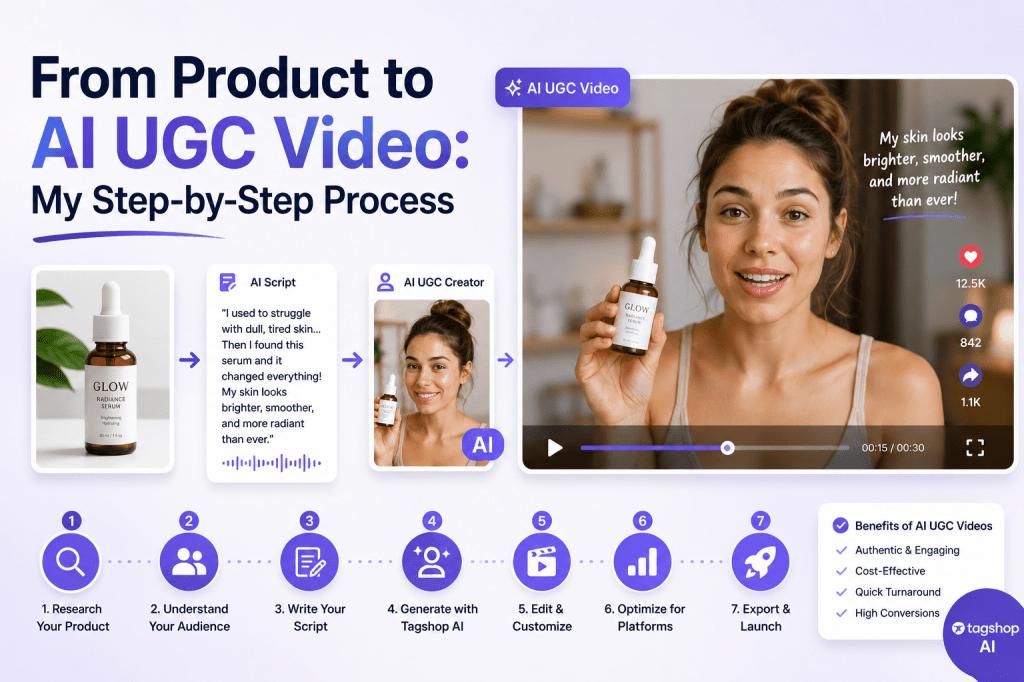
Creating high-performing video ads used to require creators, filming equipment, editing software, and a significant budget. Today, AI has completely changed that process. Brands can now transform a simple product idea into a compelling AI UGC Video in a fraction of the time and cost.
As a marketer, one of the biggest challenges I faced was producing enough video content to keep up with social media advertising demands. Platforms like TikTok, Instagram Reels, YouTube Shorts, and Facebook Ads require a constant flow of fresh creatives. Traditional content production simply couldn’t keep pace.
That’s when I started using Tagshop AI to create UGC-style videos powered by artificial intelligence.
In this guide, I’ll walk you through my complete process for turning a product into a high-converting AI UGC Video, from research and scripting to final export and campaign launch.
Whether you’re an ecommerce brand, marketer, agency, or content creator, this workflow can help you scale content production without sacrificing quality.
Why AI UGC Videos Are Becoming Essential for Brands
Before diving into the process, it’s important to understand why AI UGC Video content has become one of the fastest-growing marketing formats.
Traditional ads often feel polished and promotional. While they can be effective, today’s consumers increasingly prefer authentic and relatable content.
User-generated content performs well because it feels like a recommendation from a real person rather than an advertisement.
However, working with creators presents challenges:
- Creator sourcing takes time
- Production costs can be high
- Revisions slow campaigns
- Scaling content becomes difficult
AI-powered UGC solves these issues by enabling brands to generate creator-style content quickly and consistently.
With tools like Tagshop AI, marketers can create realistic videos designed to look and feel like genuine user-generated content while maintaining full control over messaging and branding.
My AI UGC Video Workflow Overview
My process follows six key stages:
- Product Research
- Audience Understanding
- Script Creation
- AI UGC Video Generation
- Video Optimization
- Testing and Scaling
Each step plays an important role in creating content that drives engagement and conversions.
Let’s break down each stage in detail.
Step 1: Understand the Product Thoroughly
The first mistake many marketers make is jumping directly into video creation.
A successful AI UGC Video starts with understanding the product.
Before creating any content, I answer several questions:
What problem does the product solve?
Consumers don’t buy products.
They buy solutions.
For example:
A skincare serum isn’t just skincare.
It’s confidence, healthy skin, and a better appearance.
A fitness product isn’t simply equipment.
It’s improved health and personal transformation.
Understanding the underlying benefit helps create stronger messaging.
What makes the product unique?
Every product has a unique selling proposition.
Ask:
- Why would someone choose this product?
- What features stand out?
- What benefits are competitors missing?
These answers become the foundation of your video script.
What are customers saying?
Customer reviews provide valuable insights.
Look for:
- Common praise
- Frequently mentioned benefits
- Pain points solved
- Emotional outcomes
These real customer experiences often become the most persuasive hooks and testimonials.
Step 2: Identify the Target Audience
The best AI UGC Video speaks directly to a specific audience.
Many marketers create generic content that appeals to nobody.
Instead, I define:
Audience Demographics
- Age
- Gender
- Location
- Income level
Audience Interests
What does the audience care about?
For example:
Beauty buyers may focus on:
- Appearance
- Self-confidence
- Skin health
Fitness consumers may focus on:
- Weight loss
- Performance
- Motivation
Pain Points
The strongest UGC videos begin with a problem.
Examples:
“I struggled with dry skin for years.”
“I was tired of spending hours editing videos.”
“I couldn’t find a protein supplement that actually tasted good.”
These relatable problems instantly capture attention.
Step 3: Create a High-Converting Script
The script is the heart of every successful AI UGC Video.
Even the most realistic AI avatar cannot compensate for weak messaging.
When creating scripts, I use a simple structure.
Hook
The first three seconds determine whether viewers continue watching.
Examples:
- “I wish I had found this product sooner.”
- “This completely changed my skincare routine.”
- “Here’s why everyone is switching to this.”
The goal is immediate curiosity.
Problem
Introduce a challenge the audience faces.
Example:
“My skin was constantly dry no matter what moisturizer I used.”
This creates emotional connection.
Solution
Present the product naturally.
Example:
“Then I discovered this hydrating serum.”
Avoid sounding overly promotional.
The content should feel like a genuine recommendation.
Results
Show benefits and outcomes.
Examples:
- Improved skin texture
- Faster workflow
- Increased productivity
- Better fitness results
Focus on transformation.
Call-to-Action
Guide viewers toward the next step.
Examples:
- “Definitely worth trying.”
- “Check it out for yourself.”
- “You can see why everyone is talking about it.”
Simple CTAs often perform best in UGC-style videos.
Step 4: Generate the AI UGC Video Using Tagshop AI
Once the script is ready, I move into production.
This is where Tagshop AI significantly speeds up the process.
Traditional production requires:
- Hiring creators
- Scheduling shoots
- Recording footage
- Editing content
With Tagshop AI, much of this process becomes automated.
Choose an AI Creator
The first step involves selecting a creator persona.
The ideal creator should match the target audience.
For example:
Beauty products perform better with beauty-focused creators.
Fitness products work best with active and health-conscious personas.
Audience alignment improves authenticity.
Add the Script
Next, I upload the script into Tagshop AI.
The platform transforms written content into spoken dialogue using realistic AI voices.
This eliminates the need for voice actors or manual recording.
Select Voice Settings
Voice selection is extremely important.
I choose based on:
- Audience demographics
- Product category
- Campaign goals
For example:
Luxury brands may benefit from polished professional voices.
Lifestyle brands often perform better with conversational tones.
Upload Product Assets
Tagshop AI allows me to incorporate:
- Product images
- Product videos
- Lifestyle visuals
- Brand assets
These assets help showcase the product naturally throughout the video.
Generate the Video
Once everything is configured, Tagshop AI generates the final content.
What once required days of production now takes minutes.
This efficiency is one of the primary reasons marketers are adopting AI-generated content.
Step 5: Optimize for Platform Performance
Every platform has unique content requirements.
A successful AI UGC Video should be optimized before publishing.
TikTok Optimization
TikTok rewards:
- Fast pacing
- Strong hooks
- Native-style content
Videos should feel organic rather than promotional.
Instagram Reels Optimization
Instagram audiences appreciate:
- Visual quality
- Lifestyle content
- Strong storytelling
Captions and text overlays often improve performance.
YouTube Shorts Optimization
YouTube Shorts prioritize:
- Retention
- Engagement
- Watch time
Clear storytelling helps maintain viewer attention.
Facebook Ads Optimization
Facebook users often respond well to:
- Product demonstrations
- Testimonials
- Benefit-focused messaging
Slightly longer videos can perform effectively here.
Step 6: Add Captions and Visual Elements
Most social media users watch videos without sound.
Captions increase accessibility and engagement.
I always include:
On-Screen Captions
Captions improve:
- Watch time
- Comprehension
- Accessibility
Product Highlights
Highlight important features visually.
Examples:
- Fast shipping
- Natural ingredients
- Money-back guarantee
Visual reinforcement strengthens messaging.
Branding
While UGC should feel authentic, subtle branding remains important.
Include:
- Logo placement
- Brand colors
- Product packaging
The goal is balance.
Step 7: Test Multiple Video Variations
One of the biggest advantages of AI-generated content is scalability.
Instead of creating one video, I create several.
For example:
Different Hooks
Version A:
“This changed my entire routine.”
Version B:
“I wasn’t expecting these results.”
Version C:
“Here’s why everyone is buying this.”
Different Creators
Different personas resonate with different audiences.
Testing multiple creators often reveals surprising performance differences.
Different CTAs
Small CTA adjustments can significantly impact conversion rates.
Examples:
- Learn More
- Shop Now
- Try It Today
Testing helps identify winners.
Step 8: Launch and Analyze Performance
After publishing the content, the work isn’t finished.
Performance analysis is critical.
I monitor:
View Rate
Are people watching?
If view rates are low, the hook may need improvement.
Watch Time
Retention indicates content quality.
Strong retention often predicts stronger conversions.
Click-Through Rate
CTR measures how effectively the video drives action.
Conversion Rate
Ultimately, conversions determine campaign success.
The best AI UGC Video is not necessarily the most viewed.
It’s the one that generates results.
Common AI UGC Video Mistakes to Avoid
Even with powerful tools like Tagshop AI, marketers can make mistakes.
Overly Sales-Focused Scripts
UGC should feel natural.
Avoid hard-selling language.
Instead of:
“Buy this amazing product now!”
Try:
“I’ve been using this for a few weeks and honestly love the results.”
Weak Hooks
Without a compelling opening, viewers scroll away.
Invest extra time in hook creation.
Generic Messaging
Speak directly to a specific audience.
Specificity improves engagement.
Ignoring Testing
Never assume the first version is best.
The ability to generate multiple variations is one of AI’s greatest advantages.
Use it.
Why Tagshop AI Is My Preferred AI UGC Video Platform
After experimenting with various AI video tools, Tagshop AI has become a key part of my content creation workflow.
Several factors stand out.
Built for Marketing Teams
Many AI video platforms focus on presentations or training videos.
Tagshop AI is designed specifically for marketing use cases.
Fast Content Production
The platform dramatically reduces production timelines.
This enables:
- Faster campaign launches
- More creative testing
- Increased content output
Authentic UGC-Style Videos
The platform focuses on creating content that feels native to social platforms.
This authenticity often leads to stronger engagement.
Scalable Workflow
Instead of producing one ad at a time, marketers can generate multiple variations quickly.
This scalability is essential in modern performance marketing.
Cost Efficiency
Compared to traditional creator partnerships and video production, Tagshop AI helps brands significantly reduce content creation costs.
The Future of AI UGC Video Creation
The future of content marketing will increasingly rely on AI.
We are already seeing advancements in:
- AI creators
- Voice cloning
- Personalized video generation
- Automated scripting
- Dynamic ad creation
As these technologies continue evolving, creating high-quality content will become even faster and more accessible.
Brands that embrace AI today will have a significant competitive advantage tomorrow.
Final Thoughts
Turning a product into a high-converting AI UGC Video no longer requires large budgets, complex production teams, or lengthy timelines.
By following a structured process—understanding the product, identifying the audience, crafting strong scripts, generating videos with Tagshop AI, optimizing content, and continuously testing—marketers can consistently produce engaging video content at scale.
For brands looking to increase content output, improve campaign performance, and streamline production workflows, Tagshop AI provides a powerful solution for creating authentic UGC-style videos without the traditional challenges of creator management and video production.
As consumer demand for authentic content continues to grow, mastering the AI UGC Video creation process will become an essential skill for modern marketing teams. By leveraging tools like Tagshop AI, brands can create more content, launch campaigns faster, and achieve better results in an increasingly competitive digital landscape.


Leave a Reply