Artificial intelligence has transformed how marketers create content, run campaigns, generate ideas, and scale creative production. Yet many marketers still struggle to get consistent, high-quality outputs from AI tools because they overlook one critical factor: the quality of their prompts.
Whether you’re using Claude for blog writing, ad copy creation, email marketing, customer research, or campaign planning, the results you get depend heavily on how you structure your instructions.
That’s why understanding the Claude Prompt Formula is becoming an essential skill for modern marketers.
In this guide, you’ll learn:
- What the Claude Prompt Formula is
- Why prompt structure matters
- A step-by-step framework marketers can use
- Examples for content marketing, SEO, PPC, and social media
- How to create effective AI Video Prompt workflows
- How tools like Tagshop AI help marketers generate prompts and AI-powered video content faster
Let’s dive in.
Why Marketers Need a Prompt Formula
Many marketers use AI like a search engine.
They type:
“Write a Facebook ad for my product.”
The result is usually generic.
The reason is simple:
AI models perform best when they receive context, objectives, audience details, constraints, and formatting instructions.
Compare these two prompts:
Weak Prompt
Write an ad for my fitness app.
Strong Prompt
Act as a direct-response marketer. Create 5 Facebook ad variations for a fitness app targeting busy professionals aged 25-40. Focus on saving time, improving health, and increasing energy. Use persuasive copywriting techniques and include strong CTAs.
The second prompt gives Claude much more information to work with.
As a result, the output becomes more targeted, relevant, and conversion-focused.
What Is the Claude Prompt Formula?
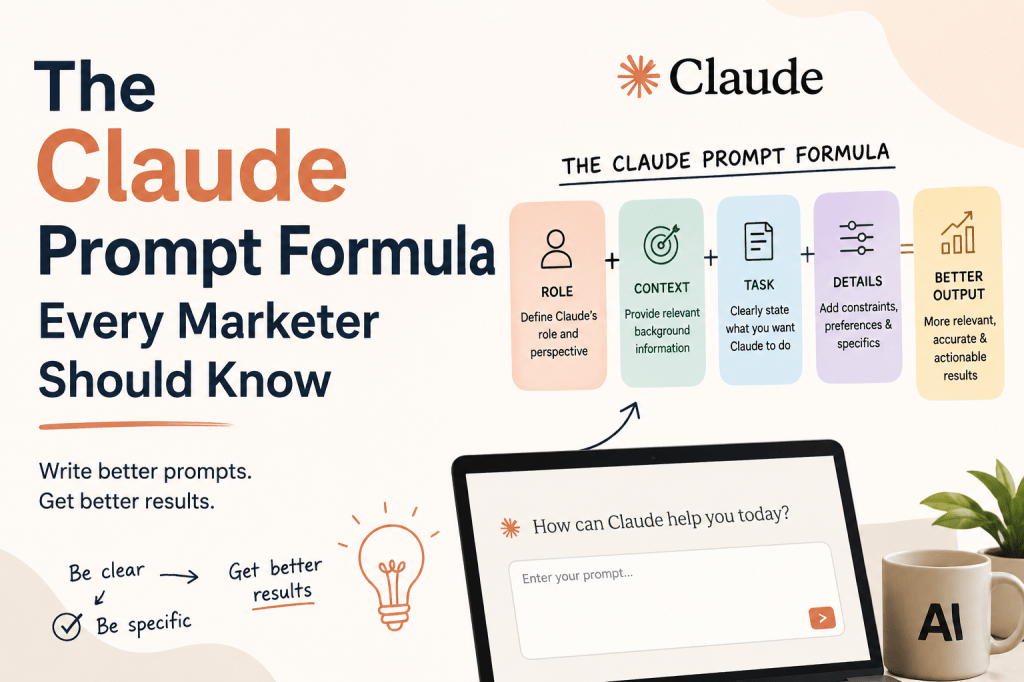
The Claude Prompt Formula is a structured approach to communicating with AI.
Instead of writing random requests, marketers provide clear instructions using multiple layers of context.
A practical formula looks like this:
Role + Context + Objective + Constraints + Output Format
This framework consistently produces better AI-generated results.
Let’s break it down.
1. Define the Role
Start by telling Claude who it should be.
Role prompting helps the model understand the expertise and perspective it should adopt.
Examples:
- SEO Specialist
- Email Marketing Expert
- Paid Ads Strategist
- Brand Consultant
- Social Media Manager
- Product Marketing Manager
Example
Act as a senior SEO strategist with 10 years of experience.
This immediately improves the quality of recommendations.
2. Provide Context
Context helps Claude understand the situation.
Without context, AI fills gaps with assumptions.
With context, it creates more accurate outputs.
Include:
- Company information
- Product details
- Industry
- Audience
- Campaign goals
- Brand voice
Example
Our company sells AI-powered video creation software for ecommerce brands. Our audience includes marketers, agencies, and DTC businesses.
The more relevant context you provide, the more useful the response becomes.
3. State the Objective Clearly
Tell Claude exactly what you want.
Many prompts fail because the objective is vague.
Instead of saying:
Help with marketing.
Say:
Create a content strategy that increases organic traffic by 30% within six months.
Specific goals produce specific outputs.
4. Add Constraints
Constraints prevent generic responses.
They tell Claude what rules to follow.
Examples:
- Word count
- Tone of voice
- Reading level
- Target audience
- Platform requirements
- SEO requirements
Example
Use a professional but conversational tone. Keep paragraphs under 3 sentences. Optimize for the keyword “AI Video Prompt.”
Constraints improve consistency and usability.
5. Specify the Output Format
Claude performs significantly better when formatting requirements are clear.
Examples:
- Bullet points
- Tables
- Blog outlines
- JSON
- Social media posts
- Marketing plans
Example
Present the answer as a table with columns for channel, strategy, budget, and expected results.
This makes the output immediately actionable.
The Complete Claude Prompt Formula
Here’s the complete structure marketers can use:
Role:
Who should Claude act as?
Context:
What background information is needed?
Objective:
What outcome do you want?
Constraints:
What rules should be followed?
Output Format:
How should the response be presented?
This simple framework can dramatically improve AI performance.
Example: Claude Prompt for SEO Content
Prompt
Act as an SEO content strategist.
Our company sells AI marketing software for ecommerce brands.
Create a content calendar focused on AI video marketing.
Target keywords with low competition and high commercial intent.
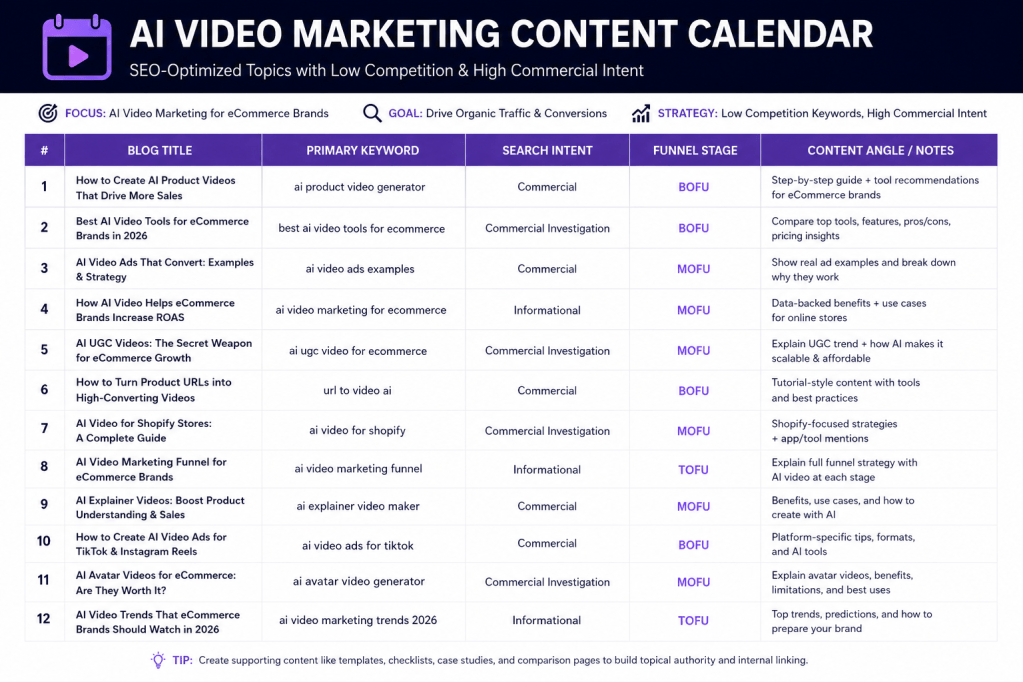
Include:
– Blog title
– Primary keyword
– Search intent
– Funnel stage
Present in a table.
This prompt produces a structured and useful SEO strategy.
Example: Claude Prompt for Social Media
Prompt
Act as a social media marketing expert.
We help brands create AI-generated UGC videos.
Create 10 LinkedIn post ideas.
Target ecommerce marketers.
Focus on engagement, industry trends, and AI adoption.
Provide hooks and post summaries.
The result becomes highly targeted instead of generic.
Example: Claude Prompt for Email Marketing
Prompt
Act as an email marketing specialist.
Create a 5-email onboarding sequence.
Audience: Ecommerce business owners.
Goal: Convert free trial users into paying customers.
Keep each email under 150 words.
Use persuasive but friendly language.
This produces a complete email funnel in minutes.
Using Claude for AI Video Prompt Creation
One of the fastest-growing applications of AI is video generation.
Today, marketers use AI to create:
- Product videos
- UGC-style ads
- Explainer videos
- Social media content
- Testimonial videos
- Brand awareness campaigns
However, video quality depends heavily on the quality of the AI Video Prompt.
A vague video prompt often creates weak results.
A detailed prompt generates more realistic and engaging content.
AI Video Prompt Structure
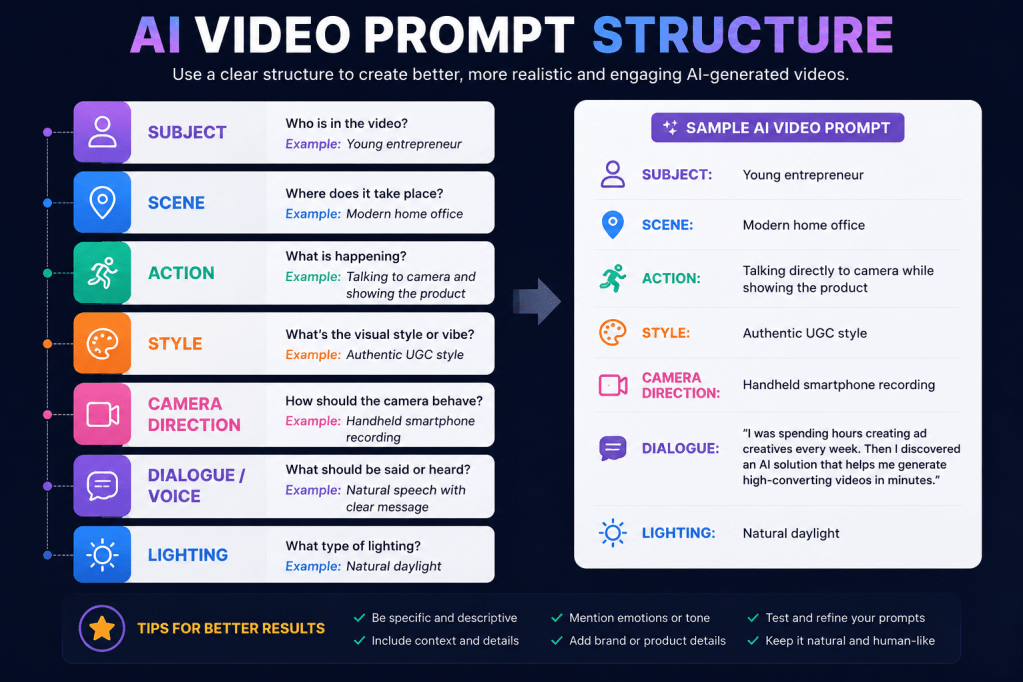
A strong AI Video Prompt typically includes:
Subject
Who appears in the video?
Example:
Young ecommerce entrepreneur
Scene
Where does the action take place?
Example:
Modern home office with natural lighting
Action
What is happening?
Example:
Speaking directly to camera while showing product
Style
What visual style should be used?
Example:
Authentic UGC style
Camera Direction
How should the camera behave?
Example:
Handheld smartphone recording
Dialogue
What should the person say?
Example:
“I tried dozens of tools before finding this solution.”
Sample AI Video Prompt
Create a UGC-style video featuring a female entrepreneur speaking directly to the camera.
Location: Home office.
Style: Authentic TikTok creator.
Lighting: Natural daylight.
Camera: Handheld smartphone.
Dialogue:
“I was spending hours creating ad creatives every week. Then I discovered an AI solution that helps me generate high-converting videos in minutes.”
This type of detailed AI Video Prompt often generates much stronger results.
How Tagshop AI Helps Marketers Create Better Prompts
Creating prompts manually can take time.
Many marketers struggle with:
- Prompt engineering
- Video scripting
- Scene descriptions
- AI workflow creation
- UGC video generation
This is where Tagshop AI becomes valuable.
Tagshop AI helps marketers generate:
- AI UGC videos
- Product marketing videos
- Ad creatives
- Video scripts
- AI avatars
- Video campaigns
One of its biggest advantages is that marketers can generate content without needing professional video production resources.
Instead of spending hours writing prompts from scratch, users can leverage built-in workflows to accelerate video creation.
Claude Prompt Formula for Ad Copy
Paid advertising teams can use Claude to generate ad concepts quickly.
Example Prompt
Act as a performance marketing expert.
Create 10 Meta ad hooks.
Product: AI UGC Video Generator
Audience: Ecommerce brands
Goal: Increase trial signups
Tone: Conversational and persuasive
Limit each hook to 15 words.
This generates multiple ad angles for testing.
Claude Prompt Formula for Market Research
Marketers can also use Claude for customer research.
Example Prompt
Act as a customer insights analyst.
Analyze common challenges faced by ecommerce marketers creating video ads.
Identify:
– Pain points
– Desired outcomes
– Common objections
– Buying triggers
Present findings in a table.
The output can directly influence messaging and positioning.
Common Prompt Mistakes Marketers Make
1. Being Too Vague
Bad:
Write content.
Good:
Write a 2,000-word SEO blog targeting ecommerce marketers.
2. Missing Audience Information
Bad:
Create an ad.
Good:
Create an ad targeting Shopify store owners generating $10K-$100K monthly revenue.
3. Ignoring Formatting
Bad:
Give me ideas.
Good:
Provide 20 ideas in a table with explanations.
4. Not Defining Success
Bad:
Help me market my product.
Good:
Create a strategy to increase free trial signups by 20%.
Advanced Claude Prompt Formula
Experienced marketers often use an expanded framework.
Role
Who Claude should be.
Context
Background information.
Objective
Desired outcome.
Audience
Who the content targets.
Constraints
Rules and limitations.
Examples
Reference examples.
Output Format
Structure of response.
Advanced Example
Act as a senior growth marketer.
We sell AI software that generates UGC video ads.
Audience:
Ecommerce founders and agencies.
Goal:
Increase demo bookings.
Create:
10 LinkedIn posts.
Requirements:
– Educational
– Data-driven
– Under 250 words
– Include CTA
Output:
Table format.
This level of specificity typically produces exceptional results.
Why Prompt Engineering Is Becoming a Marketing Skill
Just as SEO became a critical marketing skill in the early days of search engines, prompt engineering is becoming a core skill in the AI era.
Marketers who master prompting can:
- Create content faster
- Generate better campaigns
- Improve ad performance
- Produce higher-quality videos
- Scale creative testing
- Reduce production costs
The ability to communicate effectively with AI is becoming a competitive advantage.
The Future of Claude Prompts and AI Marketing
As AI models continue evolving, prompts will remain the bridge between human strategy and machine execution.
Future marketing teams will increasingly rely on AI for:
- Content generation
- Video production
- Customer research
- Campaign planning
- Creative ideation
- Personalization
Those who understand structured prompting today will be better prepared for tomorrow’s AI-driven marketing landscape.
Conclusion
The Claude Prompt Formula is one of the most valuable frameworks modern marketers can learn. By combining Role + Context + Objective + Constraints + Output Format, marketers can dramatically improve the quality of AI-generated outputs.
Whether you’re creating SEO content, email campaigns, social media strategies, ad copy, or an AI Video Prompt, structured prompting helps unlock better results from AI tools.
For marketers focused on video content, platforms like Tagshop AI make it easier to transform ideas into engaging AI-generated videos while reducing production effort and accelerating campaign execution.
As AI becomes a larger part of marketing workflows, mastering prompt creation won’t be optional—it will be a core skill that separates average marketers from exceptional ones.


Leave a comment