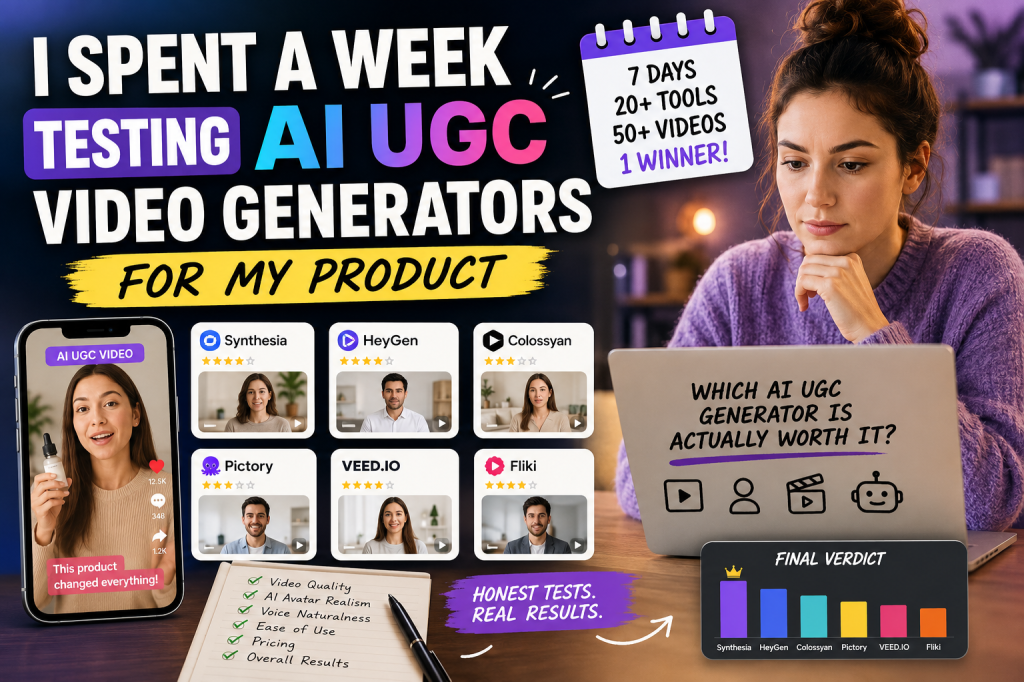
Creating product videos used to mean hiring creators, shipping products, waiting for content, and spending hours editing footage. But with the rise of AI UGC Video Generators, brands can now create user-generated-style videos in minutes.
As someone constantly looking for faster ways to create marketing content, I decided to run an experiment.
For one week, I tested several AI UGC video generators using the same product and similar marketing goals.
My objective was simple:
Can AI-generated UGC videos actually replace or complement traditional UGC content?
After creating dozens of videos, testing multiple avatars, reviewing outputs, and comparing results, I discovered some surprising advantages—and a few limitations.
In this article, I’ll walk through the entire experience, what I learned, and how businesses can use AI UGC Video Generators to scale content production in 2026.
Why I Decided to Test AI UGC Video Generators
Short-form video continues to dominate social media and digital advertising.
According to insights from Think with Google, consumers increasingly engage with video-first content across ecommerce and discovery experiences. Similarly, research shared by TikTok Business shows that authentic, creator-style videos often outperform polished brand advertisements.
That creates a challenge.
Brands need more video content than ever before.
Yet traditional UGC creation involves:
- Finding creators
- Sending products
- Managing revisions
- Editing content
- Waiting for delivery
The process can take days or weeks.
AI UGC Video Generators promise to solve these problems by turning product information into ready-to-publish videos.
Naturally, I wanted to see if the claims were true.
My Testing Process
To make the comparison fair, I used the same product throughout the experiment.
The testing criteria included:
Video Quality
How realistic did the AI creator appear?
Script Quality
Did the messaging feel natural?
Avatar Performance
Did the presenter look believable?
Voice Quality
Was the speech human-like?
Editing Features
Could the platform automatically create engaging content?
Scalability
How quickly could I generate multiple variations?
Marketing Readiness
Would I actually run these videos as ads?
Week Overview
Day 1: First Impressions
The first thing that surprised me was how easy the setup process had become.
Most platforms required only:
- Product URL
- Product description
- Product images
Some tools even analyzed the product page automatically.
Within minutes, scripts were generated.
Compared to traditional video production, the time savings were immediately obvious.
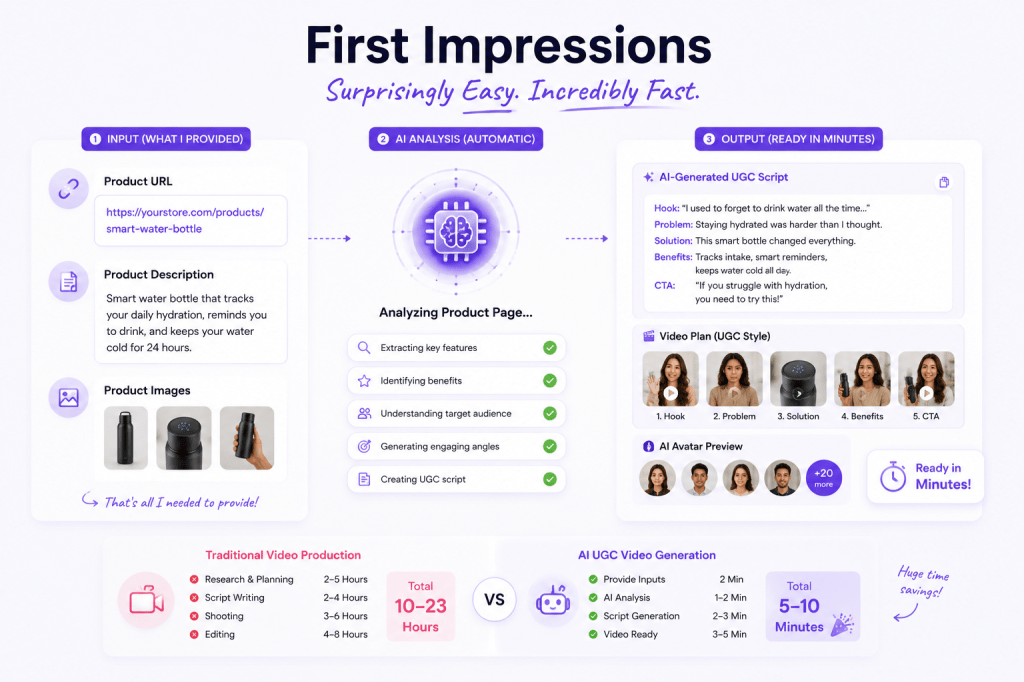
Image Alt Text: Dashboard showing AI UGC video generation from a product page
Day 2: Testing AI Script Generation
Script quality can make or break a UGC advertisement.
The strongest platforms followed proven ad structures:
Hook
Grab attention immediately.
Problem
Highlight customer pain points.
Solution
Position the product as the answer.
Benefits
Explain why it works.
CTA
Encourage action.
Interestingly, the best-performing scripts weren’t overly sales-focused.
They sounded like recommendations from real customers.
This aligns with findings frequently discussed on HubSpot’s marketing blog, where authenticity remains one of the biggest drivers of audience engagement.
Day 3: AI Avatar Testing
This was the area I was most skeptical about.
Earlier AI avatars often looked robotic and unnatural.
However, the latest generation of AI creators has improved dramatically.
I tested:
- Male presenters
- Female presenters
- Lifestyle influencers
- Professional spokespersons
- Casual creators
Some avatars were nearly indistinguishable from real creators during short-form viewing.
Others still fell into the uncanny valley.
The biggest lesson:
Avatar selection matters more than the platform itself.
A realistic creator instantly improved the quality of the video.
Day 4: Voice Quality Evaluation
Voiceovers have improved tremendously.
Most platforms offered:
- Multiple accents
- Various tones
- Different speaking styles
- Emotional delivery options
The best AI voices sounded conversational rather than robotic.
I found that:
- Casual tones worked best for social content.
- Professional voices worked best for SaaS products.
- Energetic voices improved ad performance.
Recent advancements from OpenAI and Google DeepMind have played a significant role in improving natural speech generation, making AI videos far more convincing than they were just a few years ago.
Day 5: Product Demonstration Capabilities
This was where AI really impressed me.
Several platforms automatically:
- Imported product images
- Added transitions
- Created animations
- Generated captions
- Highlighted product features
Instead of building videos manually, the software assembled complete marketing assets automatically.
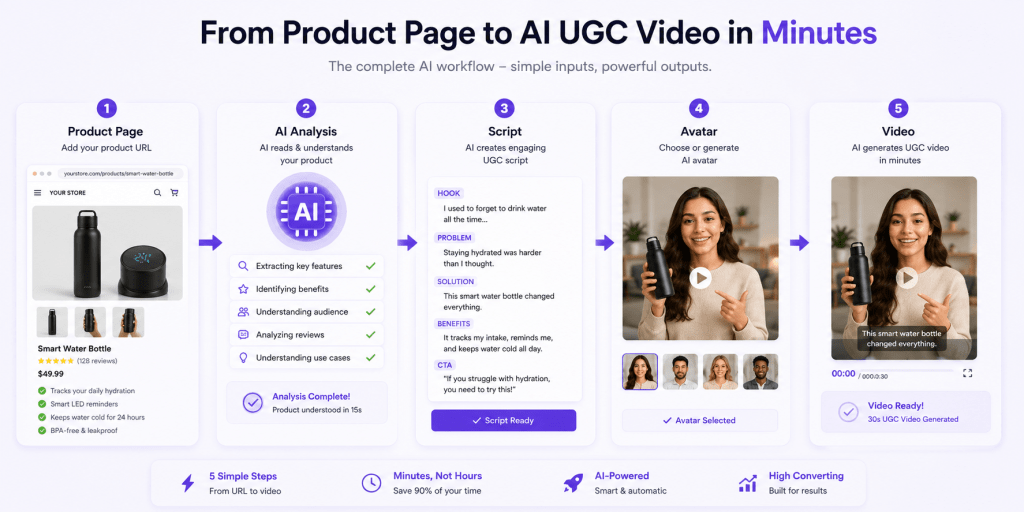
The workflow looked like this:
Product Page → AI Analysis → Script → Avatar → Video
A process that once required multiple tools could now happen inside a single platform.
What Reddit Users Are Saying About AI UGC Video Generators
Before finishing my test, I explored discussions across marketing and ecommerce communities.
Several recurring questions appeared repeatedly.
Popular Reddit Questions
Are AI UGC videos good enough for paid ads?
Many marketers report positive results when AI videos are used for rapid testing and creative experimentation.
Can AI replace real creators?
Most users agree AI won’t fully replace human creators but can significantly reduce production costs.
Which industries benefit most?
Common answers include:
- Ecommerce
- Beauty
- Fitness
- SaaS
- Fashion
- Consumer products
Are customers aware content is AI-generated?
In many cases, viewers focus more on value and messaging than production methods.
Day 6: Creating Multiple Variations
One of AI’s biggest advantages is scale.
Traditional UGC workflow:
1 Video = 1 Creator
AI workflow:
1 Product = Unlimited Variations
I generated:
- 20 hooks
- 10 creators
- 5 voice styles
- Multiple CTAs
within a single afternoon.
This is where AI UGC Video Generators become particularly powerful.
Advertising success often depends on testing.
The more creative variations you launch, the higher your chances of finding a winning advertisement.
Why AI UGC Videos Are Great for A/B Testing
Performance marketers understand the value of experimentation.
A small change in:
- Hook
- Avatar
- Voice
- CTA
can significantly impact conversion rates.
AI makes these tests affordable.
Instead of producing three ads per month, brands can produce dozens.
According to insights shared by TikTok Business, frequent creative testing is one of the strongest predictors of advertising success on short-form video platforms.
Day 7: Final Review
After reviewing dozens of videos, I noticed several patterns.
What Worked Best
Creator-Led Content
Videos featuring AI avatars generally outperformed slideshow-style videos.
Strong Hooks
The first three seconds remained critical.
Customer Pain Points
Videos focused on solving problems performed better than feature-heavy videos.
Social Proof
Customer reviews significantly improved credibility.
What Still Needs Improvement
Emotional Storytelling
AI remains less effective at creating deeply emotional narratives.
Product Handling
Real creators still provide more natural product demonstrations.
Unique Personality
Human creators often bring creativity that AI cannot fully replicate.
Biggest Benefits I Discovered
Faster Production
Videos can be created in minutes.
Lower Costs
No creator sourcing or shipping expenses.
Unlimited Testing
Generate countless creative variations.
Easier Scaling
Create content across multiple products instantly.
Global Expansion
Produce videos in multiple languages.
Consistent Branding
Maintain a unified message across campaigns.
Traditional UGC vs AI UGC Video Generators
| Feature | Traditional UGC | AI UGC |
| Cost | High | Low |
| Speed | Slow | Fast |
| Scalability | Limited | Unlimited |
| Revisions | Difficult | Instant |
| Languages | Limited | Multiple |
| Testing | Expensive | Affordable |
My Overall Verdict
After spending a week testing AI UGC Video Generators, I came away impressed.
No, AI has not completely replaced human creators.
But that isn’t the point.
The real value lies in:
- Speed
- Scale
- Efficiency
- Creative testing
For brands running paid ads, launching products, or creating content at scale, AI UGC Video Generators provide a significant competitive advantage.
The technology has advanced far beyond simple talking avatars.
Modern platforms can now transform product information into complete marketing assets within minutes.
For many businesses, that’s a game changer.
Best Practices for Using AI UGC Video Generators
Focus on Benefits
Sell outcomes, not features.
Test Multiple Hooks
Create at least 10 variations.
Use Customer Reviews
Incorporate social proof whenever possible.
Keep Videos Short
15–45 seconds often performs best.
Review Outputs
Always fact-check AI-generated claims.
Match Avatar to Audience
Choose creators your target audience can relate to.
The Future of AI UGC Videos
According to industry trends discussed by Think with Google, Shopify, and Marketing Dive, AI-powered content creation is expected to become a core marketing workflow rather than an experimental tool.
Future innovations may include:
- Personalized AI creators
- Dynamic product recommendations
- Real-time content generation
- Automated campaign optimization
- Hyper-realistic AI influencers
As these technologies mature, the line between AI-generated and human-created content will continue to blur.
FAQs
What are AI UGC Video Generators?
AI UGC Video Generators are tools that create user-generated-style marketing videos using artificial intelligence, including scripts, avatars, voiceovers, captions, and editing.
Are AI UGC videos effective for advertising?
Yes. Many marketers use AI UGC videos for TikTok, Instagram Reels, Facebook Ads, and YouTube Shorts because they enable rapid content testing and scaling.
Can AI create videos from product URLs?
Yes. Many modern platforms can analyze a product page and automatically generate scripts, visuals, and complete AI UGC videos.
Can AI replace human UGC creators?
AI can supplement and scale content production, but human creators still offer unique creativity, storytelling, and authenticity.
How long does it take to create an AI UGC video?
Most AI UGC Video Generators can create a finished video within a few minutes.
Which industries benefit most from AI UGC videos?
Popular industries include ecommerce, beauty, fitness, fashion, SaaS, consumer electronics, and DTC brands.
 AI Avatar Tech Blog
Leave a comment