User-generated content has moved far beyond customer reviews and Instagram posts. In 2026, UGC is becoming a core part of how brands build trust, create advertising assets, improve product pages, and influence purchasing decisions.
Consumers increasingly want to see products being used by real people rather than only polished studio advertisements. At the same time, marketers need more creative assets for TikTok, Instagram Reels, YouTube Shorts, paid social campaigns, landing pages, and ecommerce product pages.
That combination has created a major opportunity for UGC marketing.
Recent research shows that 79% of consumers say UGC influences their purchasing decisions, while other industry research reports that UGC can significantly improve conversion performance when it is integrated into product experiences. (Backlinko)
Video is particularly important. As short-form video continues to dominate social platforms, marketers are increasingly turning to creators and UGC video makers to produce authentic-looking videos without relying entirely on traditional production.
In this guide, we’ll explore the most important UGC statistics for 2026, what they mean for marketers, and how businesses can use UGC video more effectively.
Key UGC Statistics for 2026
Before getting into the details, here are some of the most useful numbers marketers should know:
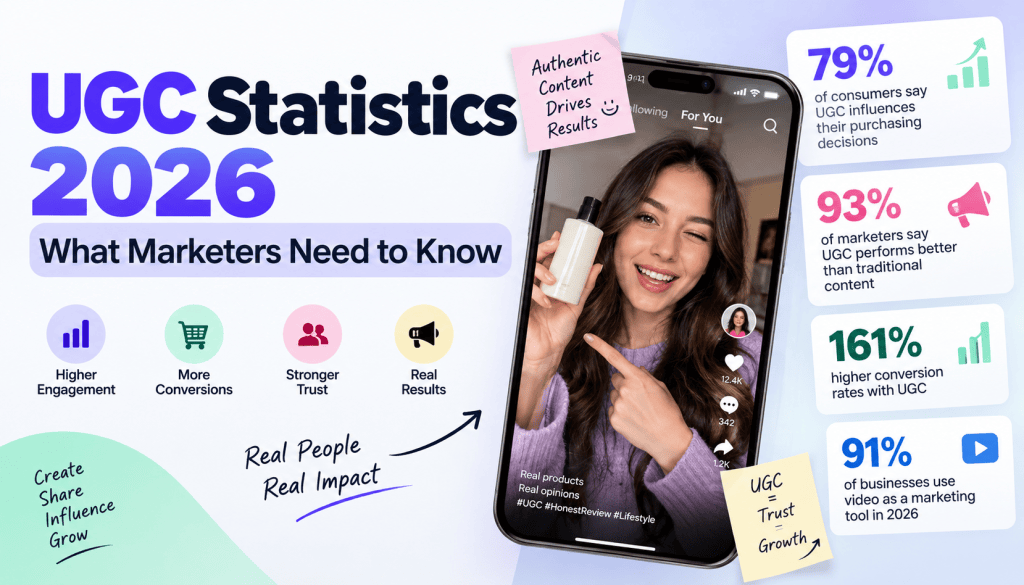
- 79% of consumers say UGC influences their purchasing decisions. (Backlinko)
- 93% of marketers using UGC say it performs better than traditional branded content, according to data compiled by Backlinko. (Backlinko)
- 81% of ecommerce marketers say visual UGC is more impactful than professionally shot photos or influencer content. (Backlinko)
- Around 55% of shoppers hesitate to purchase products without UGC. (Backlinko)
- 80% of consumers say they are more likely to purchase from a store displaying photos and videos from real customers, according to Nosto/Stackla research cited in 2026 UGC research. (CO Consulting)
- UGC has been reported as up to 161% more effective for product-page conversion in certain ecommerce datasets. (ClipLoft)
- Reviews, Q&As, and customer photos remain among the most influential types of UGC during purchase decisions. (Backlinko)
- In one 2026 benchmark dataset covering more than 12 million pieces of UGC, pages using UGC galleries showed a 22% median conversion uplift. (Idukki)
- 71% of stores in that same dataset were running at least one shoppable-video product-page variant. (Idukki)
- 91% of businesses use video as a marketing tool in 2026. (Wyzowl)
These statistics point toward a larger trend: consumers don’t just want advertising; they want evidence from people who have experienced the product.
1. 79% of Consumers Say UGC Influences Purchasing Decisions
One of the most important UGC statistics for marketers is the relationship between user-generated content and purchase decisions.
Research compiled by Backlinko reports that 79% of consumers say UGC influences their purchasing decisions. (Backlinko)
That’s significant because UGC often works differently from traditional advertising.
A brand advertisement tells consumers:
“Our product is good.”
UGC demonstrates:
“Here’s how someone like you actually uses this product.”
That difference matters.
Consumers can see the product in a more realistic environment, understand how it works, identify potential benefits, and see whether it fits their lifestyle.
For ecommerce brands, this makes UGC especially useful throughout the buying journey.
2. 93% of Marketers Say UGC Performs Better Than Traditional Content
Another important statistic comes from research summarized by Backlinko: 93% of marketers using UGC report that it performs better than traditional branded content. (Backlinko)
This doesn’t necessarily mean every UGC video will outperform every professionally produced advertisement.
Instead, it highlights a broader advantage: UGC can feel more native to the platforms where consumers spend their time.
A highly polished advertisement may look obviously like an advertisement.
A creator-style product demonstration, testimonial, unboxing, tutorial, or review can feel more like content a user would naturally watch.
That’s particularly important on platforms such as TikTok, Instagram Reels, and YouTube Shorts.
3. Visual UGC Is Becoming More Important
UGC isn’t limited to written reviews.
It includes:
- Customer videos
- Product demonstrations
- Testimonials
- Unboxing videos
- Product photos
- Social media posts
- Tutorials
- Reviews
- Before-and-after content
- Creator-style advertisements
- Customer stories
Visual content is especially valuable because consumers can see the product instead of simply reading about it.
Research cited by Backlinko found that 81% of ecommerce marketers believe visual UGC is more impactful than professionally shot photos or influencer content. (Backlinko)
This helps explain why video UGC has become such an important advertising format.
4. UGC Can Improve Ecommerce Conversion Rates
The real value of UGC isn’t simply engagement.
For businesses, the bigger question is:
Does UGC help people buy?
Several 2026 industry datasets suggest that it can.
For example, Idukki’s 2026 benchmark data, based on more than 12 million pieces of UGC across 140+ stores and 27 verticals, reports a 22% median product-page conversion uplift for pages using UGC galleries. (Idukki)
Other industry datasets report substantially larger increases under specific circumstances. One compilation cites product pages with UGC seeing conversion improvements of up to 161%. (ClipLoft)
These numbers should not be treated as a universal guarantee because results vary by industry, product, traffic source, placement, and quality of content.
But the direction is clear:
UGC can turn product pages from static sales pages into social-proof experiences.
5. Customer Reviews Are Still Powerful
Video may be growing rapidly, but traditional UGC hasn’t disappeared.
Reviews remain one of the strongest forms of customer-generated content.
According to data summarized by Backlinko, shoppers rank:
- Reviews — 78%
- Q&As — 77%
- Photos from other customers — 69%
among influential UGC formats for purchase decisions. (Backlinko)
This tells marketers something important:
The best UGC strategy isn’t necessarily video-only.
Instead, brands should combine multiple forms of customer proof.
For example, an ecommerce product page could include:
- Star ratings
- Written reviews
- Customer photos
- Customer videos
- FAQs
- Creator demonstrations
- Social posts
Each format answers a slightly different customer question.
6. Video Marketing Is Now a Mainstream Strategy
UGC is benefiting from the larger growth of video marketing.
Wyzowl’s 2026 research reports that 91% of businesses use video as a marketing tool. (Wyzowl)
HubSpot’s 2026 marketing data also identifies short-form video as the most leveraged media format among marketers and reports that short-form video is the top ROI-driving content format in its survey. (HubSpot)
This creates an interesting challenge.
Brands need more video.
But producing more traditional video requires:
- Scripts
- Cameras
- Locations
- Actors
- Editors
- Production teams
- Reshoots
- Post-production
For brands producing dozens or hundreds of creative variations, that process can become expensive and slow.
That’s one reason UGC video makers are becoming increasingly useful.
7. Why UGC Video Makers Are Growing in 2026
A UGC video maker is a tool or platform designed to help brands create user-generated-content-style videos.
Depending on the platform, marketers may be able to provide:
- A product image
- Product URL
- Script
- Creative brief
- Brand information
- Video concept
The platform can then help generate or assemble a UGC-style video.
AI-powered tools can make this process even faster by assisting with:
- Scripts
- Hooks
- Voiceovers
- Avatars
- Product demonstrations
- Captions
- Scenes
- Editing
- Multiple creative variations
The important benefit isn’t simply automation.
It’s creative volume.
Instead of producing one advertisement and hoping it works, marketers can test multiple concepts.
For example:
Concept A: “3 reasons I bought this.”
Concept B: “I didn’t expect this to work.”
Concept C: “Here’s what happened after 7 days.”
Concept D: “Things I wish I knew before buying.”
The product remains the same, but the creative angle changes.
8. Short-Form Video Is Driving UGC Growth
Short-form video has become one of the most important environments for UGC.
TikTok, Instagram Reels, and YouTube Shorts have trained audiences to consume short, vertical videos quickly.
In India, Meta reported in 2026 that 97% of surveyed users watch video on Meta platforms daily, while 89% of Gen Z respondents engage with Reels daily. The same study reported that Reels delivers stronger product discovery and influences purchase decisions. (About Facebook)
For marketers, this means UGC doesn’t necessarily need to look like a traditional commercial.
A strong UGC video may simply:
- Grab attention.
- Introduce a problem.
- Show the product.
- Demonstrate the solution.
- Add social proof.
- End with a clear CTA.
This structure fits naturally into short-form platforms.
9. Authenticity Matters More Than Production Quality
One of the biggest lessons from UGC statistics is that authenticity matters.
Consumers don’t necessarily need perfect lighting, cinematic camera movements, or expensive production.
They want content that feels believable.
Research summarized in 2026 UGC reports has found that consumers perceive UGC as substantially more authentic than traditional brand content. (CO Consulting)
That doesn’t mean brands should intentionally create poor-quality videos.
There’s an important distinction between authentic-looking and low-quality.
Good UGC should still have:
- Clear audio
- Good pacing
- Understandable messaging
- Strong visuals
- A compelling hook
- Product visibility
- A useful CTA
The goal is to make content feel native and human—not careless.
10. UGC Gives Marketers More Creative Testing Opportunities
Performance marketing depends heavily on testing.
A brand might test:
- Different hooks
- Different creators
- Different scripts
- Different CTAs
- Different product benefits
- Different video lengths
- Different opening scenes
- Different audiences
Traditional production makes large-scale testing difficult.
A UGC video maker can reduce the production barrier.
Instead of spending weeks creating one polished campaign, marketers can create multiple UGC-style variations and evaluate them.
This makes UGC particularly useful for paid social advertising.
A winning creative can then be adapted into additional variations.
11. UGC Is Becoming a Performance Marketing Asset
UGC should no longer be treated only as organic social content.
Brands can use it across the entire customer journey.
Top of funnel
Use UGC videos to introduce a problem or product.
Middle of funnel
Use testimonials, demonstrations, and comparisons.
Bottom of funnel
Use reviews, customer videos, FAQs, and social proof.
Retargeting
Show potential customers how other people use the product.
Product pages
Place UGC videos next to product information.
Use customer stories and product videos to increase engagement.
This turns UGC into a reusable marketing asset rather than a one-time social post.
12. Shoppable UGC Video Is Becoming a Bigger Opportunity
Another major trend in 2026 is the combination of UGC and shoppable video.
Idukki’s 2026 benchmark data reports that 71% of stores in its dataset were running at least one shoppable-video product-page variant. (Idukki)
This changes the role of UGC.
Instead of:
Watch → Leave → Search for product
the experience becomes:
Watch → Discover → Understand → Shop
This reduces friction between content and commerce.
For ecommerce businesses, embedding UGC video directly into product pages can help customers visualize the product before purchasing.
13. AI Is Changing How Brands Produce UGC
AI is another major reason UGC production is changing in 2026.
Modern AI tools can help marketers produce content faster without requiring a complete traditional production workflow.
A marketer can start with a simple product description and generate multiple creative concepts.
For example:
Product: Skincare serum
UGC concepts:
- “My skin changed after 14 days.”
- “I finally found a serum that doesn’t feel sticky.”
- “3 mistakes I was making with my skincare.”
- “POV: You want glowing skin without a complicated routine.”
A UGC video maker can then help turn those concepts into videos.
This doesn’t eliminate the need for strategy.
It makes execution faster.
14. The Best UGC Strategy Combines Human Insight and AI
AI can create videos quickly, but the strongest UGC campaigns still need human understanding.
Marketers need to know:
- What customers actually care about
- Which objections prevent purchases
- Which benefits matter
- Which hooks are believable
- Which language the audience uses
- Which creators feel authentic
- Which claims can legally be made
AI should accelerate the creative workflow—not replace customer research.
The best approach in 2026 is therefore a combination of:
Human strategy + customer insight + UGC + AI-powered production + performance testing.
15. What These UGC Statistics Mean for Marketers
The statistics point toward five important conclusions.
1. Consumers want proof
People don’t simply want brands to tell them that a product works. They want evidence from other customers.
2. Video is increasingly essential
With 91% of businesses using video for marketing, video is no longer an optional channel. (Wyzowl)
3. UGC can support conversion
Industry benchmarks show meaningful conversion improvements when customer-generated content is integrated into ecommerce experiences. (Idukki)
4. Creative volume matters
Marketers need multiple variations to discover which hooks and messages perform best.
5. AI is lowering the production barrier
UGC video makers allow brands to experiment with more concepts without relying entirely on traditional production.
How to Build a UGC Strategy in 2026
If you’re starting from scratch, keep your strategy simple.
Step 1: Identify customer problems
Find the questions, objections, and frustrations customers have before buying.
Step 2: Turn problems into video hooks
Create short hooks around those problems.
For example:
“I wish I knew this before buying…”
or
“If you’re struggling with X, watch this.”
Step 3: Create multiple UGC concepts
Don’t depend on one video.
Create several variations with different:
- Hooks
- Scripts
- Creators
- Benefits
- CTAs
Step 4: Use a UGC video maker
Use AI-powered UGC production tools to increase creative output and reduce production time.
Step 5: Test the videos
Measure:
- Hook rate
- Watch time
- Completion rate
- CTR
- CPA
- Conversion rate
- ROAS
Step 6: Scale winners
When a concept works, create more variations around the winning idea.
UGC Statistics 2026: The Bigger Picture
The biggest takeaway isn’t a single statistic.
It’s the direction of the market.
Consumers are increasingly surrounded by advertisements. As advertising becomes easier to produce, authenticity becomes more valuable.
UGC gives brands a way to show products through the perspective of customers and creators.
The numbers support this shift. Research shows that UGC influences purchase decisions, marketers report strong performance compared with traditional branded content, and ecommerce benchmarks continue to show conversion benefits from customer-generated content. (Backlinko)
At the same time, video has become a fundamental part of modern marketing. With 91% of businesses already using video, brands need efficient ways to produce enough creative to compete. (Wyzowl)
That’s where the UGC video maker becomes particularly valuable.
Instead of treating UGC as an occasional social media experiment, marketers can build an entire creative system around it.
Final Thoughts
The UGC statistics for 2026 tell a clear story: consumers increasingly value content created by other people, and marketers are responding by making UGC a bigger part of their advertising and ecommerce strategies.
UGC isn’t replacing every form of branded content.
Instead, it’s becoming another critical layer in the modern marketing funnel.
Reviews provide social proof. Customer photos provide context. Creator videos demonstrate products. Testimonials build trust. And short-form UGC videos can capture attention in crowded social feeds.
The emergence of the UGC video maker makes this strategy even more accessible.
Brands no longer have to choose between producing one expensive campaign or producing nothing. They can create more variations, test different concepts, learn what their audience responds to, and scale the ideas that work.
In 2026, the competitive advantage isn’t simply creating more content.
It’s creating more relevant, believable, testable content—and learning faster from every piece of it.
For marketers looking to improve paid social, ecommerce conversion rates, and creative production, UGC should be a core part of the strategy rather than an afterthought.
The brands that win with UGC won’t necessarily be the ones with the biggest production budgets. They’ll be the ones that understand their customers best and can turn those insights into authentic, high-performing content at scale.


Leave a Reply